Choose a NAS around the studio’s main constraint: prioritise usable capacity and room to expand for a growing archive, or assess the entire network if several editors need to work with large projects at once. Whichever route you take, RAID does not replace a separate, recoverable backup; client material also calls for carefully managed access.
Who needs a shared NAS archive?
Studios with growing project archives
If completed projects and camera originals are accumulating, central storage can make retained material easier to organise than a collection of loose drives. Plan for future usable capacity as well as today’s files.
Teams with several editors
When authorised workstations need the same large media files, assess concurrent access, network equipment and folder permissions alongside storage capacity.
Teams handling client material
Archives containing client footage or personal data need access that can be changed when collaborators leave, plus a separate recovery copy. The Information Commissioner’s Office advises regular reviews of access rights.
What should you check before buying?
For consumers choosing a shared-studio video archive, identify whether retained capacity, access to active projects or recoverability is the requirement that would decide the purchase.
| Concern |
What to check |
Who this matters to |
| Usable capacity and growth |
Calculate space for retained originals, projects and exports after the chosen drive-resilience layout. Check the exact NAS model’s bay count, expansion options and drive compatibility. |
When completed projects keep accumulating, I need room to retain originals without moving the archive again soon; around 38% of consumers put capacity and growth first. |
| Concurrent access |
Decide whether editors will copy files locally or work directly from the NAS. For direct work, check the NAS, switch and each workstation as one network path. |
If several editors need large files at the same time, delays in access could interrupt our work; around 31% of consumers make shared-workflow access their primary concern. |
| Backup and access control |
Plan and test a separate backup that can be isolated or kept off-site. Check individual accounts and folder permissions for the collaborators who need access. |
With client projects in the archive, I need to recover files and remove access when someone leaves. Recoverability and controlled access come first for around 31% of consumers. |
Common buying mistakes
-
Treating RAID as the only backup
A redundant drive layout is not an independent recovery copy. The National Cyber Security Centre warns that incidents can affect original files and connected backups.
Keep a separately managed copy off-site or isolated from the live studio network, and test that you can restore from it.
-
Buying a 10GbE NAS without checking the network
A faster port on the NAS alone does not establish how quickly editors can access files. Synology makes its direct-editing guidance conditional on the NAS, clients and network environment.
Check workstation adapters, switch ports and cabling before choosing faster networking for concurrent work.
-
Sizing the archive from raw drive capacity
Raw installed capacity is not the same as the usable space available after a drive-resilience layout, and retained video projects need room to grow.
Calculate the required usable capacity and check drive compatibility and expansion for the precise NAS model.
Underestimating that space could mean moving the archive or expanding it sooner than planned.
-
Giving every collaborator permanent write access
Shared or excessive privileges make it harder to limit changes to client projects. The Information Commissioner’s Office advises reviewing access rights when responsibilities change.
Use individual accounts, limit write access by role and remove access when temporary work ends.
Relevant brands to consider
Synology
NAS systems aimed at central file access and scheduled backup workflows for creators.
- Synology describes shared access across Mac, Windows and Linux, with faster networking available on supported models.
- Check the exact model, drives and network equipment; the brand’s guidance does not establish editing speed for a particular studio.
QNAP
NAS options spanning compact team storage, faster connections and expandable video archives.
- QNAP describes models with varied connection options, folder permissions and backup features.
- Match faster networking or flash-based configurations to the active workload rather than assuming an archive needs them.
ASUSTOR
Creator-focused NAS options with networking and storage configurations to assess for collaborative media libraries.
- ASUSTOR advises considering capacity, faster networking and M.2 SSDs for video-editing workflows.
- Confirm the chosen model’s ports, memory and disk compatibility against the number of people who will use it.
Seagate IronWolf
A NAS hard-drive line to consider for an HDD-based shared archive.
- Seagate states that IronWolf drives use conventional magnetic recording and are intended for multi-user NAS workloads.
- Check the precise drive model against the NAS maker’s compatibility information, and size the array by usable capacity.
Joybuy NAS choices for shared studios
These NAS models address shared access to studio media, with different stated bay counts and configurations. Check drives, usable capacity and the complete network setup against your archive and editing workload.
 No image available
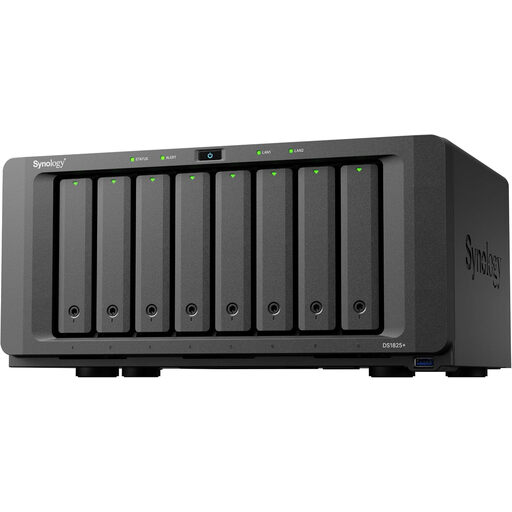
Synology DS1825+ 8-bay diskless NAS
Consider this model if several editors need access to active projects and the archive needs room to grow. Its listing describes an eight-bay diskless configuration; confirm compatible drives, usable capacity and the networking options in the configuration you intend to buy.
Plan an isolated or off-site backup separately, and check the workstations, switch and cabling before relying on faster network access.
Joybuy
 No image available
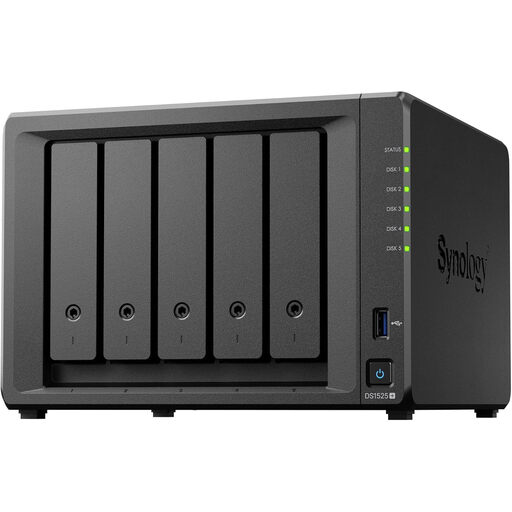
Synology DS1525+ 5-bay diskless NAS
Consider this five-bay diskless model when shared access to active video projects is a priority. Confirm the drive configuration and usable capacity behind any stated expansion figures, as well as the exact network option and compatible workstation equipment.
Keep a separate recovery copy rather than treating project versioning as an isolated backup.
Joybuy
 No image available
Synology DS425+ 4-bay NAS
Consider this four-bay model for a central media archive where managing collaborators’ access matters. Check whether drives are included and which drives are compatible; if editors will work directly from the NAS or the archive will grow substantially, also confirm its network and expansion options.
Access controls and automated backups still need administration and a separately planned recovery copy.
Joybuy
Questions about shared NAS archives
Is RAID enough to protect a shared studio’s video archive?
No. RAID can help maintain access after a drive failure, but it is not an independent backup. The National Cyber Security Centre warns that incidents can affect both original data and connected backup storage; keep a separate copy that can be isolated from the live network and test restoration.
Does every shared studio need 10GbE?
No. Faster networking is most relevant when editors need prompt access to large projects or work directly from shared storage; a completed-project archive used mainly for retrieval may call for a different balance of capacity and recovery planning. If choosing 10GbE, check the NAS, workstations, switch and cabling together. Synology notes that direct-editing performance depends on the complete environment.
How should we control access to archived client projects?
Give collaborators individual accounts and only the folder access their roles require, then review and remove permissions as roles change. The Information Commissioner’s Office advises regular access reviews; where projects contain personal data, assess appropriate security measures for the material and how it is used.


