Solo podcasters keeping local masters
A NAS can hold finished episodes, edits, artwork and project files locally. If you choose a single-drive setup, plan a separate external backup and maintain that second copy.


A two-bay NAS with compatible drives in a redundant layout is a sensible starting point if your podcast archive needs to remain available after one drive fails. A single-drive NAS can suit a simpler archive, but either setup needs a separate local backup to recover from deletion or a NAS fault; RAID and snapshots are not substitutes for that copy.
A NAS can hold finished episodes, edits, artwork and project files locally. If you choose a single-drive setup, plan a separate external backup and maintain that second copy.
A two-bay NAS with compatible drives in a redundant layout can keep a shared archive available after one drive fails. As Synology explains, that continuity does not replace a separate backup.
If the archive and the number of people using it are growing, consider bay count, usable capacity and local network connections alongside the work involved in maintaining backups.
Choose the storage layout according to how important uninterrupted access is, then plan an independent local backup before deciding how much room the archive needs.
Choose when: One person manages a modest archive and a straightforward local setup matters more than drive-failure continuity.
Accept: The NAS has no internal drive redundancy, so recovery depends on the separate backup and your backup routine.
Choose when: Keeping the archive available after one internal drive fails matters to you or your team.
Accept: A mirrored layout provides less usable space than the drives' combined raw capacity and still needs a separate backup.
Choose when: A large or growing catalogue and several editors make additional drive bays relevant.
Accept: More drives and a larger storage layout take more planning and upkeep; extra bays do not replace an independent backup.
| Concern | What to check | Who this matters to |
|---|---|---|
| Recovering the archive | Check the intended redundant layout, if needed, and how you will back up and restore a separate local copy. | If I lose an episode master or the NAS fails, I need another way to recover the files. Around 50% of consumers put archive recovery first. |
| Room to grow | Check usable capacity under your chosen layout, available drive bays and the network connections needed by your equipment. | As my catalogue and production files grow, I do not want the storage plan to become restrictive; for around 30% of consumers, capacity and transfer needs come first. |
| Local upkeep | Confirm drive compatibility and a manageable routine for local backups, drive monitoring and restore tests. | I want to keep files off cloud storage without taking on a routine I cannot maintain. Simple local operation is the main priority for around 20% of consumers. |
A mirrored NAS may remain available after one drive fails, but deletion or damage to the enclosure can still affect the archive. Synology distinguishes drive-failure continuity from backup protection.
Keep a separate local copy and test that you can restore it. Disconnect or store the backup separately when practical.
Maintaining that copy also means providing a separate backup destination and making time for backup and restore checks.
An enclosure is only part of the storage setup: QNAP states that its TS-264 ships without HDDs, while a mirrored pair provides less usable capacity than the drives' combined raw capacity.
Check what is included with the exact enclosure, choose compatible drives and calculate usable space for the layout you intend to use.
QNAP says snapshots are not independent backup copies. Their recovery value depends on the NAS storage they protect.
Use snapshots for point-in-time recovery where supported, alongside a backup on a separate local destination.
Synology's DS225+ setup guide warns that installing a drive containing data will format it and erase that data.
Copy and check the archive elsewhere before installation, then follow the setup instructions for your exact enclosure.
Relevant to a local archive if scheduled backups and a guided NAS software workflow are priorities; the DS225+ is a two-bay example.
The TS-264 is a two-bay option for buyers considering a configurable shared archive.
Offers NAS options spanning local external-drive backup workflows and larger, higher-bay systems.
An internal NAS-drive line to consider when selecting drives for an enclosure.
A 3.5-inch SATA NAS-drive line for buyers assessing internal storage options.
These enclosures cover a two-bay starting point and larger multi-bay archives. Choose compatible internal drives and plan a separate local backup for whichever layout you use.
 No image available
A starting point for a local podcast archive when you want the option of a two-drive layout.
The enclosure is diskless; choose compatible internal drives. Synology documents external-storage backups for its NAS software, but a backup drive remains a separate part of the setup.
 No image available
Consider this four-bay enclosure if the archive needs more drive positions than a two-bay setup.
Confirm which drives are compatible and included, how you will make a separate local backup, and the supported expansion arrangement before relying on future expansion.
 No image available
Its four drive bays make it an option for a growing local archive or shared file collection.
Check drive inclusion and compatibility, usable space under your intended layout, and how the NAS will back up to a separate local destination.
 No image available
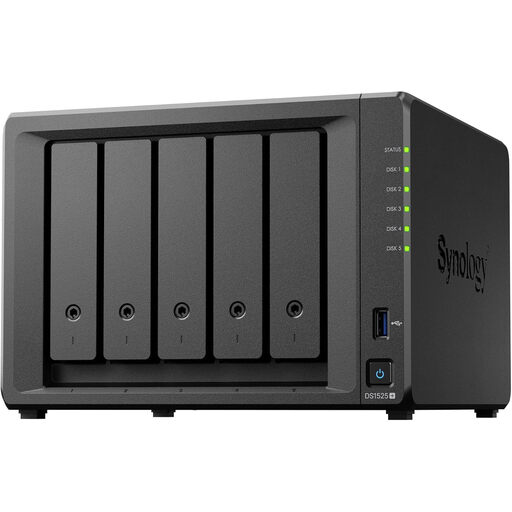
Five bays may be useful when a larger podcast catalogue or shared production files call for a multi-drive plan.
This is a diskless enclosure, so select compatible drives and calculate usable capacity for your layout. Confirm a separate local backup workflow before depending on it for recovery.
 No image available
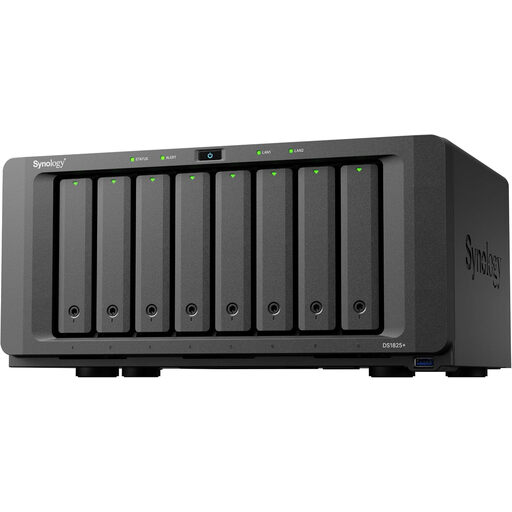
This eight-bay enclosure is a route for a particularly large or expanding shared archive, rather than a simple solo setup.
It is diskless. Check compatible drives, usable capacity under the intended layout and a separate local backup destination before building the archive around it.
No. RAID can keep a suitably configured multi-drive NAS available after certain drive failures, but it does not provide an independent copy of deleted files or protect against loss of the enclosure. Keep a separate local backup and check that you can restore it.
Use a supported NAS backup function to copy files to a separate local destination, such as an external drive or another NAS. Synology documents external-storage and local shared-folder destinations for Hyper Backup, while ASUSTOR documents scheduled external-drive backups; check the workflow for the model you choose.
For a NAS archive, consider drives intended for NAS use, then check each exact drive model against the enclosure's compatibility requirements. Seagate describes IronWolf and Toshiba describes N300 as NAS-drive lines, but neither line name alone confirms compatibility with a particular enclosure.
It can: Synology's DS225+ hardware guide says that installing a drive containing data will format it and erase the data. Make another copy before moving a drive, and follow the setup guide for the exact NAS you buy.