What matters when choosing?
Decide what the group will retain and how it will recover valued captures before choosing drive capacities; then check simultaneous access needs and who may administer the archive.
| Concern | What to check | Who this matters to |
|---|
| Usable capacity and retention |
Estimate capture growth and retention needs, then calculate usable space for the selected drives and array layout. |
If I am keeping a growing collection of matches, I need to know how much footage will fit after array protection takes its share of capacity. Around 36% of consumers put usable archive space and retention first. |
| Drive-failure recovery and backup |
Check the array’s drive-failure tolerance and arrange a separately protected, recoverable backup. |
When recordings would be difficult to recreate, I want a failed drive or destructive incident not to end the archive. Keeping footage recoverable is the primary concern for around 29% of consumers. |
| Shared access and compatibility |
Check the exact HDD model against the enclosure maker’s compatibility information and assess the group’s access needs. |
With several members uploading and finding clips, I need drives that are compatible with the NAS we choose. Around 21% of consumers prioritise that shared-storage fit. |
| Permissions and retention |
Check account and encryption options; decide who can administer, upload, view or delete recordings. |
If captures identify players through voices or usernames, I need control over access and how long the group keeps them. Responsible handling comes first for around 14% of consumers. |
Joybuy NAS enclosures
These enclosures provide four-bay and eight-bay starting points for a shared game-capture archive. Choose the drive set and array layout separately according to compatibility, usable-capacity and recovery needs.
 No image available
Synology DiskStation DS925+ 4-Bay NAS
For a group planning shared capture storage, this four-bay enclosure leaves the drive and array choices to be made. Confirm whether HDDs are included and check exact drive compatibility before purchase.
View on Joybuy
 No image available
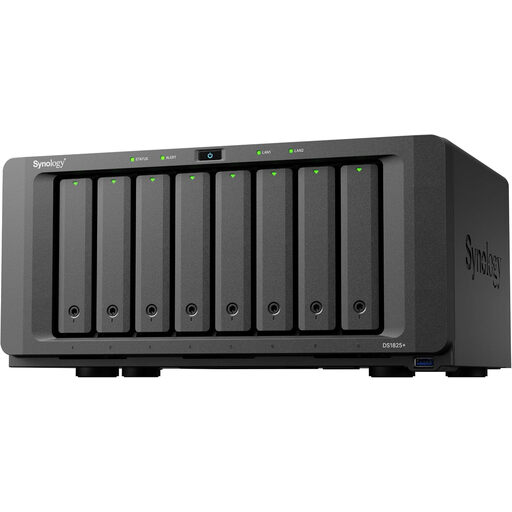
Synology DS1825+ 8-Bay Diskless NAS
For a group planning a larger drive array, this eight-bay enclosure provides more slots. It is diskless, so obtain compatible HDDs separately and calculate usable capacity for the intended layout.
View on Joybuy
Common questions
Is RAID enough to protect our game captures?
No: a fault-tolerant array can help the archive remain available after a supported drive failure, but it is not an independent backup. The National Cyber Security Centre recommends regular backups for recovery from destructive ransomware, so arrange a separately protected copy that the group can restore.
Should we use one large drive or a fault-tolerant array?
Choose a fault-tolerant layout when continued access after a drive failure matters more than maximum immediately usable capacity. A single drive may suit disposable captures or an archive already kept in an independent, recoverable copy; Synology Knowledge Center notes that array choice changes both usable capacity and data protection.
How do we check whether a NAS drive will fit?
Check the exact HDD model and capacity against the selected enclosure maker’s compatibility information before ordering. Synology specifically recommends its compatibility list for drives used with its products; a drive line’s NAS positioning alone does not establish compatibility with a particular enclosure.
What if captures include identifiable players or voice chat?
If the group stores personal information, set access permissions and a retention period tied to why the recordings are kept. Information Commissioner’s Office guidance says personal information should not be kept longer than needed for its purpose and identifies encryption as a safeguard for stored information; the appropriate arrangements depend on the group’s circumstances.


