Choose a NAS by planning how the studio will recover its catalogue, then calculate usable capacity and assess access for everyone who needs it. A two-bay unit can serve as a compact backup target if mirrored-drive capacity is sufficient; four bays offer more room to plan for growth and shared use. RAID can help with certain drive failures, but Synology Knowledge Center cautions that it is not a backup: keep a separate, versioned copy and test restoring it.
Who needs this setup?
Small studios focused on recovery
When a photo folder is deleted or a workstation fails, the priority is getting the catalogue back. Synology Knowledge Center distinguishes drive redundancy from backup and describes versioned copies for longer-term recovery.
Teams sharing a growing archive
Several contributors may need access to RAW files and project folders while the archive expands. Plan usable storage alongside individual access and the wired network serving concurrent users.
Studios holding identifiable client imagery
Recognisable photographs and associated client details make access and recoverability particularly important. The Information Commissioner’s Office advises organisations handling personal data to consider suitable protection and the ability to restore access after an incident.
What matters when choosing?
Work out the recovery plan and usable capacity before paying for faster networking. Assess network upgrades against how often the studio retrieves or works from shared files, rather than the NAS port label alone.
| Concern |
What to check |
Who this matters to |
| Recovery beyond drive failure |
Check backup and snapshot support for the exact model and file system. Plan a separate versioned destination and test restores. |
If a catalogue folder is deleted or the studio site is affected, I need an earlier copy I can restore. Around 36% of consumers put recovery beyond drive failure first. |
| Usable capacity and growth |
Calculate space for the current archive, expected growth and the chosen drive layout; compare bay counts using usable rather than raw capacity. |
As RAW files and finished projects accumulate, I need space that will still work with my chosen redundancy layout. For around 29% of consumers, capacity and growth are the primary concern. |
| Access for several users |
Check concurrent use against the NAS connection, switch, wired client adapters and file-sharing setup. |
When colleagues upload and retrieve projects at the same time, I do not want the shared connection to hold up hand-offs. Around 21% of consumers prioritise multi-user access. |
| Client-file access controls |
Check individual accounts and folder permissions; assess encryption and recovery arrangements if the catalogue contains personal data. |
If freelancers and staff need different folders, I want access I can grant and remove without sharing an administrator login. Controlled access is the leading need for around 14% of consumers. |
Buying pitfalls
-
Treating RAID as the entire backup plan
RAID may keep files available after certain drive failures, but it cannot recover every deleted, corrupted or otherwise lost catalogue. Synology Knowledge Center explicitly distinguishes RAID from backup.
Keep versioned copies on a separate destination, with an off-site or otherwise isolated copy, and practise restoring the folders the studio depends on.
Allow time to monitor those copies and repeat restore tests.
-
Choosing an enclosure without planning the full system
The number on a drive label is not the usable space left after a mirrored or other redundant layout. Drives, backup storage and suitable network equipment also affect what can be put into service.
Calculate usable capacity for the intended drives and layout, then check what is supplied with the exact NAS and what the backup destination requires.
-
Expecting dual Ethernet ports to speed up one computer
Link aggregation and SMB Multichannel depend on compatible equipment and configuration. ASUSTOR’s published transfer figures come from its own optimised lab conditions, not a guarantee for an existing studio network.
Map the switch, client adapters and wired connections before choosing a network upgrade for simultaneous transfers.
-
Sharing one administrator login
A shared credential makes it harder to limit folder access or remove a former collaborator’s access. Where the catalogue contains personal data, the Information Commissioner’s Office also emphasises security suited to the processing risk.
Give staff individual accounts and permissions suited to their roles; assess encryption and recovery controls against the studio’s actual files and access arrangements.
Brands to consider for this workflow
Synology
A route to examine when the studio wants backup software alongside shared storage. Synology lists the four-bay DS425+ with built-in 2.5GbE.
- Synology Knowledge Center describes distinct uses for Active Backup for Business, Snapshot Replication and Hyper Backup, including versioned off-site copies.
- Package and file-system requirements matter: Synology says Snapshot Replication uses Btrfs, while Active Backup for Business requires a compatible x64 NAS using Btrfs. Check the exact unit and intended workload.
QNAP
A route to examine when catalogue backup will sit alongside shared access or a developing media workflow. QNAP lists two-bay TS-264 and four-bay TS-464 models with 2.5GbE connections.
- QNAP describes folder permissions and concurrent access in its creative-storage material, alongside a choice of RAID layouts.
- Check drives, SSDs and the wider network separately. Published transfer claims depend on the stated storage and network configuration.
ASUSTOR
A four-bay option to examine for wired shared storage: ASUSTOR lists dual 2.5GbE ports and four M.2 NVMe slots on the AS5404T.
- The AS5404T datasheet specifies 4 GB of memory and the four NVMe slots, giving the studio concrete configuration points to assess.
- ASUSTOR’s SMB Multichannel results were measured under its lab conditions. Confirm client, switch, protocol and drive compatibility before expecting similar transfers.
Joybuy NAS options
These models cover four-bay choices for a growing shared catalogue and larger enclosures to consider if active shared work calls for more storage planning. Whichever enclosure fits, plan a separate backup destination and a restore test.
 No image available
Synology DS425+ four-bay NAS
Consider this model when the studio needs a four-bay enclosure for its growing catalogue. Synology specifies built-in 2.5GbE for the DS425+; check drive inclusion, compatible backup functions and the separate destination needed for versioned recovery.
View on Joybuy
 No image available
Synology DiskStation DS925+ four-bay NAS
A four-bay choice to assess if the studio expects its catalogue to grow. Before planning later expansion, confirm the compatible expansion unit and drive choices for this exact model; also check the intended versioned, separate backup workflow.
View on Joybuy
 No image available
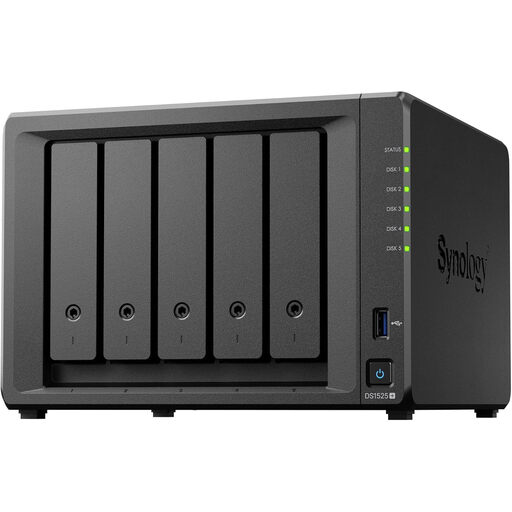
Synology DS1525+ five-bay diskless NAS
Consider five bays if the archive needs more storage-layout flexibility or will also serve active projects. This is a diskless model, so plan compatible drives separately; assess any network upgrade against the switch and client connections, and arrange an independent backup.
View on Joybuy
 No image available
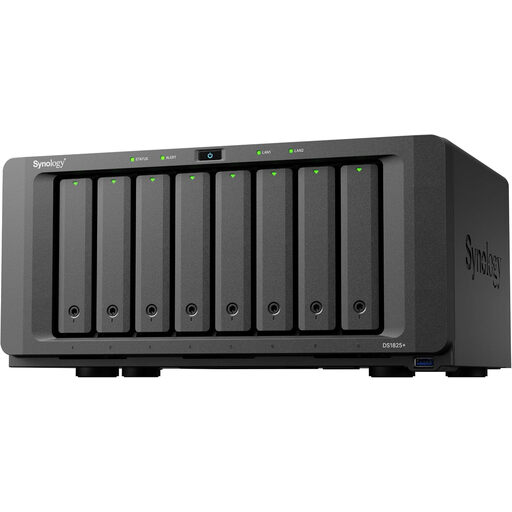
Synology DS1825+ eight-bay diskless NAS
Eight bays are worth assessing if a substantially larger shared archive justifies the enclosure. The model is described as diskless; calculate capacity using the drives and layout actually planned, and check network needs and separate restore arrangements before choosing it for the studio.
View on Joybuy
Common questions
Is RAID enough to back up a studio photo catalogue?
No. Synology Knowledge Center explains that RAID is not a backup: redundancy for certain drive failures does not replace a separate copy after deletion or loss of the site. Keep versioned backups and test recovery from an off-site or otherwise isolated destination.
Should a shared studio choose two bays or four?
Two bays can suit a compact backup target if the usable capacity of a mirrored pair covers the archive and its expected growth. Four bays offer more storage-layout choices when the catalogue is growing; calculate capacity with the actual drives and chosen layout before deciding.
Will 2.5GbE speed up every studio computer?
No. Transfer speed also depends on the switch, each client’s connection, storage and configuration. Dual ports and SMB Multichannel need suitable equipment and setup; ASUSTOR’s published lab figures should not be treated as expected speeds on an existing studio network.
What if the catalogue includes identifiable client photographs?
Assess the studio’s handling of those files as personal data rather than assuming a NAS feature establishes compliance. UK government guidance describes data-protection legislation as governing organisations’ use of personal information; the Information Commissioner’s Office advises appropriate security measures and the ability to restore access after an incident.
What should the studio test after installation?
Restore a photo folder and any catalogue file the workflow relies on from the separate backup destination. Check that individual accounts have the intended folder access and that routine users cannot change the isolated or off-site copy.


