
24/7 Customer Support

Free returns

Same-day & Next-day Delivery

Quality Guaranteed

Unlock Your Welcome Offers: FREE Delivery | Up to 80% OFF | Free 30-day JoyPlus trial
Download the APP
Choosing disposable potty training pants can feel straightforward until you compare pack sizes, materials, fit and absorbency. Marketing terms such as “natural”, “breathable” and “leak-proof” do not always explain what a parent actually receives.
For UK families, the right pair should support movement, simplify changes and suit the child’s skin and weight. This guide explains the important details behind Naty bamboo training pants, highlights common buying traps and matches available options to different everyday needs.
Bamboo viscose can provide a soft, plant-derived outer or inner layer, but a disposable nappy pant may also contain an absorbent core, elastic, adhesives and a moisture barrier. These additional components affect disposal and environmental impact.
Check the materials listed for the individual product rather than relying only on the word “bamboo”. These Naty options use bamboo viscose in key layers, while the Size 7 product description also lists cellulose pulp, superabsorbent polymer, elastic, adhesives and a PE film.
Children of the same age can have noticeably different body shapes. A pair that is too small may leave red marks, restrict movement or pull away from the waist. One that is too large may create gaps around the legs and increase the chance of leaks.
Use the weight range on the product packaging as the primary guide. Also check whether the waistband sits comfortably and whether the leg cuffs lie flat against the skin.
Absorbent cores and leak barriers can help manage wetness, but no disposable training pant can suit every child, sleeping position or change interval. Overnight use, heavy wetting and an incorrect size can all affect performance.
Look for practical features such as multi-layer absorbency, elasticated leg cuffs, a flexible waist and a wetness indicator. Change the pant when wet or soiled, and do not use it as a substitute for regular potty-training routines.
For children prone to sensitivity, look for products that clearly state what they do not contain. The Naty bamboo range is described as free from fragrance, lotion or cream, chlorine, latex, dioxins, phthalates and dyes. The Size 5 product is also described as free from parabens and formaldehyde.
The Size 4 product uses a natural bamboo back and plant-based surface, while the Size 5 product specifies bamboo viscose in the back sheet and enhanced top sheet. These details may appeal to parents looking for sensitive skin nappies, although individual skin can react differently. Stop using the product if irritation appears and seek medical advice for persistent redness or discomfort.
A breathable outer layer can help reduce the feeling of trapped moisture, but it does not eliminate the need for regular changes. The available products describe absorbent cores designed to lock away wetness, alongside breathable materials and leak barriers.
For daytime potty training, underwear-like flexibility may be more important than maximum capacity. For naps, nursery days or overnight wear, consider the child’s usual wetness level and whether the fit remains secure when moving, sitting and sleeping.
Pull-on nappies should be easy for a toddler to raise and lower, especially when practising independence. Check for:
The available range includes Naty nappies Size 4, Naty nappies Size 5 and Naty nappies Size 7. The Size 5 description gives a suitable weight range of 12–18 kg, while the Size 7 description gives approximately 15–25 kg. Always confirm the current pack label before ordering, particularly when a child is between sizes.
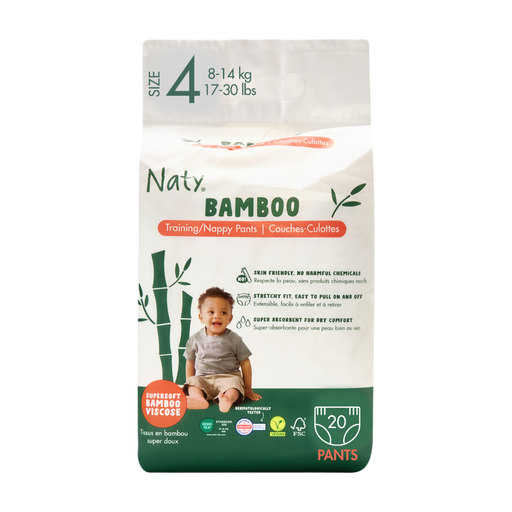
Why This Fits Their Persona: A 20-pant pack gives families starting potty training a practical supply for home, short trips or nursery changes, subject to the child’s correct fit.
The product information identifies a bamboo-based surface, elastic waist and leg cuffs, helping shoppers assess construction instead of relying only on an eco-friendly label.
20-pack format; listed as free from fragrance, creams, chlorine, latex, dioxins, phthalates and dyes.
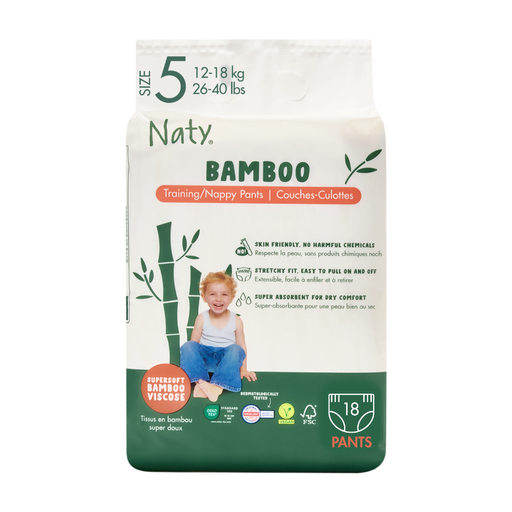
Why This Fits Their Persona: Suitable for parents prioritising soft, underwear-like pull-on nappies for active toddlers who are learning to dress themselves.
The listed Size 5 range is 12–18 kg, and the design includes stretchy waist and leg cuffs, making fit easier to assess than age-only sizing.
18-count pack; wetness indicator and bamboo viscose layers are listed alongside a multi-layer absorbent core.

Why This Fits Their Persona: Designed for toddlers around 15–25 kg, this option suits larger children needing disposable potty training pants for travel, nursery or everyday use.
The stated weight guidance, adjustable waistband and leak barriers help shoppers avoid sizing up or down simply to manage accidents.
16-pack format; listed breathable bamboo viscose, absorbent core and leak barriers for day or night use.
We have compiled a complete, real-time list of products that fully satisfy these strict selection criteria and UK safety regulations.
Pull the training pant up like underwear, then check that the waist and leg barriers sit comfortably. For removal, tear the side seams where provided. Change promptly after wetting or soiling, especially if your child has sensitive skin.
Keep unused nappies and packaging away from children because plastic bags and detached components can present a suffocation or choking risk. Roll used pants up and place them in a waste bin. Do not flush disposable training pants, as they can block household plumbing.
The listed products are described as free from several common additives, including fragrance, lotion, chlorine, latex and dyes. Some are also described as OEKO-TEX certified or dermatologically tested. However, no product is suitable for every child. Introduce a new pair while checking for redness, discomfort or irritation.
There is no universal time limit. Change it when wet or soiled rather than waiting for a fixed number of hours. Overnight use depends on the child’s wetness level, the fit and the absorbency required. Regular changes can help maintain comfort and hygiene.
The answer depends on how frequently they are changed, pack price and whether laundry costs are included. Disposable pants offer convenient clean-up for nursery, travel and accidents, while reusable underwear may reduce packaging waste but requires washing and drying. Compare the cost per pant, not only the pack price, before purchasing.