
24/7 Customer Support

Free returns

Same-day & Next-day Delivery

Quality Guaranteed

Unlock Your Welcome Offers: FREE Delivery | Up to 80% OFF | Free 30-day JoyPlus trial
Download the APP
Choosing Naty bamboo viscose nappies involves more than looking for the word “bamboo” on the packaging. Parents and carers also need to check the fit, absorbency, materials, pack size and whether the product is a conventional nappy or a pull-up training pant.
For families shopping for eco-friendly bamboo nappies, the right choice can provide a softer-feeling surface and practical protection for nursery, travel, overnight use or potty training. However, several common marketing shortcuts can make a product appear more sustainable or suitable than it really is.
Bamboo viscose is a plant-derived fibre, but a disposable nappy is usually made from several materials. These may include absorbent pulp, superabsorbent polymer, elastic, adhesives and a moisture-resistant layer. Therefore, a bamboo component does not automatically mean the entire product is biodegradable or suitable for home composting.
Treat terms such as biodegradable-style baby nappies as descriptive rather than proof that the complete nappy will break down quickly. Always follow the packaging and local UK waste guidance. Used nappies and training pants should not be flushed.
Age ranges can be useful, but children of the same age can have very different body shapes. A nappy that is too small may leave red marks or gaps, while one that is too large can allow leaks around the waist and legs.
Check the manufacturer’s weight guidance where available. For example, the Size 7 Naty bamboo viscose training pants are listed for toddlers weighing approximately 15–25kg. The Size 7 baby nappies are described as suitable for children aged 24 months and above, but the fit should still be checked around the waist and leg openings.
Pull-up styles are designed to be put on like underwear and can support growing independence. They may be convenient for toddler potty training, but they are not identical to tab-fastened baby nappies.
For younger babies or children who need frequent lying-down changes, standard nappies may be more practical. For toddlers who are learning to use the toilet, bamboo training pants or disposable training pants can simplify changes while offering a familiar underwear-like design.
If your child has sensitive skin, focus on the materials that touch the body rather than only the outer packaging. Naty options in this guide are described as using bamboo viscose in the outer layer or top sheet and as being free from fragrance, chlorine, latex, dioxins, phthalates and dyes, depending on the product.
These features may make them worth considering as fragrance-free nappies or sensitive skin nappies, but every child’s skin responds differently. Stop using a product if irritation or redness develops and seek healthcare advice if symptoms persist.
Some products also list OEKO-TEX certification or a Dermatest rating in their supplied product information. These are useful details to check on the product page, but they should not be treated as a guarantee that irritation cannot occur.
A soft surface is only one part of everyday performance. Look for a multi-layered absorbent core, a wetness indicator where useful and elasticated leg cuffs that sit close to the body without digging in.
For overnight or longer journeys, consider how often you can change the child. Nappies designed for day and night use may be convenient, but they should still be changed promptly when wet or soiled. No disposable nappy can replace regular changes and a correctly adjusted fit.
Standard nappies with fastening tabs can be positioned around the waist and adjusted after the child is lying down. Training pants are pulled up over the legs, so check that the waistband and leg openings stretch comfortably.
Pack size also affects running cost. Compare the price per nappy or pant rather than the pack price alone. A 20-pack may offer more individual items, while a 16-pack or 18-pack may suit occasional use, travel or a trial before committing to larger purchases.
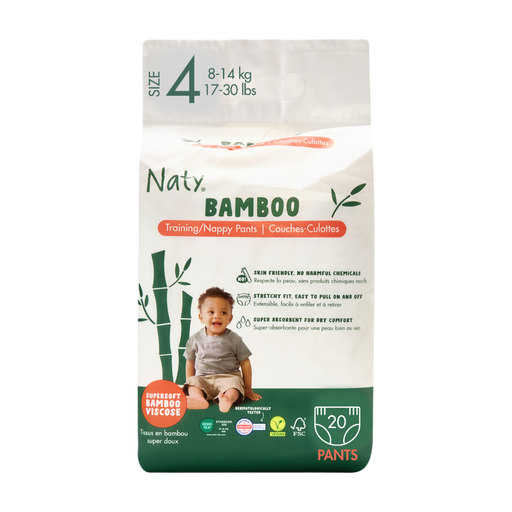
Why This Fits Their Persona: A 20-pack gives families a practical starting quantity for everyday changes, nursery bags or trying pull-up styling before buying more.
The product information identifies bamboo material, elastic waist and leg cuffs and a wetness indicator, helping shoppers assess practical details rather than relying on a broad eco claim.
Soft bamboo surface, absorbent construction and a pull-up design intended for children aged 0+ according to the supplied product details.

Why This Fits Their Persona: Suitable for families prioritising a plant-based feel, detailed material information and a fastening nappy for active toddlers.
Its listed specifications identify the absorbent core, stretchy waist and leg cuffs plus a wetness indicator, so shoppers can check fit and changing features together.
100% bamboo viscose back sheet and enhanced top sheet, listed fragrance-free and latex-free, with an 18-pack format.

Why This Fits Their Persona: A pull-up option for toddlers weighing approximately 15–25kg, particularly useful for potty training, travel, nursery and active days.
The stated weight range, adjustable waistband and leak-proof side barriers make it easier to match the product to the child rather than selecting by age or appearance.
16-pack, disposable pull-up construction and listed fragrance-free, paraben-free and chlorine-free materials.
We have compiled a complete, real-time list of products that fully satisfy these strict selection criteria and UK safety regulations.
The listed products are described as hypoallergenic or skin-friendly and free from selected substances including fragrances, chlorine, latex and dyes. These features may suit families seeking hypoallergenic nappies, but individual reactions vary. Discontinue use if irritation appears and consult a healthcare professional if it continues.
The Size 7 baby nappies are described as having a multi-layered absorbent core and being intended for day and night use. Fit remains important, particularly around the waist and legs. Change the nappy when wet or soiled rather than relying solely on the stated usage period.
No. The products described here are single-use disposable training pants. Do not wash or reuse them, and do not flush them down the toilet. For lower laundry use during potty training, dispose of each used pant in a covered waste bin according to local waste guidance.