
24/7 Customer Support

Free returns

Same-day & Next-day Delivery

Quality Guaranteed

Unlock Your Welcome Offers: FREE Delivery | Up to 80% OFF | Free 30-day JoyPlus trial
Download the APP
A neoprene hex dumbbell set can make home exercise more convenient, but product listings often leave out details that matter once the weights are in regular use. A soft-touch finish, colourful coating and included rack may look appealing, yet they do not automatically indicate suitable weight progression, reliable construction or comfortable handling.
Before buying, UK shoppers should look beyond promotional wording and check the actual weight range, core material, handle dimensions and storage requirements. The right set should fit your available space, training style and current ability without encouraging unsafe lifting or unnecessary spending.
Neoprene provides a comfortable, tactile outer finish, but it is not the main structural component. Many neoprene dumbbells contain a cast iron core, which provides the mass and rigidity. Check the listed material rather than assuming that every coated dumbbell has the same internal construction.
Also look for care instructions. Coatings can deteriorate if weights are dragged across rough flooring, left in damp conditions or stored in direct sunlight for prolonged periods.
Light hand weights for home workouts are useful for Pilates, mobility work, aerobic routines and higher-repetition exercises. However, a single pair may become limiting for squats, rows, presses and other strength movements.
A multi-weight set gives you more flexibility, but only if the increments are practical. A selection such as 1 kg, 2 kg and 3 kg per dumbbell can suit beginners and casual exercisers, while a pair of 4 kg or 5 kg weights may be more appropriate for users who already have some lifting experience.
Hexagonal heads are useful because they are less likely to roll across the floor between sets. They can also support floor-based exercises such as renegade rows. However, the dumbbells still need to be placed gently on a stable, flat surface. A non-rolling shape does not remove the risk of dropped weights, damaged flooring or trips in a crowded workout area.
For beginners, dumbbells for toning and general conditioning often start in the 1 kg to 3 kg range. More demanding strength training may require 4 kg, 5 kg or heavier options, depending on the exercise and the user’s experience.
Check whether the stated figure applies to one dumbbell or the pair. For example, “2 x 5 kg” means two individual 5 kg dumbbells, not a combined adjustable weight. Some listings also note a possible weight discrepancy of up to 3%, so buyers who need precise loading should take that information into account.
A cast iron centre offers a dense, compact form, while a neoprene coating can make the grip more comfortable than bare metal. Inspect the handle dimensions as well as the head shape. A grip diameter around 3 cm to 4 cm may feel different depending on hand size and whether you are performing slow strength movements or fast cardio exercises.
The coating should feel secure without making the handle excessively bulky. Wipe the surface with a soft, damp cloth after use and allow it to dry fully before storage.
A dumbbell set with stand can be worthwhile in a flat, spare room or compact home gym because it keeps several pairs together and reduces floor clutter. Confirm the stand’s footprint and place it on a level surface away from children, pets and walkways.
If you are buying individual hex dumbbells, measure your storage area first. Hexagonal ends help with stability, but they do not make a heavy dumbbell easy to move once it has been left in an inconvenient location.
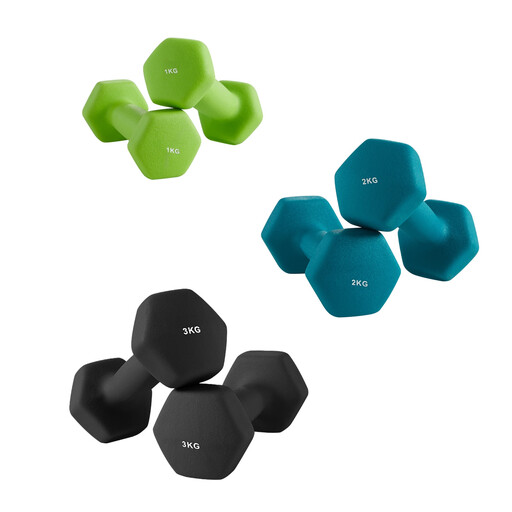
Why This Fits Their Persona: The three paired weights provide a straightforward starting range for home workouts, including lighter Pilates-style movements and moderate conditioning. The included stand is practical for keeping a small exercise area organised.
It avoids relying on one weight only, while the clearly marked 1 kg, 2 kg and 3 kg pairs make selection easier during a session.
Cast iron construction, neoprene coating, hexagonal heads and a PP plastic stand are listed specifications.
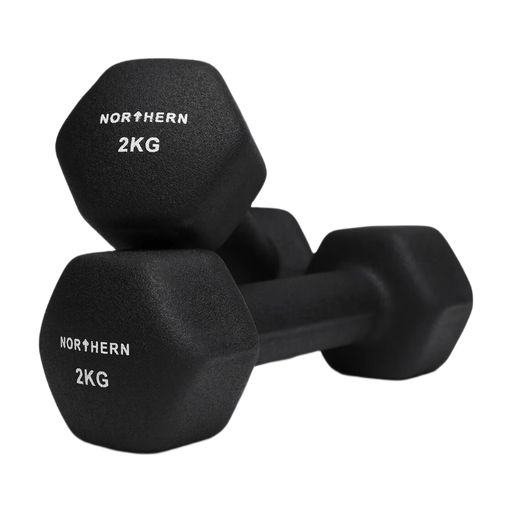
Why This Fits Their Persona: This 2 kg pair is suited to users who prefer a restrained, compact setup for light strength training, Pilates sequences and functional movement in a home or studio space.
The listing specifies the 2 kg maximum load per dumbbell, helping buyers match the product to lighter training instead of assuming it is designed for heavy lifting.
The product has a solid cast iron core, matt neoprene finish and hexagonal shape. The listed care advice includes wiping it with a soft, damp cloth.
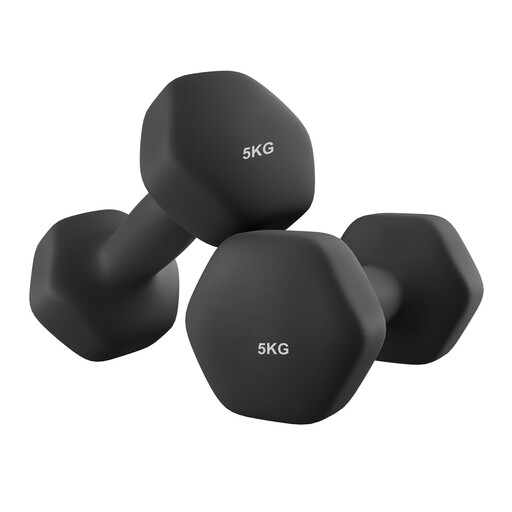
Why This Fits Their Persona: The 5 kg pair is intended for users who want a fixed, heavier option for rows, presses, squats and other strength-focused home gym exercises.
It states the individual weight, grip dimensions and possible 3% discrepancy, giving buyers information that a vague “heavy-duty” label does not provide.
Each dumbbell has a cast iron construction, neoprene coating and hexagonal ends designed to keep it stationary when placed down.
We have compiled a complete, real-time list of products that fully satisfy these strict selection criteria and UK safety regulations.
Yes, lighter neoprene dumbbells can suit beginners, Pilates, mobility routines and moderate conditioning. Start with a load that allows controlled movement and sound technique. A multi-weight set can make it easier to increase resistance gradually without buying several separate pairs.
Keep the weights on a stable, flat surface or on the supplied stand if one is included. Avoid high shelves, damp areas and direct sunlight for long periods. Place each dumbbell down carefully rather than dropping it, and inspect the coating periodically for cracks, peeling or other damage.
They can support many strength-training exercises, but suitability depends on the weight available. Pairs from 1 kg to 3 kg are generally more appropriate for lighter resistance and higher repetitions, while 4 kg and 5 kg pairs may provide more challenge for experienced home users. Check the product’s dimensions and stated load before ordering.