Start with the equipment already in the loft: a network player must connect to an amplifier, receiver or suitable powered speakers, and passive speakers need amplification. If film and TV-app sound must use the same stereo, look for a compatible HDMI ARC/eARC TV-audio input; if you mainly play soundtrack albums, a music-first streamer may be enough. In either case, check the network connection and whether room adjustment or subwoofer controls matter to your setup.
Who is this for?
TV-linked soundtrack listeners
If soundtrack albums and TV audio need to share one stereo system, check the player's TV-audio input, supported formats and control settings. WiiM and Bluesound document different HDMI ARC/eARC connections on their respective players.
Existing hi-fi owners with limited loft space
If you already have an amplifier, receiver or powered speakers, choose a network source with outputs those components can accept. Cambridge Audio describes its MXN10 as a compact, half-width option for an existing system.
Listeners planning around room and network conditions
If speaker placement makes bass difficult to balance or Wi-Fi is unreliable at the equipment position, consider the adjustment controls you would use and whether a wired network connection is practical.
What matters when choosing?
Decide how the player will connect to your speakers before weighing TV features, loft-room controls and access to your soundtrack collection.
| Concern |
What to check |
Who this matters to |
| System and speaker compatibility |
Identify whether your speakers are passive or powered. Match the player's analogue or digital output to the input on your speakers, amplifier or receiver. |
If I have passive speakers, I need an amplifier in the signal chain rather than assuming the player will power them. Around 33% of consumers would put system compatibility first. |
| TV sound and control |
Check for an HDMI ARC/eARC TV-audio input and a compatible TV port. Confirm any HDMI-CEC setting needed for the intended controls. |
When I watch films through the TV, I want their sound on the loft stereo as well as my soundtrack albums. Roughly 27% of consumers would prioritise TV integration. |
| Room and bass adjustment |
Check the specific model's EQ or room-adjustment tools and whether it has an output for a compatible powered subwoofer. |
If bass is difficult to balance at my listening position, I want controls I can use to adjust the system. Around 20% of consumers would make room adjustment their primary concern. |
| Network and library access |
Check Wi-Fi at the intended position, whether Ethernet is practical, and support for your streaming service or USB/NAS library. |
If my soundtracks are on a network drive or Wi-Fi is patchy in the loft, dependable access matters more to me than extra TV controls. About 20% of consumers would put network and library access first. |
Mistakes to avoid
-
Expecting a source-only streamer to power passive speakers
A player can offer the streaming features you want yet still have no way to drive passive speakers on its own.
Map the full connection from player to amplifier or receiver to speakers. Connect directly to powered speakers only when they accept the player's line-level output.
A passive-speaker setup may require a separate amplifier if you do not already have one.
-
Assuming every HDMI connection handles TV audio alike
HDMI ARC/eARC capability, supported audio formats and TV-control behaviour depend on the player and TV setup.
Check the exact player input and your TV's ARC/eARC port. WiiM says HDMI-CEC must be enabled on the TV for its documented ARC control behaviour.
-
Choosing a position before checking the network
Weak wireless coverage at the equipment position can interrupt network playback. Bluesound advises that Ethernet is the more stable connection where it is practical.
Check Wi-Fi where the player will sit, then consider a wired connection if playback stability takes priority over avoiding a cable.
Using Ethernet may mean running a cable or changing the equipment position.
-
Assuming all streamers support the same casting method
A player may support streaming services without supporting the phone or tablet playback method you use.
Check the specific model against your preferred method. WiiM states that Ultra does not support AirPlay 2, while Cambridge Audio lists AirPlay 2 and Chromecast built-in for MXN10.
Brands to consider
WiiM
The WiiM Ultra is a digital-hub option for a loft stereo that also needs a TV-audio connection.
- WiiM lists HDMI ARC, analogue and digital outputs, a subwoofer output and RoomFit room correction for Ultra.
- WiiM states that Ultra does not support AirPlay 2. Confirm another suitable playback method if you normally use Apple-device casting.
Bluesound
The NODE is a TV-capable streaming option if you also want a personal music library or may later use compatible players in other rooms.
- Bluesound lists HDMI eARC, Dolby Digital decoding, analogue and digital outputs, and playback across compatible Bluesound players.
- Multi-room use depends on adding compatible players; for a single loft system, assess the NODE's connections and control platform on their own merits.
Cambridge Audio
The half-width MXN10 is a music-first network source for an existing amplifier, DAC or suitable powered speakers.
- Cambridge Audio lists USB/NAS playback, AirPlay 2, Chromecast built-in, Bluetooth, RCA, coaxial and optical outputs for MXN10.
- Its cited product specification does not list an HDMI ARC/eARC input. Plan a separate compatible path if TV sound must use the stereo.
Joybuy product choices
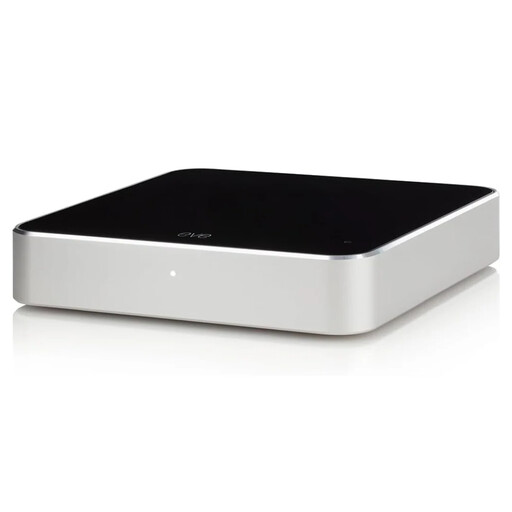
This Eve Play option is for considering network-streamed soundtrack music through existing audio equipment. If TV sound also needs to reach the stereo, confirm the required TV-audio connection separately.
 No image available
Eve Play Ethernet LAN Wi-Fi (Black, Silver)
Consider this for soundtrack music played through an existing amplifier, receiver or suitable powered speakers. Its listed connectivity includes Ethernet LAN and Wi-Fi; check the audio outputs against your equipment and confirm any TV-audio, room-adjustment or subwoofer features you need.
Joybuy
Questions about loft soundtrack setups
Do I need an amplifier with a network audio player?
You need amplification if you use passive speakers. With suitable powered speakers, a separate amplifier may not be needed: Cambridge Audio says its MXN10 can connect to powered speakers through its RCA line output. Check the inputs and outputs of the particular equipment you intend to pair.
Can a network streamer play TV film sound through my loft stereo?
Yes, if the TV and player have a compatible TV-audio connection. WiiM lists HDMI ARC for Ultra, while Bluesound lists HDMI eARC for NODE; WiiM also says HDMI-CEC must be enabled on the TV for its documented ARC control behaviour. Check the TV port, audio format settings and player setup before buying.
Is Wi-Fi or Ethernet more suitable for a converted loft?
Ethernet is worth using when a cable route is practical and connection stability is the priority. Bluesound describes it as the more stable option; if you prefer Wi-Fi, check coverage at the player's intended position rather than relying on the signal elsewhere in the home.
What product information should I check for a Great Britain setup?
Check the specific player's marking and documentation, plug and power arrangement, and the seller's stated returns and warranty terms. GOV.UK guidance dated 31 March 2026 says CE marking continues to be recognised alongside UKCA marking for relevant products placed on the Great Britain market; that general guidance does not establish whether an individual product listing meets the applicable requirements.


