Start with the equipment already in the loft: a network player can feed an integrated amplifier or powered speakers, but passive speakers still need an amplifier. Then check network access, your music service or local-library route, and gapless playback if uninterrupted album sequencing matters. TV, headphone and multi-room features are worth considering when you will use them, rather than as a substitute for matching the player to your system.
Who is this for?
Rock-album listener with an existing hi-fi
You already have an integrated amplifier, receiver or powered speakers and want to add streaming or local albums without replacing the rest of the system. Check whether its inputs call for analogue RCA, a digital connection or both.
Loft listener unsure about network coverage
You want full albums to play reliably where the network signal may differ from the signal near your router. Test Wi-Fi at the intended shelf position and consider whether an Ethernet cable can reach it.
Music-room user with other listening plans
You may also want TV audio, wired headphones or music in multiple rooms. Those plans make the player’s inputs, outputs and ecosystem relevant alongside its music-streaming functions.
What matters when choosing?
Match the player to your speakers and existing inputs first; then check the network and the way you play albums. Consider extra room functions only if they belong in your setup.
| Concern |
What to check |
Who this matters to |
| System connections |
Identify whether your speakers are powered or passive, then match RCA, optical or coaxial outputs to the available inputs. |
If my existing amplifier or speakers cannot take the player’s output, I may need another component before I can listen. Around 33% of consumers put system matching first. |
| Loft network |
Test Wi-Fi where the player will sit and check whether Ethernet cabling is practical. |
I want an entire album to play without a weak connection interrupting it in the loft; around 25% of consumers give network reliability priority. |
| Album and library playback |
Check your service or local-file route and whether gapless playback works through that route. |
When tracks run together, I do not want added pauses, and I need access to the albums I actually use. Around 25% of consumers prioritise that playback workflow. |
| Other room functions |
Check the specific TV, headphone or multi-room connections you need; verify the current requirements of any room-correction feature. |
I may use the loft for TV sound or private listening as well as albums, so those connections could shape my choice. Around 17% of consumers put additional room functions first. |
Buying pitfalls
-
Mistaking a streamer for a speaker amplifier
A network player supplies audio to another component; it does not power passive speakers. WiiM advises using an amplifier with passive speakers.
List the inputs on your amplifier, receiver or powered speakers before choosing a player. If you have only passive speakers, plan for an amplifier or consider a streaming amplifier instead.
-
Assuming Wi-Fi will work equally well throughout the loft
Playback depends on the connection at the player’s actual position. WiiM offers Ethernet as a wired option, while Cambridge Audio says the MXN10 needs both supplied antennas fitted for full Wi-Fi functionality.
Test the intended position before settling on wireless placement, and check whether a wired connection is feasible.
-
Choosing by audio-format figures alone
A format specification does not tell you whether your preferred service, control app or local-library route will play a continuous album as you expect. Playback behaviour can depend on the app and service path.
Check those routes against your own music collection, and try a familiar continuous album while a return is still possible.
-
Reading room-correction readiness as acoustic treatment
Bluesound describes the NODE as Dirac Live Ready, with availability linked to a future software update. That does not establish that correction is usable at purchase or that it will resolve the acoustics of a particular loft.
If room correction is important, check current availability, operating requirements and any licence terms. Assess speaker placement and the room separately.
Setup may also require a measurement microphone kit and time to take measurements.
Brands to consider for this setup
Cambridge Audio
The compact MXN10 is a source component for adding network and local-file playback to an existing hi-fi or desktop system.
- Cambridge Audio lists USB playback and RCA, coaxial and optical outputs for the MXN10.
- It does not amplify passive speakers. Cambridge Audio says both supplied antennas must be connected for full MXN10 Wi-Fi functionality.
WiiM
The Pro Plus offers a network-streaming route for a system using analogue output or a compatible downstream digital input.
- WiiM lists dual-band Wi-Fi, Ethernet and gapless playback for the Pro Plus.
- Passive speakers still require an amplifier; choosing Ethernet also requires a workable cable route.
Bluesound
The current NODE is relevant when a loft system may also handle TV audio, wired headphones or multi-room music.
- Bluesound lists HDMI eARC, analogue and optical inputs, several audio outputs and a 6.3 mm headphone output for the NODE.
- Bluesound describes Dirac Live as a future-update-ready feature; check its current availability and requirements if room correction affects your decision.
Joybuy product choices
This network-audio option is relevant if you want to add streaming to an existing amplifier, receiver or powered speakers. Check its outputs and playback route against your system and albums.
 No image available
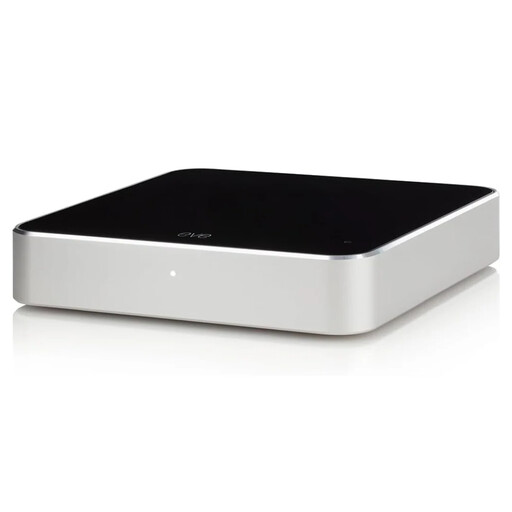
Eve Play Ethernet LAN Wi-Fi, Black, Silver
Consider this player for adding network audio to an existing amplifier, receiver or powered speakers; match the player’s output to your equipment’s input before ordering.
The named variant specifies Ethernet LAN and Wi-Fi. If continuous album sequencing or local files matter to you, confirm gapless playback and USB or NAS compatibility for your intended setup.
Joybuy
Frequently asked questions
Can a network audio player power passive speakers?
No: a network player is a source component, not a speaker-power amplifier. WiiM advises using an amplifier to power passive speakers; an integrated amplifier or receiver can sit between the player and those speakers.
Should I use Wi-Fi or Ethernet in a converted loft?
Use Wi-Fi if the signal is dependable at the player’s intended position; Ethernet is an option if you can run a cable. WiiM describes its wired connection as an option for greater stability. For a Cambridge Audio MXN10 on Wi-Fi, fit both supplied antennas.
How can I avoid pauses between tracks on a rock album?
Check gapless playback on both the player and the particular service or local-file route you will use. WiiM lists gapless playback for the Pro Plus, but it is worth trying a familiar continuous album through your intended app while a return is still possible.
Does a streamer need attention after setup?
Keep its software and playback routes working as your apps and services change. Cambridge Audio advises keeping the MXN10 connected to the internet as often as possible; periodically check its updates, service sign-ins and access to any local library you use.
What product-marking check matters when buying in the UK?
Check the conformity information applicable to the product and the market where it will be supplied. UK Department for Business and Trade guidance says businesses may use UKCA or CE marking for relevant goods placed on the market in Great Britain; Northern Ireland has separate arrangements, so a Great Britain marking conclusion should not simply be applied there.


