
24/7 Customer Support

Free returns

Same-day & Next-day Delivery

Quality Guaranteed

Unlock Your Welcome Offers: FREE Delivery | Up to 80% OFF | Free 30-day JoyPlus trial
Download the APP
Choosing newborn soothers can feel simple until you compare teat shapes, materials, age ranges and cleaning instructions. A product that looks suitable in a photograph may be too large for a newborn, incompatible with your sterilising routine or made from a material your baby does not accept.
The following guide focuses on practical details rather than marketing language, helping expectant parents and carers compare baby soothers for children aged 0–6 months.
Age labels are useful, but they are not the only consideration. A 0–2 months soother may have a smaller shield and teat than a 0–6 months soother, while some Size 1 products are listed as suitable from birth through six months. Check the manufacturer’s stated age range, shield dimensions and teat design rather than relying on the phrase “newborn dummy”.
A latex baby soother is generally soft and flexible, while a silicone baby soother usually has a firmer, consistent texture and can be easier to clean. Neither material suits every baby. Natural rubber latex can also cause reactions in sensitive individuals, so silicone may be the more suitable option where latex sensitivity is a concern.
A glow-in-the-dark soother can be useful during night feeds, but only if the handle is exposed to light according to the instructions. A self-sterilising case is convenient for travel, yet it requires access to a microwave and careful use of the specified water quantity and heating time. Consider whether the feature solves a real daily problem before paying more.
For babies from birth, look for products marked 0+ months, 0–2 months, 0–3 months or 0–6 months, depending on the product design. A symmetrical teat can be positioned either way up, whereas a round teat has a cherry-like shape. An anatomical or orthodontic soother has a more shaped teat intended to sit in a particular way.
These descriptions explain construction, not a guaranteed oral or developmental outcome. Always follow the manufacturer’s positioning and replacement advice. If your baby struggles to keep a soother in place or appears uncomfortable, stop using it and seek advice from your midwife, health visitor or GP.
Silicone is a synthetic material with a smooth, stable texture. It is commonly suitable for microwave sterilisation when the product instructions allow it and may be preferable for families avoiding latex.
Natural rubber latex is soft and flexible but can change shape, become sticky or deteriorate faster when exposed to heat, sunlight or oils. Many latex baby soothers require scalding rather than microwave sterilisation. Check the care instructions for each product, even within the same range.
Look for a shield with ventilation openings to allow airflow around the mouth. This may help reduce moisture accumulation, although it cannot prevent all skin irritation. The shield should remain outside the baby’s mouth and must not obstruct the nose.
Products sold in the UK should include appropriate safety information. Some of the products below state compliance with EN 1400, the European standard for soothers. This does not remove the need for supervision, inspection and regular replacement.
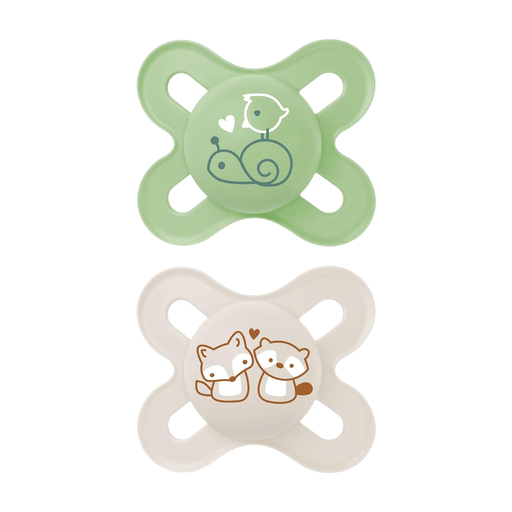
Why This Fits Their Persona: A straightforward two-pack for parents wanting newborn-specific baby soothers without buying a larger trial collection. The compact shield is designed for babies aged 0–2 months.
The age range is clearly stated, and the included steriliser and carry case avoid the need to purchase a separate storage case.
Symmetrical SkinSoft silicone teat, ventilated shield and a microwave self-sterilising case.
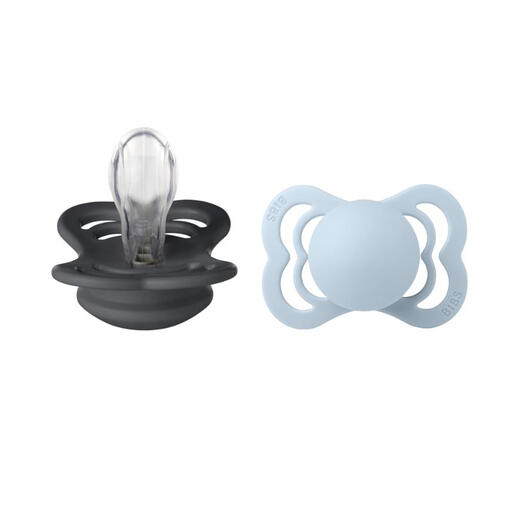
Why This Fits Their Persona: Suitable for parents who prioritise a food-grade silicone nipple, a wide shield and a two-pack for rotating at home and while travelling.
The silicone version avoids latex-specific care limitations, while the wide shield has ventilation openings rather than relying on appearance alone.
Symmetrical nipple, food-grade silicone and stated BPA-free materials; the product description also references EN 1400:2013+A2:2018.
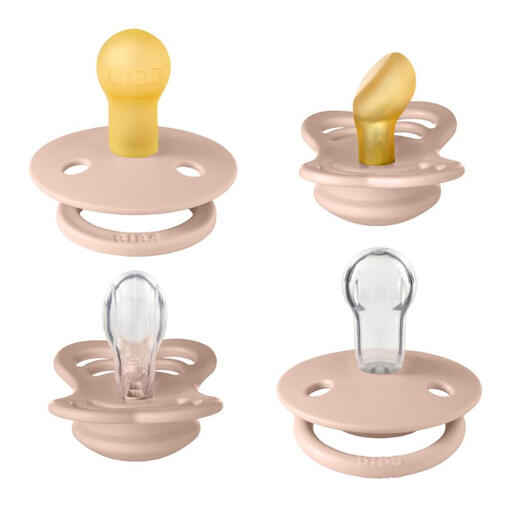
Why This Fits Their Persona: A baby soother trial pack for families unsure whether a round, anatomical or symmetrical nipple, or latex versus silicone, will be accepted.
Instead of buying several full packs, the four-pack lets you compare three nipple shapes and two materials within the stated 0–6 months range.
Includes round, anatomical and symmetrical options, with both natural rubber latex and silicone nipples.
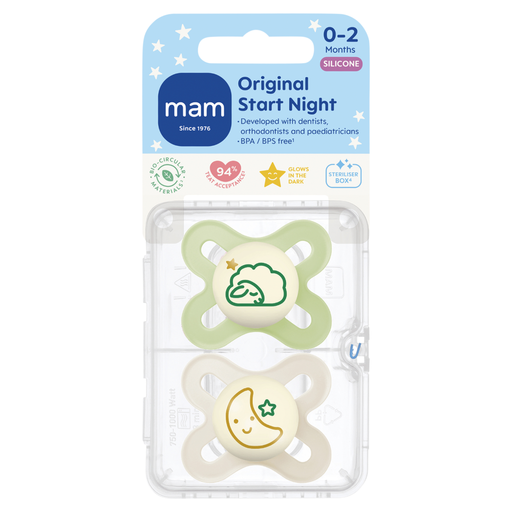
Why This Fits Their Persona: Designed for newborn routines where finding a soother during night feeds matters, with a glow-in-the-dark button and self-sterilising travel box.
The glow feature has a clear practical purpose, while the case provides a defined sterilising method rather than an unspecified travel accessory.
Extra-small design for 0–2 months, symmetrical silicone teat and a microwave case requiring 25 ml of water for three minutes.
Before first use, sterilise newborn soothers exactly as directed. Silicone products may allow boiling, steam or microwave sterilisation, while latex products often require scalding and should not be microwaved unless the instructions specifically permit it.
Before every use:
Many listed products recommend replacement every 4–6 weeks, while some MAM products state one to two months. Follow the specific product guidance and replace sooner if damage appears.
We have compiled a complete, real-time list of products that fully satisfy these strict selection criteria and UK safety regulations.
A two-pack provides a clean spare for night-time, travel or rotation. If you are unsure which design your baby will accept, a baby soother trial pack can reduce the need to buy several different multi-packs.
Use the manufacturer’s schedule, commonly four to six weeks for natural rubber latex products. Inspect before every use and replace immediately if the teat becomes damaged, sticky, enlarged or weak.
Silicone is often compatible with more sterilisation methods, including microwave systems where stated. Latex requires more careful heat management and may deteriorate faster. Always follow the instructions supplied with the specific soother rather than applying one cleaning method to every material.