
24/7 Customer Support

Free returns

Same-day & Next-day Delivery

Quality Guaranteed

Unlock Your Welcome Offers: FREE Delivery | Up to 80% OFF | Free 30-day JoyPlus trial
Download the APP
Whether you work in dentistry, healthcare, tattooing, food preparation, cleaning or gardening, the right nitrile examination gloves should protect your hands without making everyday tasks awkward. However, product pages often place more emphasis on colour and broad claims than on the details that affect real-world use.
This guide explains the practical specifications to check before buying powder-free nitrile gloves, including fit, cuff design, grip, chemical resistance and food-contact suitability.
Disposable gloves vary in material, thickness, finish and intended use. A lightweight glove designed for quick food preparation may not be suitable for prolonged cleaning, while a household glove may not be appropriate for clinical or hygiene-sensitive work.
Look for a clearly stated material, intended application and relevant conformity information. Latex-free disposable gloves are a practical choice for users who wish to avoid natural rubber latex, but “latex-free” does not automatically mean suitable for every chemical or task.
A glove that is too tight can split during donning and cause hand fatigue. One that is too loose may reduce dexterity and allow liquids to enter around the wrist. Check the seller’s size guide where available, and consider the width of your palm as well as finger length.
The supplied Unigloves range includes sizes from XS to XL in selected colours, making it easier to match the glove to different users or workplace colour-coding systems.
Nitrile has resistance to a wide range of chemicals, but no disposable glove protects against every substance indefinitely. Contact time, concentration, temperature and glove thickness all affect performance.
Always check the chemical manufacturer’s safety information and the glove’s technical documentation for specialist or industrial tasks. Household cleaning gloves should not be used with strong corrosive chemicals unless the label specifically permits it.
Nitrile is a synthetic rubber commonly used for examination, food handling, cleaning and general protective applications. It offers a snug fit and avoids natural rubber latex, which is important for allergy-conscious households and workplaces.
Powder-free nitrile gloves help reduce loose particulate contamination and avoid the drying sensation some users associate with powdered gloves. A chlorinated finish, used on some disposable gloves, can also make pull-on fitting easier.
Reusable household gloves may use natural rubber latex or a nitrile coating over another material. For example, Marigold Kitchen Gloves contain natural rubber latex, so they are not a suitable substitute for latex-free disposable gloves if latex avoidance is essential.
A beaded cuff adds structure around the wrist and can make gloves easier to put on. It may also help reduce liquid rolling back towards the forearm. Roll-top cuffs on reusable cleaning gloves are designed to stay in position and help limit water ingress during washing-up or household cleaning.
For food handling, dentistry, beauty work and healthcare, select the cuff style that suits the task and replace disposable gloves whenever they become damaged or contaminated.
Textured fingertips or a textured palm can improve grip when handling wet, oily or slippery items. This is particularly useful for cleaners, gardeners, food handlers and tattoo or piercing artists who need controlled handling of tools.
Some Unigloves Pearl nitrile examination gloves are described as touchscreen-compatible gloves, allowing users to operate mobile phones or tablets without removing them. This can be convenient for checking instructions or recording information, but touchscreen performance can vary with the device and the degree of moisture on the glove.
If you need food-safe gloves, check that the specific product is labelled for contact with food and covers the types of food you handle. The Unigloves Pearl products listed below are described as suitable for contact with all food types.
For medical examination gloves, dentistry or clinical work, check the product packaging and documentation for the relevant UK market conformity markings, standards and intended-use information. A general-purpose glove should not automatically be treated as a clinical barrier simply because it is made from nitrile.
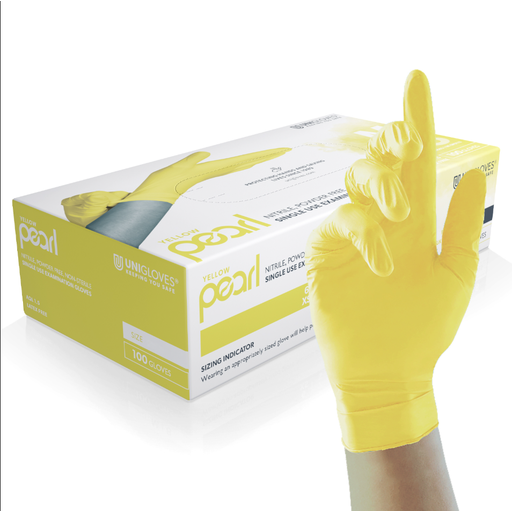
Why This Fits Their Persona: A practical starting point for households, food handlers and small businesses needing a 100-glove box in a visible yellow colour.
The product description specifies powder-free, latex-free nitrile construction and food-contact suitability rather than relying on a generic “protective glove” label.
Textured fingertips, touchscreen compatibility, beaded cuffs and a box of 100 gloves.
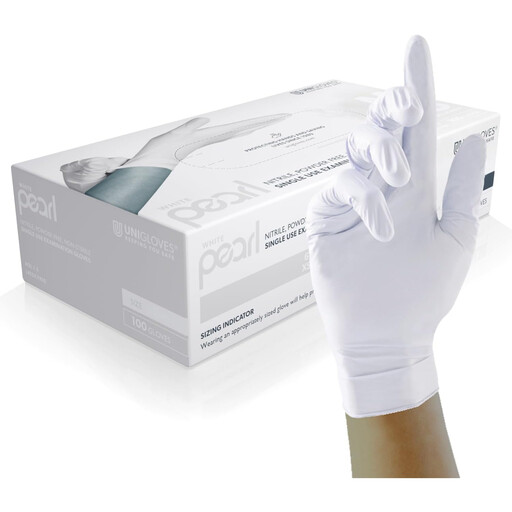
Why This Fits Their Persona: White gloves suit hygiene-focused settings such as clinics, salons, beauty work and food preparation where visible cleanliness matters.
The description identifies the nitrile material, powder-free finish, textured surface and beaded cuff, helping buyers assess more than colour alone.
Latex-free, powder-free construction with wet-grip texture and stated food-contact suitability.
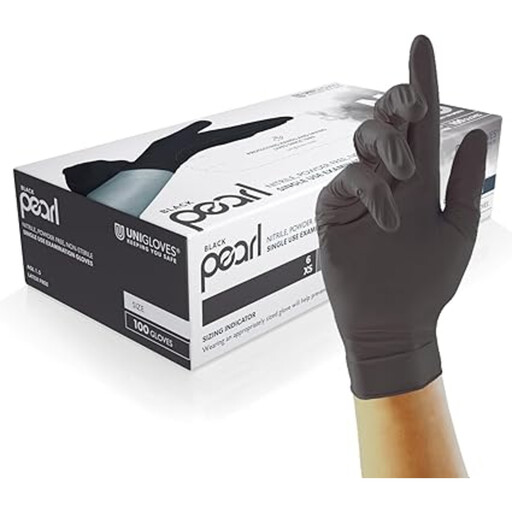
Why This Fits Their Persona: Black is useful for tattoo and piercing studios, grooming, mechanics, workshop tasks and jobs where stains are more noticeable on lighter colours.
It is specified as a single-use, powder-free, latex-free glove with a textured finish, rather than a reusable glove being stretched beyond its intended purpose.
Textured grip, beaded cuffs, touchscreen compatibility and stated resistance to a wide range of chemicals.
We have compiled a complete, real-time list of products that fully satisfy these strict selection criteria and UK safety regulations.
Some are, but not all. Choose a product specifically labelled as suitable for food contact and follow the handling instructions. The Unigloves Pearl products listed here are described as suitable for contact with all food types.
There is no universal wear time. Replace them when they become torn, visibly soiled, contaminated, wet inside or when you change tasks. Healthcare, food and beauty workplaces may also have specific hygiene procedures requiring more frequent changes.
Nitrile offers resistance to a wide range of chemicals, but performance depends on the substance and exposure time. For strong corrosive products, consult the chemical safety data and glove manufacturer’s compatibility information rather than relying on the word “nitrile” alone.