Parents packing a regular school lunch
If an apple drink goes into lunch most days, compare the sugars in the packed serving as well as the front-of-pack claim. A juice drink and an apple juice carton can have quite different recipes.


Water is the straightforward everyday packed-lunch choice if you do not need an apple-flavoured drink. If you do, choose between a juice drink with lower listed sugars and sweeteners, or a 150ml apple juice carton without that type of recipe; “no added sugar” alone does not settle the choice. NHS guidance recommends no more than 150ml of fruit juice and smoothies combined per day, taken with meals.
The useful distinction is not simply whether a carton says “no added sugar”, but what is in the drink and how much will go into the lunchbox.
If an apple drink goes into lunch most days, compare the sugars in the packed serving as well as the front-of-pack claim. A juice drink and an apple juice carton can have quite different recipes.
A 150ml carton gives a defined juice portion for lunch. Check whether it contains pressed apple juice, a juice blend or a sweetened-with-sweeteners juice drink before treating those cartons as interchangeable.
Look for sucralose and other sweeteners in the ingredients. Pressed apple juice and some juice blends offer different recipes, but still have sugars listed on the nutrition label.
Start with the drink type and the serving you will pack, then check ingredients and storage. The figures below describe particular products, not every no-added-sugar apple drink.
| Priority | What to check | Your needs |
|---|---|---|
| Sugars in the serving | Read “of which sugars” for the amount you will pack, not just per 100ml. ASDA Groceries lists 1.8g per 150ml for its Apple & Pear Juice Drink, 13g for innocent Kids Pure Fruit Juice Apple and 15g for Tropicana Kids Apple. | I want to know how much sugar is in the actual lunch portion; “no added sugar” does not answer that on its own. |
| Ingredients | Check whether the product is apple juice, a blend or a juice drink. ASDA Groceries lists sucralose and 6% apple juice plus 4% pear juice in its Apple & Pear Juice Drink; its listing for innocent Kids Apple gives pressed apples and vitamin C. | If I avoid sweeteners, I need to read the ingredients rather than choosing by the sugars figure alone. |
| Juice portion | For fruit juice and smoothies, NHS guidance sets a combined daily limit of 150ml and recommends having them with meals. Measure a serving from a larger juice carton rather than treating the whole pack as one portion. | A 150ml juice carton fits the amount I plan to pack, provided there is no other juice or smoothie that day. |
| Lunchbox handling | Check whether the drink needs refrigeration before packing and how long its pack permits it to be out of the fridge. ASDA Groceries states up to 12 hours out of the fridge for the listed innocent and Tropicana children’s juice cartons. | I need a drink that can be packed and handled according to its particular label throughout the school day. |
| School rules | Check the school’s packed-lunch drinks policy. Department for Education guidance on school food in England concerns food and drink provided by state-funded schools; it does not establish an individual school’s rule for a parent-provided lunch. | Before buying cartons for school, I want to know which drinks my child’s school allows in packed lunches. |
Apple juice can contain fruit-derived sugars without added sugar. ASDA Groceries lists 13g sugars in a 150ml innocent Kids Apple carton and 15g in a 150ml Tropicana Kids Apple carton.
Read the sugars line for the whole serving you intend to pack. NHS guidance counts fruit juice and smoothies together within its 150ml daily limit.
A per-100ml figure, a 150ml carton and a larger carton do not describe the same quantity. Concentrated squash also needs to be diluted before it is compared as a prepared drink.
Compare ready-to-drink products at the same serving size. If packing juice from a larger carton, measure the amount into a suitable bottle.
ASDA Groceries lists 1.8g sugars per 150ml for its Apple & Pear Juice Drink, which contains water, 6% apple juice, 4% pear juice and sucralose. That recipe differs from pressed apple juice.
Check both the product name and ingredient list. If sweeteners matter to your choice, look for them by name rather than relying on the nutrition panel alone.
These examples show why pack format and recipe matter; a brand name alone does not tell you whether a particular drink is pure juice, a blend or a diluted drink.
Tropicana Kids Apple is a 150ml lunchbox juice; Fresh & Light Apple is a larger juice-and-water blend.
Copella Cloudy Apple is pressed apple juice sold in bottles rather than an established 150ml lunchbox carton.
Tesco No Added Sugar Apple Juice Drink is a 1L juice drink, not a single-serve apple juice carton.
Sainsbury’s No Added Sugar Apple & Pear Juice Drink is a 1L apple-and-pear option.
ASDA Apple & Pear Juice Drink comes in a 150ml carton and has a different recipe from pure apple juice.
M&S Apple and Elderflower High Juice is concentrated squash, not a ready-to-drink apple juice carton.
The option here is a no-added-sugar apple-and-blackcurrant soft drink in 200ml bottles. It is not a pure apple juice carton or a 150ml juice portion.
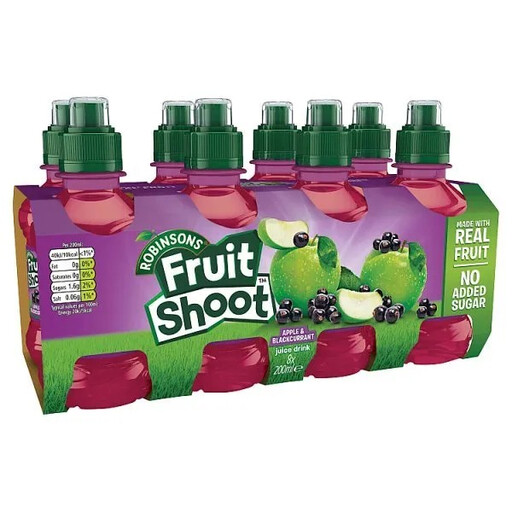 No image available
The 200ml bottles offer an apple-and-blackcurrant drink for a packed lunch, rather than pure apple juice in a 150ml carton. This mixed-fruit soft drink contains sweeteners, so check the ingredients if you prefer to avoid them.
No. Apple juice can contain sugars from the fruit even when no sugar is added. ASDA Groceries lists 13g sugars per 150ml for innocent Kids Pure Fruit Juice Apple and 15g per 150ml for Tropicana Kids Apple, so check the serving’s nutrition label.
NHS guidance recommends no more than 150ml of fruit juice and smoothies combined per day for children and adults, and advises having them with meals. A 150ml apple juice carton at lunch accounts for that combined amount for the day.
No. ASDA Groceries lists water, 6% apple juice, 4% pear juice and sucralose in its Apple & Pear Juice Drink, with 1.8g sugars per 150ml. Its listing for innocent Kids Apple instead gives pressed apples and vitamin C, with 13g sugars per 150ml. Choose according to the recipe as well as the sugars figure.
Check the particular carton’s storage directions. ASDA Groceries says the listed 150ml innocent Kids Apple and Tropicana Kids Apple cartons can be out of the fridge for up to 12 hours; store them refrigerated before packing and follow the pack directions after opening.
No universal packed-lunch rule follows from the cited standards. Department for Education guidance addresses food and drink provided by state-funded schools in England, not every parent-provided packed lunch. Check your child’s school policy for its drinks rules.