Choose 100% apple juice if you want an apple-juice ingredient list rather than a diluted drink: Tropicana Orchard Apple and Copella Cloudy Apple each list 15g sugars per 150ml. If a ready-to-carry pack with a lower labelled sugar figure matters more, compare no-added-sugar juice drinks, checking their sweeteners, fruit content and serving sizes. The NHS Eatwell Guide advises limiting fruit juice and smoothies to a combined total of no more than 150ml a day.
Who is each type of drink for?
Start with how you will take the drink to breakfast, then decide whether fruit-juice content or the labelled sugar figure matters more to your choice.
People leaving home with breakfast
A single pack avoids pouring from a larger bottle before you leave. ASDA Groceries lists its Apple & Pear Juice Drink as five 150ml cartons; Tesco Groceries lists Fruit Splash in a 250ml bottle. Check the nutrition figures against the size of the pack you intend to drink.
Shoppers comparing labelled sugars
No-added-sugar juice drinks can have different fruit percentages and sweeteners, so compare their ingredient lists as well as their sugar figures. ASDA Groceries lists 1.8g sugars per 150ml carton for its Apple & Pear drink, while Tropicana and Copella each list 15g per 150ml for the apple juices discussed here.
Shoppers who want apple juice rather than a juice drink
Tropicana Orchard Apple lists apple juice and ascorbic acid, while Copella Cloudy Apple lists pressed apple juice. Both labels give 15g sugars per 150ml. Choose this route for the juice ingredients, not on the assumption that no added sugar means little total sugar.
What should you check before choosing?
Compare like-sized servings where possible, then check whether the pack works for your morning routine. A no-added-sugar claim does not tell you the drink’s total sugars or fruit content.
| Priority |
What to check |
Your needs |
| Total sugars |
Read “of which sugars” and note whether the figure is per 100ml, per 150ml or per pack. Tropicana and Copella each list 15g per 150ml; ASDA Groceries lists 1.8g per 150ml carton for its Apple & Pear drink. |
I want to know how much sugar is in the amount I will actually drink, rather than relying on “no added sugar” on the front of the pack. |
| Fruit content |
Check whether the ingredients describe apple juice or a drink made with water and juice. ASDA Groceries lists 6% apple juice from concentrate in its Apple & Pear cartons; Sainsbury’s lists 20% apple and 5% pear juice from concentrate in its 1L drink. |
If I am choosing a juice drink for its other features, I still want to know how much fruit juice it contains. |
| Sweeteners |
Read the ingredients rather than assuming all no-added-sugar drinks are alike. Tesco Groceries lists sucralose in its 1L Apple & Pear Juice Drink. |
I may prefer an apple-juice ingredient list, or I may be happy with a sweetened juice drink. The label lets me make that choice. |
| Pack format |
Compare individual cartons and ready-to-drink bottles with 1L packs that need pouring. ASDA Groceries lists five 150ml cartons; Tesco Groceries lists Fruit Splash as a 250ml bottle. |
On mornings when I leave straight away, I would rather pick up a pack than measure a serving from a large bottle. |
| Juice portion |
The NHS Eatwell Guide advises limiting fruit juice and smoothies to a combined total of no more than 150ml a day. Check the pack size or measure the amount you pour when choosing fruit juice. |
If I choose 100% apple juice with breakfast, I want the amount I pour to be clear rather than treating a large bottle as one serving. |
| After opening |
Check the pack’s refrigeration and use-after-opening instructions before opening a larger carton. Consider whether you will use it within the stated period. |
A 1L pack works better for my routine if I expect to pour from it more than once; otherwise, an individual pack avoids opening a larger one. |
What is easy to overlook?
-
Reading “no added sugar” as “sugar-free”
Apple juice contains sugars that appear in the nutrition declaration even when sugar has not been added. Tropicana Orchard Apple and Copella Cloudy Apple each list 15g sugars per 150ml.
Compare the “of which sugars” figures on the same volume basis, alongside the ingredients.
-
Treating every apple-based drink as 100% juice
Juice drinks made with water and juice from concentrate differ from pressed apple juice. ASDA Groceries lists 6% apple juice from concentrate in its Apple & Pear cartons, while Sainsbury’s lists 20% apple and 5% pear juice from concentrate in its 1L Apple & Pear drink.
Check the fruit percentages and sweetener list before deciding which type of drink you want.
-
Using the bottle size as the juice serving
A larger bottle makes it easy to pour without checking the amount. The NHS Eatwell Guide advises a combined limit of no more than 150ml of fruit juice and smoothies a day.
If you choose fruit juice, pour a measured serving rather than drinking directly from a large bottle.
-
Opening a large pack for an occasional drink
A 1L pack needs to be stored and used according to its after-opening instructions. That matters if you only want a drink on some mornings.
Read those instructions before buying a larger pack, or choose an individual pack when that better fits your routine.
Which brand products illustrate the options?
These product examples show differences in ingredients, pack formats and nutrition labels; a brand name alone does not identify which type of apple drink is in the pack.
Tropicana
Orchard Apple is an apple-juice option for shoppers who prefer juice ingredients to a diluted juice drink.
- Tropicana lists apple juice and ascorbic acid in the ingredients.
- Its label lists 15g sugars per 150ml, so check total sugars separately from the no-added-sugar description.
Copella
Cloudy Apple is a pressed apple-juice option rather than a water-based juice drink.
- Copella lists pressed apple juice as an ingredient.
- Its label gives 15g sugars per 150ml. The NHS Eatwell Guide advises limiting fruit juice and smoothies to a combined total of no more than 150ml a day.
Tesco
Its no-added-sugar juice drinks include a 250ml Fruit Splash bottle and a 1L Apple & Pear pack.
- Tesco Groceries lists 3.1g sugars per 250ml Fruit Splash bottle and 3.9g per 150ml glass of its 1L Apple & Pear drink.
- Check the particular product’s ingredients: Tesco lists sucralose in the 1L Apple & Pear drink.
Sainsbury’s
Its 1L no-added-sugar Apple & Pear Juice Drink is a pack to pour at home rather than an individual carton.
- Sainsbury’s lists 3.9g sugars per 150ml serving.
- The ingredients list 20% apple and 5% pear juice from concentrate; it is not 100% apple juice.
ASDA
Its Apple & Pear Juice Drink comes in a pack of five individual 150ml cartons.
- ASDA Groceries lists 1.8g sugars per carton, with no pouring needed before leaving home.
- The ingredients list 6% apple juice from concentrate, so this is a juice drink rather than 100% apple juice.
M&S
Its Cloudy Apple Juice and Apple and Elderflower High Juice represent different types of drink.
- Marks & Spencer describes the concentrated Apple and Elderflower High Juice as made with 50% fruit juice.
- High-juice squash needs diluting, so it is not a ready-to-drink pack for a rushed departure. M&S lists 10.2g sugars per 100g for its separate Cloudy Apple Juice.
Apple-based options on Joybuy
This portable apple-and-pear fruit water is an option for a breakfast on the move. It is neither 100% apple juice nor the same product type as the sweetened juice drinks above, so use its own ingredients and nutrition label when comparing it.
 No image available
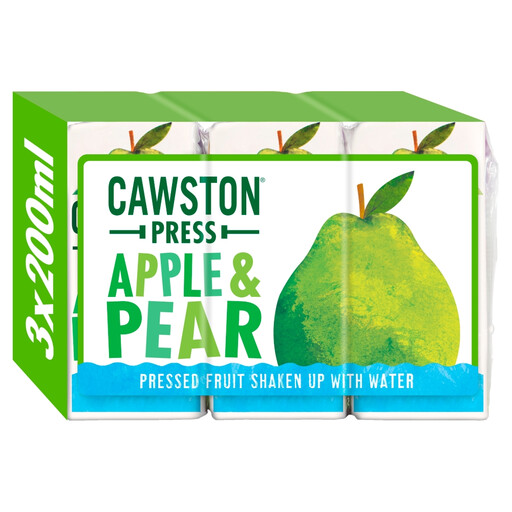
CAWSTON PRESS Apple & Pear Fruit Water, 3 x 200ml
The individual cartons suit a breakfast packed before leaving home. This no-added-sugar fruit-water blend contains 54% pressed apple juice and 6% pear purée, rather than being 100% apple juice. Its product information lists 6.4g sugars per 100ml; check that figure against the 200ml carton size when deciding how much to take.
View on Joybuy
Common questions
Does “no added sugar” mean an apple drink is sugar-free?
No. Check “of which sugars” on the nutrition label: Tropicana and Copella each list 15g sugars per 150ml of the apple juices discussed here. Juice drinks can have different figures and ingredients, so compare the serving size, fruit content and sweeteners too.
How much 100% apple juice should I pour with breakfast?
The NHS Eatwell Guide advises limiting fruit juice and smoothies to a combined total of no more than 150ml a day. If you pour from a large apple-juice bottle, measure the serving rather than using the bottle as a guide.
Is a carton, bottle or 1L pack easier to take out?
An individual carton or ready-to-drink bottle needs no decanting. ASDA Groceries lists its Apple & Pear drink in 150ml cartons, while Tesco Groceries lists Fruit Splash in a 250ml bottle. A 1L pack suits a routine where you can pour a serving before leaving; check how much you pour.
What should I check before opening a larger juice drink?
Read that pack’s refrigeration and use-after-opening instructions, then consider whether you will use the remaining drink within the stated period. If you only want an occasional grab-and-go drink, an individual pack may fit your routine better.


