Households planning regular drinks
If a bottle needs to last, compare its stated servings and dilution instructions rather than relying on its size alone.


For a budget shop, compare dilution instructions and stated servings before choosing by bottle size: Tesco Groceries lists 100 servings at a 1:19 dilution for its quadruple-strength lemon squash, while Sainsbury's lists 20 servings at 1:4 for its lime cordial. Check the exact bottle's diluted nutrition panel and ingredients too, because “no added sugar” does not mean no naturally occurring sugars or no sweeteners.
If a bottle needs to last, compare its stated servings and dilution instructions rather than relying on its size alone.
The front-of-pack claim is only part of the picture. Read the diluted nutrition information and ingredients if naturally occurring sugars or sweeteners matter to you.
Several of the named squash and cordial examples list sweeteners and sulphites. Check the declaration on the exact flavour and bottle size you intend to use.
Start with how the concentrate is prepared, then compare the label details that matter to your household.
| Priority | What to check | Your needs |
|---|---|---|
| Dilution and servings | Read the ratio and stated serving size together. Tesco Groceries gives 100 servings at 1:19 for its 1.5L quadruple-strength lemon squash; Sainsbury's gives 20 at 1:4 for its 1L lime cordial. Those stated servings are not the same measure as bottle volume. | I want to know how many drinks the bottle is intended to make, not just how much concentrate it holds. |
| Sugars on the label | Check whether the nutrition figures describe concentrate or the diluted drink, and compare the same serving basis. A no-added-sugar claim does not rule out naturally occurring sugars. | The label claim matters to me, but I also want to understand the sugars shown for the drink I prepare. |
| Sweeteners and sulphites | Read the ingredients and allergen declaration on the exact pack. Tesco's named lemon squash lists sucralose, acesulfame K and sodium metabisulphite; Sainsbury's named lime cordial lists sucralose and sodium metabisulphite. | Someone in my household avoids a particular ingredient, so the precise flavour and formulation matter. |
| Fruit content | Compare stated juice percentages for the products that interest you. Marks & Spencer describes its Apple and Elderflower High Juice as 50% fruit juice; its Lemon and Lime High Juice lists 25% lemon and 25% lime juice from concentrate. | I would like to choose by the fruit ingredients as well as the flavour named on the bottle. |
| Pack format | Check whether the listing is for one bottle or several, then read the serving information for the relevant bottle size. A multipack should not be mistaken for a single large bottle. | I need a format that suits how often we make squash and how much space we have to store it. |
Fruit ingredients can contribute naturally occurring sugars, and a no-added-sugar drink can contain sweeteners. Robinsons describes naturally occurring fruit sugars in its range; the cited Sainsbury's lime cordial lists sucralose.
Read the diluted nutrition panel and full ingredient list, keeping the serving basis in view when comparing bottles.
Tesco's cited quadruple-strength lemon squash states 100 servings at 1:19 dilution, while Sainsbury's cited lime cordial states 20 servings at 1:4. Bottle volume alone does not show the amount of diluted drink.
Follow each pack's preparation instructions and compare stated servings only with their serving sizes understood.
The cited Tesco lemon squash, Sainsbury's lime cordial and Marks & Spencer High Juice examples list sodium metabisulphite or E223 as sulphites.
If sulphites matter to your household, inspect the current ingredients and allergen declaration for every flavour and size you consider.
These examples show different formats and ingredients; a brand name alone does not establish the details of every bottle in its range.
Its Quadruple Strength Lemon Squash No Added Sugar is an example to consider when stated serving yield matters.
Its Lime Cordial No Added Sugar offers a different flavour and a less concentrated preparation than the cited Tesco quadruple-strength example.
Its no-added-sugar squash range includes fruit flavours such as orange and summer fruits; check the particular format before comparing servings.
The cited High Juice products give stated fruit-juice proportions for shoppers comparing fruit ingredients.
Waitrose & Partners lists no-added-sugar Apple and Elderflower and Blackcurrant High Juice products in its squash and cordial range.
These Joybuy options cover blackcurrant, orange, summer-fruits and pineapple-and-passion-fruit squash, including a summer-fruits multipack. Use the exact pack's preparation and ingredient information when narrowing the choice.
 No image available
Consider this bottle if blackcurrant is the flavour you want. Follow its preparation directions, and check whether the nutrition figures on the current pack refer to concentrate or the diluted drink before comparing them with another squash.
 No image available
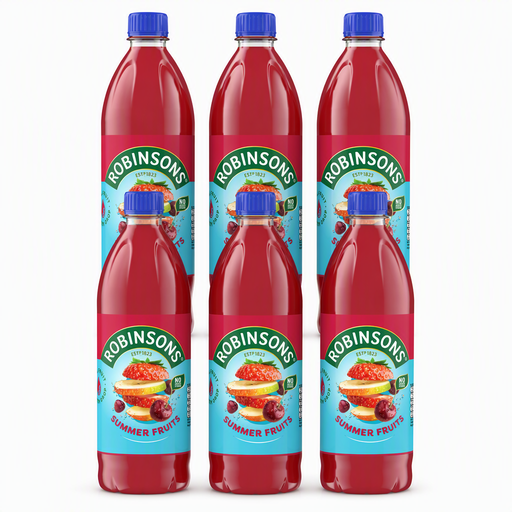
The six-bottle format may suit a household planning to keep squash in stock. Check the preparation instructions and serving size for each 1L bottle rather than treating the multipack volume as a serving guide.
 No image available
For an orange squash, read the instructions on this 1L bottle before comparing servings. Tesco Groceries' listing for this variant names sweeteners and sulphites, so check the current pack if either matters to your household.
 No image available
This single bottle offers the summer-fruits flavour without the six-bottle format. Check its own dilution directions, ingredients and allergen declaration; do not assume they match another size or flavour.
 No image available
Choose this flavour for consideration if you prefer a pineapple-and-passion-fruit squash in an 850ml bottle. Read the pack's dilution and ingredient information before comparing its servings or checking it against household ingredient requirements.
No. A no-added-sugar cordial can contain naturally occurring sugars from fruit ingredients. Robinsons describes these sugars in its no-added-sugar range, while Sainsbury's reports less than 0.5g sugars per diluted 250ml serving for its cited lime cordial. Check the nutrition panel and its dilution basis for the exact bottle.
Compare each bottle's stated dilution ratio and serving size before relying on its volume. Tesco Groceries states 100 servings at 1:19 dilution for its quadruple-strength lemon squash; Sainsbury's states 20 at 1:4 for its lime cordial. The two concentrates are prepared at different strengths.
Yes. The cited Tesco lemon squash lists sucralose and acesulfame K, while Sainsbury's lime cordial and the named Marks & Spencer High Juice products list sucralose. Check the ingredients on the bottle you choose rather than assuming every flavour uses the same formulation.
Read the ingredients and allergen declaration on the exact bottle. The cited Tesco lemon squash, Sainsbury's lime cordial and Marks & Spencer High Juice products list sodium metabisulphite or E223 as sulphites; another flavour or size needs its own label check.