Shoppers checking added sugar
If the words “no added sugar” matter for your TV dinner, check that claim on the specific pack. Read “of which sugars” per 100ml separately to see its total sugars figure.


Choose by the exact pack label, the sugars figure per 100ml and whether caffeine matters for your evening. A no-added-sugars claim concerns what was added to the drink; it does not replace the nutrition panel. If you want cola without caffeine, choose a variant explicitly labelled caffeine-free rather than assuming a zero-sugar cola has no caffeine.
If the words “no added sugar” matter for your TV dinner, check that claim on the specific pack. Read “of which sugars” per 100ml separately to see its total sugars figure.
Regular Coca-Cola Zero Sugar and Pepsi MAX list caffeine, while Pepsi MAX No Caffeine is labelled as a caffeine-free option. Check the exact variant when buying.
Lemon-lime, orange and cream-soda options give you different flavours. Compare the sugars figure and ingredients on the particular drink you choose rather than treating the flavours as interchangeable.
Start with the claim and nutrition panel, then check caffeine, ingredients and whether the pack size fits how you will use it.
| Priority | What to check | Your needs |
|---|---|---|
| Sugar wording | Check for the exact “no added sugar” claim if required, then compare “of which sugars” per 100ml. The Advertising Standards Authority and Committee of Advertising Practice explained in September 2025 that the Great Britain no-added-sugars claim concerns added sugars and other foods used for sweetening. | I want to know both what the pack claims and how much total sugar its nutrition panel lists. |
| Caffeine | Read the variant name and ingredient list. Pepsi UK labels Pepsi MAX No Caffeine as containing no caffeine; its regular Pepsi MAX lists caffeine. | For a dinner close to bedtime, I would rather choose a drink explicitly labelled caffeine-free than infer it from “zero sugar”. |
| Ingredients | Compare sweeteners and any phenylalanine-source statement on the exact pack. Formulas can differ between drinks and variants. | If I need to avoid an ingredient, the label on the drink I am buying matters more than the brand name alone. |
| Pack size | Check the number and size of cans, or the bottle volume and instructions after opening. Tesco says its 2L No Added Sugar Cream Soda should be consumed within three days of opening. | A can pack may fit occasional dinners; a large bottle makes more sense if we will share it or use it within the stated period. |
The claim and the total-sugars figure answer different questions. The Joybuy listing for Fanta Orange Zero Sugar, for example, lists 0.4g sugars per 100ml.
Read the front-of-pack wording alongside “of which sugars” per 100ml on the nutrition panel.
Coca-Cola GB lists caffeine flavouring in Coca-Cola Zero Sugar, and Pepsi UK lists caffeine in regular Pepsi MAX. NHS Borders advises that caffeinated drinks can disrupt sleep.
If caffeine avoidance matters for a late dinner, look for an explicitly caffeine-free variant.
The drinks listed by Tesco, Coca-Cola GB and Pepsi UK use different sweeteners; some also carry a phenylalanine-source statement. Recipes can change.
Check the ingredients and on-pack statements when changing flavour, variant or pack format.
Tesco instructs shoppers to consume its 2L No Added Sugar Cream Soda within three days of opening.
Consider cans or a smaller format if you are unlikely to use a large bottle within its stated period.
These examples illustrate differences between named drinks and variants; check the pack you buy for its current formulation.
Coca-Cola Zero Sugar is a cola option for shoppers comparing zero-sugar drinks.
Pepsi MAX and Pepsi MAX No Caffeine offer a choice between regular and explicitly caffeine-free zero-sugar cola variants.
Sprite Zero is a lemon-lime option for shoppers who would rather not have cola.
Fanta Orange Zero Sugar provides an orange-flavoured alternative to cola.
Tesco No Added Sugar Cream Soda is a vanilla-flavoured drink in a 2L bottle for sharing or repeat servings.
These can packs cover caffeine-free cola, lemon-lime, regular zero-sugar cola and an apple-flavoured option for a TV dinner. If the exact words “no added sugar” are essential, check the pack claim separately from its sugars figure.
 No image available
A cola option when you want to avoid caffeine with an evening meal. The product information lists 0g sugars per 100ml and a 24-can pack; check the current pack for its sweeteners, phenylalanine-source statement and exact sugar-claim wording.
 No image available
For cola flavour when avoiding caffeine at dinner, this variant is described as caffeine-free. Its product information lists 0g sugars per 100ml and 24 cans; check the pack for sweeteners, the phenylalanine-source statement and any required no-added-sugar wording.
 No image available
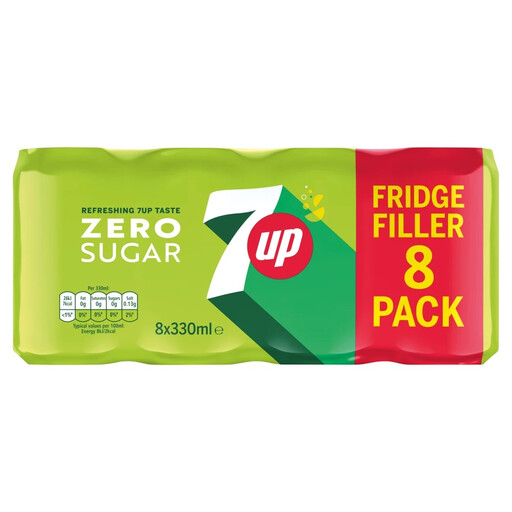
A lemon-lime alternative to cola for an evening meal. Its product information describes it as caffeine-free, lists 0g sugars per 100ml and specifies eight cans; check the pack for its sweeteners, phenylalanine-source statement and exact claim wording.
 No image available
A cola option if caffeine is acceptable with dinner. Its product information lists 0g sugars per 100ml and a 24-can pack, but identifies caffeine; check the current ingredients and the pack wording if a specific no-added-sugar claim matters.
 No image available
An apple-flavoured option for several servings. Its product information lists 0g sugars per 100ml and 24 cans; if avoiding caffeine matters for a late dinner, confirm the status on the exact pack. Check its ingredients and claim wording too.
No. The Advertising Standards Authority and Committee of Advertising Practice explained in September 2025 that, in Great Britain, the no-added-sugars claim concerns whether sugars or other foods used for sweetening were added. Read “of which sugars” per 100ml on the exact drink to find its total-sugars figure.
If you also want to avoid caffeine, choose an explicitly caffeine-free variant such as Pepsi MAX No Caffeine. Pepsi UK lists caffeine in regular Pepsi MAX, and Coca-Cola GB lists caffeine flavouring in Coca-Cola Zero Sugar; NHS Borders advises that caffeine can disrupt sleep.
Yes. Sweeteners and on-pack statements differ between drinks, and some of the named variants carry a phenylalanine-source statement. Read the ingredients and warnings on the specific pack if you need to avoid an ingredient.
Choose a large bottle if its volume and after-opening instructions fit your plans. Tesco says its 2L No Added Sugar Cream Soda should be consumed within three days of opening; check the instructions on any other bottle separately.