Cola drinkers cutting out sugar
If you want a familiar cola flavour, compare the sugar value on the exact variant and check whether its caffeine and sweeteners suit your preferences.


For a weekend breakfast, choose the flavour you want after checking the exact drink’s ‘of which sugars’ value per 100ml: a no-added-sugar claim alone does not establish 0g sugars. Coca-Cola Zero Sugar and Pepsi Max list caffeine flavouring and aspartame, so check their ingredients if either matters to you. Wirral Community Health and Care NHS Foundation Trust also cautions that sugar-free fizzy drinks can be acidic and contribute to tooth wear.
If you want a familiar cola flavour, compare the sugar value on the exact variant and check whether its caffeine and sweeteners suit your preferences.
A weekend breakfast may call for more than cola. Lemon-lime, fruit-flavoured and cream-soda options give people different flavours to choose from; check each drink’s label separately.
Cutting out sugar does not make a fizzy drink tooth-neutral. Wirral Community Health and Care NHS Foundation Trust notes that sugar-free and no-added-sugar soft drinks can still be acidic.
Start with the exact variant and its label, then narrow the choice by flavour, ingredients and the amount you expect to serve.
| Priority | What to check | Your needs |
|---|---|---|
| Sugar value | Read ‘of which sugars’ per 100ml on the exact variant; do not treat ‘no added sugar’ as another way of saying 0g sugars. Check the ingredients as well as the front-of-pack wording. | I want a breakfast drink whose current label shows 0g sugars per 100ml, rather than assuming every no-added-sugar drink does. |
| Flavour and pack | Choose the flavour on the exact pack, then compare individual cans with a larger bottle for the number of people drinking it. Follow the bottle’s instructions after opening. | For a shared breakfast, I want a flavour people will drink and a pack size we can use while it is fresh. |
| Caffeine and sweeteners | Read the ingredients and any phenylalanine statement. Coca-Cola GB and Pepsi UK list caffeine flavouring and aspartame for Coca-Cola Zero Sugar and Pepsi Max respectively; ‘zero sugar’ does not mean caffeine-free. | If I want to avoid caffeine or need to check a phenylalanine declaration, the precise ingredients matter more than the sugar claim. |
| When you drink it | Consider having a fizzy drink with breakfast rather than sipping it between meals. Wirral Community Health and Care NHS Foundation Trust warns that sugar-free fizzy drinks can be acidic and contribute to tooth wear. | I may choose a fizzy drink with breakfast, but I do not want to treat it as equivalent to plain water between meals. |
Variants from the same brand can differ. Pepsi UK lists 4.5g sugars per 100ml for Pepsi Classic and 0g per 100ml for Pepsi Max.
Check the full variant name and the current ‘of which sugars’ figure per 100ml before choosing.
Coca-Cola GB and Pepsi UK list caffeine flavouring in Coca-Cola Zero Sugar and Pepsi Max. Their sugar claims do not answer a caffeine-avoidance question.
If caffeine avoidance matters, look for an explicitly caffeine-free option and check the ingredients on its exact pack.
Wirral Community Health and Care NHS Foundation Trust says sugar-free, no-added-sugar and diet fizzy drinks can be acidic and contribute to tooth wear.
Have a fizzy drink with a meal rather than sipping it between meals; choose water or plain milk as a routine between-meal drink.
A bottle may not fit the occasion if only a little will be served and the rest must be stored after opening.
Compare the servings you expect to use with the pack instructions. Tesco states that its 2L No Added Sugar Cream Soda should be consumed within 3 days of opening.
Coca-Cola Zero Sugar is a cola option for someone choosing a no-sugar variant of the brand.
Pepsi Max is Pepsi’s zero-sugar cola variant; check the name rather than assuming every Pepsi cola has the same sugar value.
Sprite Zero Sugar offers a non-cola route when lemon-lime flavour is the preference.
For a fruit-flavoured alternative to cola, check the full name of the Fanta variant you are considering.
Dr Pepper Zero is another non-cola flavour to consider for a breakfast selection.
Tesco’s own-label range includes flavours beyond cola, including No Added Sugar Cream Soda.
These cola, lemon-lime, lemonade and apple-flavoured cans offer different routes for a weekend breakfast. Check the exact pack’s nutrition and ingredients before choosing.
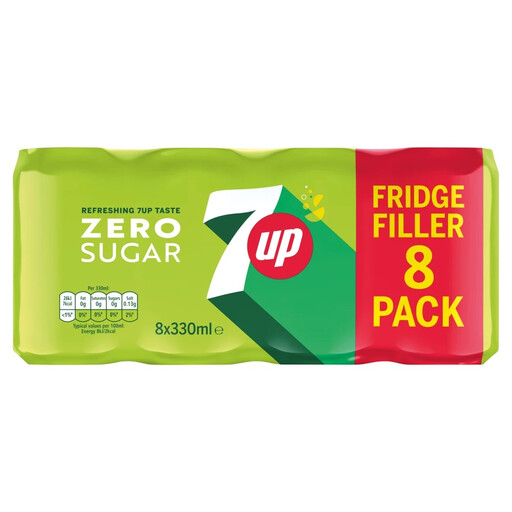 Image unavailable
A lemon-lime alternative to breakfast cola in individual cans. Check the pack’s sugar value, ingredients and any phenylalanine statement if these affect your choice.
 Image unavailable
A cola choice in a 24-can pack. Pepsi UK lists 0g sugars per 100ml for Pepsi Max; its ingredients include caffeine flavouring and aspartame, and its label carries a phenylalanine statement.
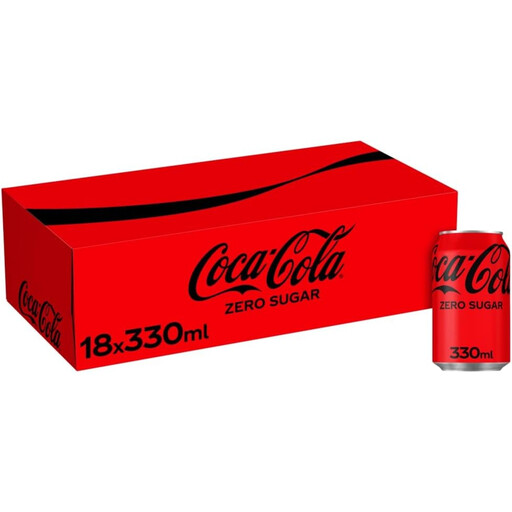 Image unavailable
A cola option in an 18-can pack. Coca-Cola GB lists 0g sugars per 100ml for Coca-Cola Zero Sugar; its ingredients include caffeine flavouring and aspartame, with a phenylalanine statement.
 Image unavailable
A non-cola lemonade option in individual cans. Check the pack for the precise lemonade flavour, as well as its sugar value, ingredients and any phenylalanine statement.
 Image unavailable
An apple-flavoured, non-cola choice in individual cans. Check the exact pack’s sugar value and ingredients, including caffeine status if you need to avoid it.
No. Read ‘of which sugars’ on the exact drink’s nutrition panel. Tesco lists its No Added Sugar Cream Soda with 0g sugars per 100ml, but that figure should not be assumed for every drink carrying a no-added-sugar claim.
No: Coca-Cola GB and Pepsi UK list caffeine flavouring for these products. If you want to avoid caffeine at breakfast, choose a drink explicitly labelled caffeine-free and check its ingredients.
Coca-Cola GB and Pepsi UK list aspartame in Coca-Cola Zero Sugar and Pepsi Max, and both product pages state that the drinks contain a source of phenylalanine. Check the exact pack if you need to avoid phenylalanine.
No. Wirral Community Health and Care NHS Foundation Trust says sugar-free and no-added-sugar fizzy drinks can still be acidic and contribute to tooth wear. Consider having them with a meal rather than sipping them between meals.