Snack shoppers watching added sugar
If you want a fizzy drink alongside an afternoon snack, compare the precise claim, ingredients and total sugars per 100ml. A no-added-sugar drink can still contain sugars from fruit ingredients.


For a familiar lemonade flavour, compare classic lemon drinks and check both the claim on the pack and the sugars per 100ml. Pink lemonade offers a lemon-and-raspberry option, while lemon-lime zero-sugar drinks suit a different flavour preference; neither “diet” nor “zero sugar” alone confirms the exact “no added sugar” wording. Sweeteners vary between products, and Northumbria Healthcare NHS Foundation Trust notes that sugar-free fizzy drinks remain acidic.
If you want a fizzy drink alongside an afternoon snack, compare the precise claim, ingredients and total sugars per 100ml. A no-added-sugar drink can still contain sugars from fruit ingredients.
If you prefer a plain lemon flavour, start with classic lemonade rather than assuming pink lemonade or a lemon-lime drink will taste the same. Check the sweeteners too: the listed formulations differ.
If aspartame, sulphites or another ingredient matters to you, read the current pack rather than relying on the flavour name. Tesco’s listed pink lemonade contains sulphites, while the listed R.White’s Diet Lemonade and Sprite Zero formulations contain aspartame.
Choose the flavour style first, then compare the pack claim, nutrition panel and ingredients within that style.
Consider it when: You want a traditional lemon flavour rather than a mixed-fruit or lemon-lime drink.
Bear in mind: Classic diet lemonades use different sweeteners, and “diet” is not the same wording as “no added sugar”.
Consider it when: Lemon-and-raspberry flavour appeals more than plain lemon with your snack.
Bear in mind: Tesco’s no-added-sugar pink lemonade contains fruit ingredients, declares 0.3g sugars per 100ml and lists sulphites.
Consider it when: You are happy to choose lemon-lime instead of conventional lemonade.
Bear in mind: A zero-sugar name does not by itself confirm that the current pack carries a “no added sugar” claim.
| Priority | What to check | Your needs |
|---|---|---|
| Claim and sugars | Read the exact pack wording, ingredients and total sugars per 100ml together. “No added sugar” does not mean 0g total sugars. | I want to avoid choosing a conventional sugary lemonade by mistake, without assuming that every no-added-sugar drink has zero total sugars. |
| Sweeteners and other ingredients | Check the named sweeteners and any phenylalanine or allergen statement on the current pack. Formulations vary between drinks. | If aspartame or sulphites matter to me, I need to check the particular bottle or can I am buying. |
| Flavour | Distinguish plain lemon from lemon-and-raspberry and lemon-lime. Check the flavour description rather than relying on a zero-sugar name. | For an afternoon snack, I would rather pick a flavour I want than treat these three styles as interchangeable. |
| Fizzy-drink use | Consider when you will drink it. Northumbria Healthcare NHS Foundation Trust notes that sugar-free fizz is still acidic and can contribute to tooth erosion. | I want a fizzy drink with a snack, not something to sip repeatedly throughout the day in place of water. |
A no-added-sugar drink can still declare total sugars. Tesco’s No Added Sugar Pink Lemonade, for example, lists 0.3g sugars per 100ml on its product page.
Check the exact wording alongside the ingredients and per-100ml nutrition panel; do not infer 0g sugars from “no added sugar”.
The listed R.White’s Diet Lemonade and Sprite Zero formulations contain aspartame, while Tesco’s No Added Sugar Pink Lemonade lists sulphites. They are not interchangeable for an ingredient-specific choice.
Read the current physical pack for sweeteners, allergen information and any phenylalanine statement, particularly if phenylketonuria (PKU) is relevant.
Northumbria Healthcare NHS Foundation Trust notes that sugar-free fizzy drinks remain acidic and can contribute to tooth erosion with frequent exposure.
If you choose one with an afternoon snack, avoid repeatedly sipping it between meals; choose water when you simply want a routine drink.
Joybuy’s listing for R.White’s Lemonade 24 × 330ml describes it as having no added sugar but also lists sugar as an ingredient and 2.4g sugars per 100ml. That listing should not be confused with R.White’s Diet Lemonade.
When a claim, ingredient list and nutrition panel disagree, check the physical pack or choose a product whose details are consistent.
These examples describe particular listed drinks, not every product made by each brand.
Tesco lists R.White’s Diet Lemonade as a carbonated, low-calorie lemon-flavour drink with sweeteners.
Tesco No Added Sugar Pink Lemonade is a lemon-and-raspberry option rather than a plain-lemon drink.
Sainsbury’s Diet Lemonade is a classic lemon-flavour option listed in a 2L bottle.
M&S Diet Lemonade is a classic lemon option whose Ocado listing explicitly states “no added sugar”.
Coca-Cola Great Britain describes Sprite Zero as a lemon-and-lime drink, not a traditional plain-lemon lemonade.
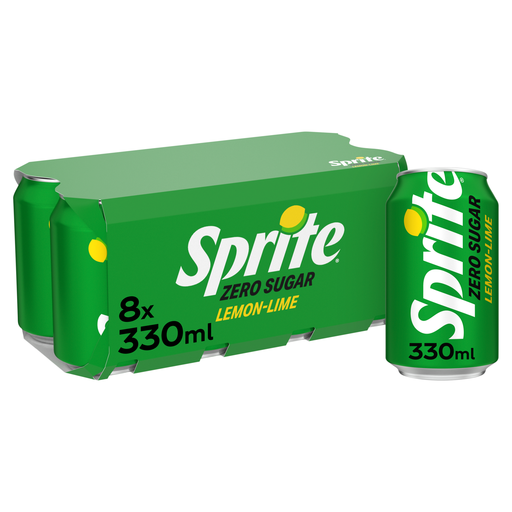
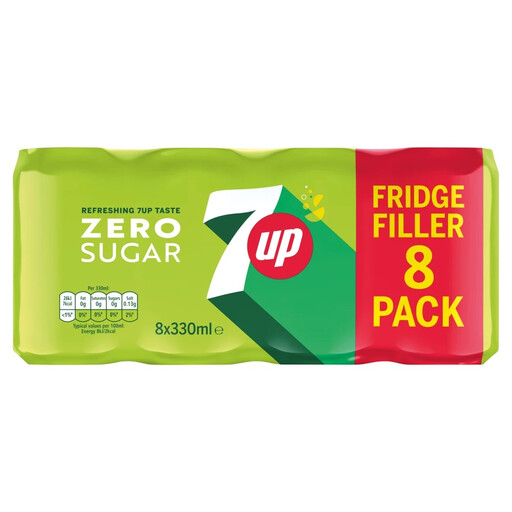
These 8 × 330ml multipacks are lemon-lime alternatives for an afternoon snack, rather than the classic or pink lemonade styles above. If the precise “no added sugar” claim matters to you, check the wording and ingredients on the current pack.
 No image available
Consider this multipack if a lemon-lime drink appeals more than plain lemonade with your snack. Check the current pack for its exact sugar claim, sweeteners and phenylalanine statement if those details affect your choice.
 No image available
This multipack is another option if you are considering lemon-lime rather than classic lemonade. Read the current pack to confirm the precise sugar claim and ingredients, particularly if you need to check for aspartame or a phenylalanine statement.
No. The claim concerns added sugars or foods used for sweetening, while the nutrition panel reports total sugars. Tesco No Added Sugar Pink Lemonade declares 0.3g sugars per 100ml; check both the claim and the per-100ml figure when comparing drinks.
NHS advice includes sugar-free, diet and no-added-sugar drinks among alternatives to sugary fizzy drinks when reducing sugar. They are not equivalent to water for frequent sipping: Northumbria Healthcare NHS Foundation Trust notes that sugar-free fizz remains acidic and can contribute to tooth erosion.
Check the current pack for aspartame and a statement that it contains a source of phenylalanine. The listed R.White’s Diet Lemonade and Sprite Zero formulations contain aspartame; do not assume another flavour, pack size or recipe has the same ingredients.
NHS guidance does not recommend diet or reduced-sugar drinks for babies and young children. It also says fizzy drinks are acidic and can damage tooth enamel.
Follow the directions on the bottle you buy. Sainsbury’s listing for its 2L Diet Lemonade says to refrigerate it after opening and use it within three days; directions for other products should be checked separately.