Shoppers avoiding added sugar but not oats
Choose plain porridge carefully when you want no added sweeteners, and distinguish naturally occurring sugars from a sugar-free claim. UK sugar-free rules are set out in Regulation (EC) No 1924/2006.


Start with the allergen that must be avoided: plain oats can reduce extra ingredients and added sweeteners, but they are not suitable for an oat allergy, and ordinary oats may not suit a gluten-free diet because of cereal cross-contamination. If gluten control is required and oats are tolerated, choose oats labelled gluten free; for milk, nuts, wheat, barley or soya, check the current pack’s ingredients and precautionary wording for the exact product. No added sugar is not the same as a legal sugar-free claim.
Choose plain porridge carefully when you want no added sweeteners, and distinguish naturally occurring sugars from a sugar-free claim. UK sugar-free rules are set out in Regulation (EC) No 1924/2006.
If you can tolerate oats but need to avoid gluten contamination, select oats labelled gluten free rather than relying on terms such as 100% oats, pure or organic. Coeliac UK notes that standard oats can be contaminated with other gluten-containing cereals.
Screen each current pack for the relevant allergen and any precautionary statement. Oat products are unsuitable for an oat allergy, while other allergen risks vary between products and formats.
Choose this when: You do not need gluten-free certification and the current allergen information fits the allergy being managed.
Key trade-off: A short ingredient list does not rule out oats themselves or product-specific precautionary allergen wording.
Choose this when: Gluten contamination must be avoided and oats are tolerated.
Key trade-off: Gluten-free status does not make an oat product appropriate for an oat allergy.
Choose this when: Fast preparation matters and the exact sachet’s allergen statement is acceptable.
Key trade-off: Flavoured and fortified sachets can have different ingredients, sugars and precautionary statements.
| Priority | What to check | Your needs |
|---|---|---|
| Exact allergy compatibility | Read the full ingredients list, highlighted allergens and any current may-contain wording. Check oats themselves against the allergy being managed. | I need to avoid a named allergen and cannot assume a plain-oat, organic or no-added-sugar description makes a product suitable. |
| Gluten control | Look for an explicit gluten-free label when gluten contamination must be avoided. Do not treat ordinary 100% oats as an equivalent substitute. | I can eat oats but need a product intended to control contamination from wheat, barley or rye. |
| Sugar wording | Compare sugars per 100g and read the ingredients. A sugar-free claim requires no more than 0.5g sugars per 100g or 100ml under Regulation (EC) No 1924/2006. | I want to avoid added sweeteners, while recognising that plain oats can still contain naturally occurring sugars. |
| Preparation and format | Check whether the product is prepared with water or milk, then assess sachets, pots and toppings separately for relevant allergens. | Quick breakfasts matter to me, but I want to keep control over the liquid and toppings I add. |
A strict sugar-free choice can be missed if these claims are treated as interchangeable. Regulation (EC) No 1924/2006 sets the sugar-free threshold at no more than 0.5g sugars per 100g or 100ml, while cited plain oats contain 0.9g to 1.1g sugars per 100g.
Read the sugars value per 100g alongside the ingredients list. Use no added sugar to identify the absence of added sweeteners, not as proof of a sugar-free claim.
Gluten-free oats are still oats, so they are not appropriate for an oat allergy. Coeliac UK also notes that a small number of people with coeliac disease remain sensitive to gluten-free oats.
Identify whether the issue is an oat allergy, coeliac disease or another allergen before choosing a gluten-free product.
Simple oat ingredients do not remove product-specific precautionary wording. For example, cited Quaker Original sachets may contain wheat, barley and soya, while Waitrose Original Instant Porridge Oats may contain milk and nuts.
Check the exact pack’s ingredients, highlighted allergens and precautionary statement every time. Do not transfer an assumption between brands, formats or flavours.
Flavoured or fortified versions can add sugar, milk protein, seeds or other ingredients. Quaker Sweet Cinnamon includes sugar, and Flahavan’s High Protein Porridge Pot includes sugar and milk protein.
Re-check sachets, pots, seed blends and flavoured versions individually rather than using a plain-oat product as a proxy.
Relevant for shoppers seeking gluten-free porridge oats as well as standard oat products.
Relevant for plain rolled oats and original sachets with no-added-sugar positioning.
Relevant for own-label plain Scottish oats and instant plain-oat sachets with retailer ingredient and allergen information.
Relevant for plain wholegrain rolled oats and for showing why variants within one oat brand need separate checks.
Relevant for organic porridge oats, particularly when assessing cross-contact information alongside simple ingredients.
Joybuy product options for plain, instant and gluten-free porridge oats where oats are tolerated. Check the current pack against the specific allergy requirement before eating.
 No image available
For gluten-contamination control where oats are tolerated.
Listed as 100% gluten-free oat flakes and wheat free, with 1.1g sugars per 100g. Contains oats and is not suitable for an oat allergy; check the physical pack for precautionary allergen information.
 No image available
For quick plain-oat breakfasts when preparation ingredients can be controlled.
Listed as wholegrain rolled oats in individual sachets, with microwave preparation in 2½ minutes and 1.0g sugars per 100g. Contains oats; check the current pack for precautionary allergen wording and assess milk or toppings separately.
 No image available
For shoppers who can tolerate oats and want to choose their own preparation and toppings.
Listed as 100% organic wholegrain oat flakes with 0.9g sugars per 100g. Contains oats and is not labelled gluten free in the product information; check the physical pack for precautionary allergen information.
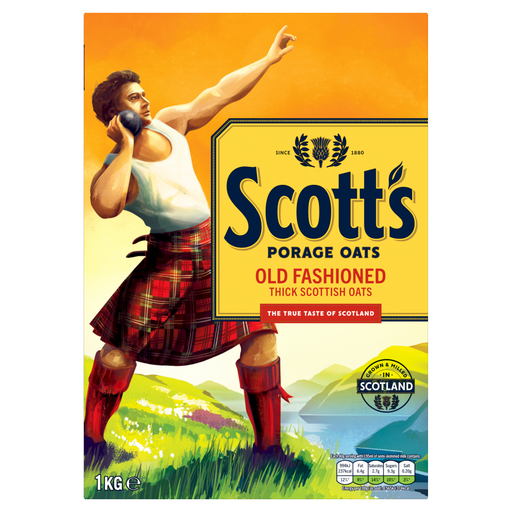 No image available
For plain cooked porridge with water or milk preparation options.
Listed as 100% rolled oats with 1.1g sugars per 100g and stove or microwave directions. Contains oats and may contain wheat and barley, so it does not fit wheat, barley or gluten-contamination avoidance.
Not necessarily. Under UK nutrition-claim rules, a food described as sugar free must contain no more than 0.5g sugars per 100g or 100ml. Plain oats can have no added sugar while still containing naturally occurring sugars: cited Waitrose Scottish Porridge Oats contains 0.9g per 100g and Mornflake Gluten Free Porridge Oats contains 1.0g per 100g.
No. Gluten-free status addresses gluten contamination; it does not remove oats from the product. Food Standards Agency guidance lists oats among cereals containing gluten that must be declared as allergens, and gluten-free oat products still contain oats.
Do not assume so. Coeliac UK says standard oats can be contaminated with wheat, barley and rye, so wording such as 100% oats, pure oats or organic does not confirm gluten-free suitability. Choose oats labelled gluten free when this certification is required.
Use an online listing for initial screening, then check the physical pack before eating. Waitrose states that recipes can change and this may affect nutrition and allergen information; where a precautionary statement is unclear, contact the manufacturer or retailer before consumption.
Yes, where the product instructions allow it. Waitrose Scottish Porridge Oats gives both water and milk preparation options, but using water does not resolve allergens in the oats or any stated may-contain warning, and toppings need checking separately.