
24/7 Customer Support

Free returns

Same-day & Next-day Delivery

Quality Guaranteed

Unlock Your Welcome Offers: FREE Delivery | Up to 80% OFF | Free 30-day JoyPlus trial
Download the APP
Choosing no added sugar squash can help UK households reduce reliance on full-sugar soft drinks while keeping water appealing for meals, packed lunches and family occasions. However, labels such as “no added sugar”, “real fruit juice” and “low calorie” do not tell the whole story.
The product still needs to suit your household’s preferred flavour, dilution strength, storage routine and ingredient requirements. Below, Joybuy’s Product Recommendation Officer highlights the main buying traps and the product details worth checking before ordering.
“No added sugar” means that manufacturers have not added sugar during production. A drink may still contain naturally occurring sugars from fruit juice or concentrate. Check the nutrition table per 100ml, and confirm whether the figures refer to the drink as sold or diluted.
Some products use sweeteners such as aspartame, acesulfame K, saccharin or sucralose to provide sweetness with relatively little energy. This may suit shoppers looking for a low calorie squash, but it is not suitable for everyone. Products containing aspartame provide a source of phenylalanine and should be checked carefully by people with phenylketonuria.
A 1L bottle is not necessarily equivalent to another 1L bottle. Concentration instructions vary, and taste preferences affect how much water each household adds. A smaller bottle may offer good value if it is strongly concentrated, while a multipack may be more practical for regular use.
Compare the recommended dilution ratio, the number of bottles in a pack and the volume of finished drink you expect to make. This is particularly important when buying squash multipacks for a large family.
Fruit cordial and concentrated fruit drinks can contain sulphites, preservatives and sweeteners. These ingredients are clearly listed on the packaging, but they can be missed when shoppers focus only on flavour claims.
After opening, many bottles need refrigeration and should be consumed within a stated period. Some products also advise extra dilution for toddlers or are not suitable for very young children. Always check the latest label before serving, as formulations and guidance can change.
Nutrition panels are only useful when you compare like with like. Robinsons No Added Sugar Squash Real Fruit Lemon Juice, for example, lists 2 kcal per 100ml diluted and 5 kcal per 250ml diluted serving in the supplied product information. Robinsons Orange lists 1 kcal per 100ml diluted and 3 kcal per 250ml diluted.
Ribena Pineapple and Passion Fruit Squash lists 2 kcal per 100ml undiluted, with 0.2g of sugars per 100ml. These figures are presented differently, so avoid comparing them without checking the serving basis.
“Real fruit juice squash” can contain different proportions of fruit juice from concentrate. Robinsons lemon contains 10% lemon juice from concentrate, while Ribena Pineapple and Passion Fruit Squash contains 10% fruit juices, comprising 9% pineapple and 1% passion fruit.
For a sharper drink, consider lemon squash. Orange squash offers a softer citrus flavour, while summer fruits squash usually combines fruit such as apple, strawberry, raspberry and cherry. Blackcurrant squash tends to provide a deeper berry taste, whereas pineapple and passion fruit squash has a tropical profile.
Check whether the drink contains:
The following selections match different household needs rather than claiming one product suits everyone.

Why This Fits Their Persona: A familiar 1L format suits households trying no added sugar squash for the first time, with orange flavour that works at family meals and school breaks.
The nutrition information specifies 1 kcal per 100ml diluted and 3 kcal per 250ml diluted serving, making comparison with full-sugar drinks more straightforward.
10% orange fruit from concentrate; suitable for vegan and vegetarian diets according to the supplied product information.

Why This Fits Their Persona: A choice for shoppers who prioritise a clearly stated fruit source and a sharp citrus taste for serving chilled or with meals.
Its listing identifies 10% lemon juice from concentrate and provides diluted nutrition figures, rather than relying only on a front-of-pack flavour description.
Contains 10% lemon juice from concentrate; 2 kcal per 100ml diluted in the supplied nutrition information.
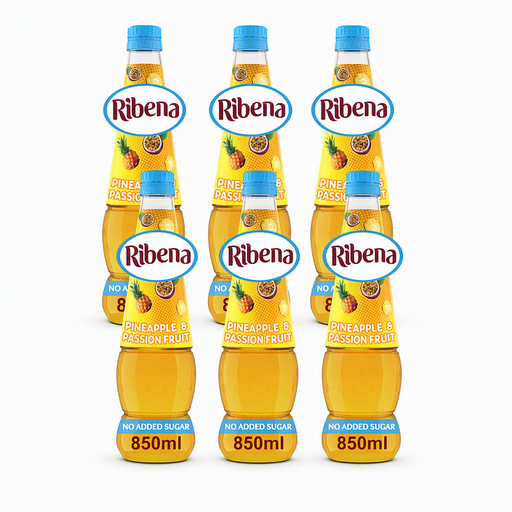
Why This Fits Their Persona: The six-bottle format is practical for households that regularly serve squash at family meals, picnics or summer gatherings.
The multipack makes the total quantity clear, while the label states the fruit juice percentage and storage period after opening.
Six 850ml bottles; 10% pineapple and passion fruit juices from concentrate; contains vitamin C according to the supplied listing.
For everyday family drinks, a standard 1L bottle gives you flexibility without committing to a large quantity. If your household has a consistent favourite, a 6 x 1L multipack can reduce the need for frequent reordering.
For packed lunches and on-the-go use, ready-to-drink cartons or bottles may be more convenient than carrying a large bottle and separate water. Ribena Strawberry No Added Sugar Cartons come as 24 x 250ml, while the Ribena Pineapple and Passion Fruit Juice Drink is available in 12 x 500ml bottles.
Shoppers wanting a darker berry flavour can consider Ribena Conc Blackcurrant No Added Sugar 1.5L. Its supplied instructions state a dilution of one part squash to at least four parts water. It should not be consumed undiluted, and the label includes sweetener and age guidance.
We have compiled a complete, real-time list of products that fully satisfy these strict selection criteria and UK safety regulations.
No. “No added sugar” means sugar has not been added to the recipe. Fruit juice or concentrate may contribute naturally occurring sugars. Some products may contain very little sugar, but you should check the nutrition panel and whether the figures are for diluted or undiluted drink.
Follow the instructions on the bottle and adjust to taste without serving the concentrate undiluted. Some concentrated products specify one part squash to at least four parts water. Extra dilution may be advised for toddlers, but always follow the product’s age and serving guidance.
It depends on the item price, bottle volume and dilution ratio. To compare cost, calculate the price per bottle and then consider the approximate volume of finished drink. A multipack can be more convenient for frequent family use, but individual bottles may be preferable if you are still deciding between lemon, orange, summer fruits or blackcurrant flavours.