Students stocking their first kitchen
If you are choosing a flavour for yourself, a single bottle lets you check the prepared-serving label and see how quickly you use it before buying more.


For a student moving in, compare sugars and energy in the diluted drink, then choose a bottle size you expect to use: ‘no added sugar’ does not mean sugar-free or sweetener-free. A higher-juice squash may appeal if fruit content matters more to you, but check its prepared-serving figures against other options, along with the dilution and after-opening instructions.
If you are choosing a flavour for yourself, a single bottle lets you check the prepared-serving label and see how quickly you use it before buying more.
If several people will use the bottle, compare its stated servings and dilution instructions, not just its size. Waitrose & Partners lists 60 servings for its Essential Apple & Blackcurrant bottle.
If sugar content is driving the choice, read the figures for the squash after dilution and check which sweeteners it contains. The NHS describes approved sweeteners as an alternative to sugar; that does not make every squash nutritionally alike.
Start with the drink as prepared, then consider how many servings the bottle makes and whether you can use it within the stated storage period.
| Priority | What to check | When it matters to me |
|---|---|---|
| Sugars in the drink | Compare ‘of which sugars’ and energy per prepared serving, using the same serving size. Check the dilution instructions behind those figures. | I want to know what is in the glass, rather than decide from ‘no added sugar’ on the front of the bottle. Sainsbury's lists 2.4g sugars and 17 kcal per 250ml for its High Juice Orange; Waitrose & Partners lists negligible sugars and 3 kcal per 250ml for Robinsons Orange. |
| Servings and storage | Read the labelled serving count, dilution ratio and after-opening instructions together. Compare current shelf prices only against the prepared drinks you expect to use. | For a shared flat, a bottle with more stated servings may be convenient. If I am trying a flavour alone, I would rather check how long it keeps once opened before choosing a larger pack. |
| Fruit content | Check the fruit-juice percentage and the sugars and energy per diluted serving; a higher juice percentage does not determine those serving figures. | I may prefer more fruit juice, but I do not want to assume that it means less sugar. Sainsbury's lists 50% fruit juice for its High Juice Orange and 2.4g sugars per prepared 250ml serving. |
| Ingredients | Read the current sweetener and allergen declarations for the exact flavour. Check any dietary statement on that bottle rather than applying it to the whole range. | If an ingredient affects what I can drink, I need to check each bottle. The NHS says aspartame is unsuitable for people with phenylketonuria (PKU); some of the squash products described here contain sulphites. |
Fruit-derived sugars can remain in the drink, and a no-added-sugar squash can contain sweeteners. The figures that matter for a glass are those for the squash after dilution.
Compare ‘of which sugars’, energy and ingredients on the same prepared-serving basis.
Concentration changes how many drinks a bottle makes. Waitrose & Partners lists 60 servings and a suggested 1:9 dilution for its Essential Apple & Blackcurrant bottle; its Robinsons Orange listing gives 20 servings and a 1:4 dilution.
Check the stated servings and mixing instructions alongside the current shelf price.
Sweeteners and sulphite declarations differ between the cited products. The NHS says aspartame is unsuitable for people with PKU.
If you have PKU, an allergy or an intolerance, read the ingredients and allergen declaration on the exact bottle each time.
The cited Robinsons Orange bottle advises consuming it within four weeks of opening. That matters if only one person will drink it or a shared kitchen uses squash irregularly.
Start with a flavour and pack size you expect to use, and follow its own storage instructions.
An opened bottle left unfinished adds waste to a small kitchen.
Robinsons offers no-added-sugar squash in standard bottles and more concentrated formats. Check the exact variant rather than applying one flavour's label to the range.
Tesco Groceries lists own-label no-added-sugar quadruple-strength squash, including 750ml and 1.5L formats.
Sainsbury's lists own-label no-added-sugar squash, including a High Juice Orange option.
M&S Food lists no-added-sugar squash options with differing fruit percentages and flavours.
The Waitrose Essential range includes a no-added-sugar Apple & Blackcurrant bottle suited to comparing yield for regular or shared use.
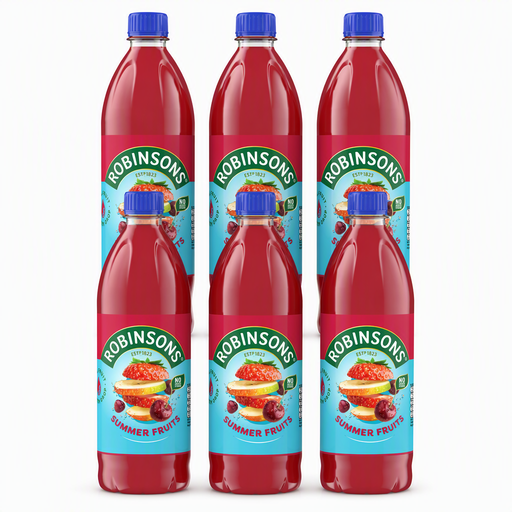
These options include individual bottles in several fruit flavours and a six-bottle Summer Fruits pack. For a first kitchen, compare the pack size and current bottle label before deciding how much to buy.
 No image available
A single bottle to consider when trying an orange flavour in your own kitchen. The matching Robinsons Orange product information lists 20 servings at 1:4 dilution and 3 kcal per diluted 250ml glass. Check the sweeteners, sulphites and four-week after-opening instruction on the current bottle.
 No image available
A single-bottle lemon option if you do not want to start with a multipack. Check the bottle's dilution and serving count when comparing yield. Its listed ingredients include aspartame and a phenylalanine warning, which matters for people with PKU.
 No image available
A six-bottle pack to consider if several flatmates expect to use the same flavour. Check the current bottles for dilution, prepared-serving nutrition and after-opening instructions before comparing it with single bottles. The listed ingredient information includes aspartame and sulphites.
 No image available
An 850ml tropical-fruit flavour to compare with the larger Robinsons bottles. Check the current bottle for the dilution ratio and nutrition of the prepared drink; the listing gives conflicting energy information. Its listed ingredients include aspartame and sulphites.
 No image available
A single Summer Fruits bottle if a six-bottle pack would be too much for your kitchen. Read the current label for the dilution ratio and prepared-serving figures before comparing it with other flavours; the listed energy figures have different, unclear bases. The listed ingredients include sulphites.
No. Fruit can contribute naturally occurring sugars to a squash with no added sugar, and the drink may contain sweeteners. Compare sugars per diluted serving: Sainsbury's lists 2.4g per 250ml for High Juice Orange, while Waitrose & Partners lists negligible sugars per 250ml for Robinsons Orange.
Read the ingredients and allergen declaration on the exact bottle before drinking it. The NHS says aspartame is unsuitable for people with phenylketonuria (PKU), and some of the squash products described here contain sulphites; recipes can differ by flavour.
Compare each bottle's stated servings at its own dilution ratio, then check whether you expect to use it within its storage period. Waitrose & Partners lists 60 servings at a suggested 1:9 dilution for Essential Apple & Blackcurrant, compared with 20 servings at 1:4 for Robinsons Orange.
Not necessarily. Compare the prepared-serving labels: Sainsbury's High Juice Orange lists 50% fruit juice and 2.4g sugars per diluted 250ml serving, while Waitrose & Partners lists negligible sugars for a diluted 250ml serving of Robinsons Orange. Choose on the figures and flavour that matter to you, rather than fruit percentage alone.
Use the listing to narrow your choices, then read the current bottle before consumption. Waitrose & Partners and M&S advise checking the product label because product information or recipes can change.