Cyclists who want cola flavour without sugar
A no-sugar cola may suit your taste preference around an easy ride or afterwards. It is a drink choice, though, rather than a meaningful source of carbohydrate for exercise.


No-added-sugar cola can be an optional drink around a ride, but it should not replace carbohydrate fuel for a long or hard session. The listed no-sugar colas provide zero or very little carbohydrate per serving, while British Cycling and the British Dietetic Association identify carbohydrate as important for longer or harder exercise. Choose between caffeinated and explicitly caffeine-free versions according to your preference and total caffeine intake, and plan ride fuel separately.
A no-sugar cola may suit your taste preference around an easy ride or afterwards. It is a drink choice, though, rather than a meaningful source of carbohydrate for exercise.
If you are planning fuel for a longer or harder ride, keep the cola choice separate from your carbohydrate plan. British Cycling gives a general sportive rule of about 1 g of carbohydrate per kg of bodyweight per hour; the British Dietetic Association says carbohydrate needs generally rise with harder and longer training.
If caffeine is something you avoid or keep track of, check the exact variant. Pepsi MAX No Caffeine and Diet Coke No Caffeine are caffeine-free, no-sugar options; ordinary Pepsi MAX and Coca-Cola Zero Sugar list caffeine.
First decide whether you need a drink for its flavour or carbohydrate for the ride. Then compare the exact cola variant’s caffeine declaration, nutrition panel and pack format.
Choose when: You want cola flavour around an easy ride or afterwards, with any needed ride fuel planned separately.
Trade-off: No-sugar variants contribute little or no carbohydrate; some also contain caffeine.
Choose when: You need to plan food or drink for a sportive or another long or hard session.
Trade-off: A carbohydrate-containing choice serves a different purpose from choosing a cola with no added sugar.
| Priority | What to check | Your needs |
|---|---|---|
| Ride fuel | Read carbohydrate per serving, not just the sugar claim. British Cycling gives about 1 g of carbohydrate per kg of bodyweight per hour as a general sportive rule; choose ride food or drink with that separate purpose in mind. | For a long or hard ride, I need a carbohydrate plan rather than relying on diet cola. The British Dietetic Association identifies carbohydrate as the main fuel for exercising muscles. |
| Caffeine | Look for an explicitly caffeine-free variant if needed. Check caffeine from other drinks, gels or supplements as well as cola; an ingredient listing does not tell you the amount in a serving. | If I am limiting caffeine, I want to know which exact cola I am taking and what else I will consume that day. |
| Dental acidity | Do not equate a no-sugar label with low acidity. Wirral Community Health and Care NHS Foundation Trust advises against brushing immediately after a fizzy soft drink. | Cutting back on sugar does not mean I want to sip an acidic drink throughout a ride. |
| Pack and storage | Compare can and bottle sizes with where you will drink the cola. Follow the opened-pack directions: ASDA’s Diet Cola listing, for example, says to refrigerate its 2 L bottle after opening and use it within 3 days. | A multipack may suit drinks kept at home, while anything taken on a ride needs a container I can carry securely. |
No-sugar colas with zero or negligible carbohydrate per serving cannot provide the carbohydrate described in British Cycling’s sportive guidance or the British Dietetic Association’s exercise guidance.
Plan carbohydrate-containing food or drink separately for the ride’s duration and intensity, rather than counting cola towards that fuel.
Ordinary Pepsi MAX, Coca-Cola Zero Sugar, Tesco Diet Cola and ASDA Diet Cola list caffeine, whereas specifically named caffeine-free variants offer a different choice.
Read the exact variant label and include other caffeine sources when considering your intake. The NHS advises a limit of 200 mg of caffeine a day during pregnancy, counting sources such as cola.
Wirral Community Health and Care NHS Foundation Trust says sugar-free and diet fizzy drinks can be acidic and contribute to tooth wear.
Avoid frequent sipping and follow its advice not to brush immediately after a soft drink.
A large bottle needs a transport plan if the drink is intended for a ride. Opened bottles also have product-specific storage directions.
Choose a format you can handle securely and read the label after opening. ASDA directs purchasers of its 2 L Diet Cola to refrigerate it and use it within 3 days.
These brand examples illustrate nutrition, caffeine and pack-label differences; a brand name alone does not establish whether a cola can fuel a ride.
ASDA’s Coca-Cola Zero Sugar 2 L listing gives 0 g carbohydrate and sugars per 250 ml and lists caffeine flavouring. Its separate Diet Coke No Caffeine listing gives 0 g carbohydrate and sugars per 250 ml without caffeine.
PepsiCo UK lists 0 g carbohydrate and sugars per 330 ml for Pepsi MAX, which contains caffeine. Pepsi MAX No Caffeine lists 0.2 g carbohydrate and 0 g sugars per 330 ml.
Tesco lists its Diet Cola as an 8 × 330 ml pack with caffeine and sweeteners. Its product information gives 0.3 g available carbohydrate and less than 0.1 g sugars per can.
ASDA lists a 2 L Diet Cola with less than 0.5 g carbohydrate and sugars, and 25 mg caffeine, per 250 ml.
Sainsbury's lists Cola Zero 2 L and Diet Cola 2 L in its diet and sugar-free drinks category.
These 24 × 330 ml can packs cover caffeine-free and caffeinated cola choices for drinking around a ride or keeping at home. They are not substitutes for carbohydrate fuel on a long or hard ride.
 No image available
A caffeine-free cola choice for drinking around a ride or afterwards, rather than for ride fuel. The product description lists 0 g carbohydrate and 0 g sugars per 330 ml; plan a separate carbohydrate source for longer or harder riding.
 No image available
An explicitly caffeine-free option if you want cola without caffeine around a ride. The product description lists 0.2 g carbohydrate and 0 g sugars per 330 ml, so it does not take the place of carbohydrate fuel for a longer session.
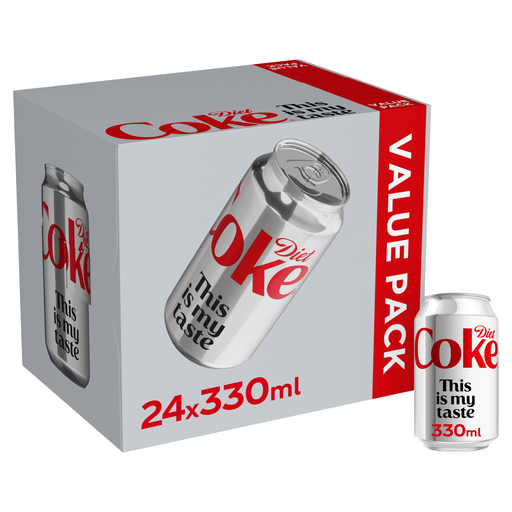 No image available
A cola option for those who do not require a caffeine-free variant. The product description lists caffeine and gives 0 g carbohydrate and sugars per 330 ml. Check the pack for its caffeine amount if you are tracking intake, and arrange ride fuel separately.
 No image available
A no-sugar cola with caffeine listed in its ingredients. Its product description gives 0 g carbohydrate and sugars per 330 ml, so choose it for the drink rather than as long-ride fuel. Check the pack’s caffeine information if total intake matters to you.
 No image available
A no-sugar cola choice for around a ride or afterwards, with caffeine identified in the product description. It lists 0 g carbohydrate and sugars per 330 ml. Check the pack if you need its caffeine amount, and use a separate carbohydrate plan for longer or harder riding.
Not as the main carbohydrate source. The no-sugar colas described here provide zero or negligible carbohydrate per serving, whereas British Cycling’s sportive guidance calls for carbohydrate during a ride and the British Dietetic Association identifies it as the main fuel for exercising muscles. Plan suitable carbohydrate food or drink separately for a long or hard session.
Choose an explicitly caffeine-free variant if you do not want caffeine; otherwise, consider cola alongside any caffeine you get from coffee, tea, gels or supplements. Pepsi MAX No Caffeine and Diet Coke No Caffeine are named caffeine-free options. For pregnancy, the NHS advises no more than 200 mg of caffeine a day from all sources, including cola.
No-sugar cola does not replace a carbohydrate plan for a longer or harder ride. British Cycling treats hydration as part of ride nutrition, but choosing a cola for flavour or caffeine does not by itself establish that you have covered both your drink and fuel needs.
No. Wirral Community Health and Care NHS Foundation Trust says sugar-free, no-added-sugar and diet fizzy drinks can be acidic and contribute to tooth wear. It advises against brushing immediately after a soft drink.