
24/7 Customer Support

Free returns

Same-day & Next-day Delivery

Quality Guaranteed

Unlock Your Welcome Offers: FREE Delivery | Up to 80% OFF | Free 30-day JoyPlus trial
Download the APP
From a Sunday roast to a batch of freshly baked biscuits, the right ovenware is the unsung hero of a British kitchen. Yet, choosing new non-stick bakeware can feel like a gamble. We’ve all been there: a promising new tray that warps on its first use, or a non-stick coating that starts to peel after a few washes. It’s frustrating and a waste of money.
As a Joybuy Product Recommendation Officer, my role is to help you see past the marketing jargon. Before you add another disappointing pan to your collection, let’s look at the common pitfalls and what really matters when selecting reliable, long-lasting ovenware.
Many products look the part online, but fail to deliver in a real kitchen environment. Here are the three most common issues that lead to buyer's remorse:
To avoid these traps, focus on a few key specifications. These are the non-negotiable details that separate a short-term fix from a long-term kitchen investment.
The material is the most critical factor for heat distribution and longevity. While aluminium is lightweight, heavy-gauge carbon steel is often the preferred material for high-performance ovenware. Look for a thickness of at least 0.8mm, with 1.0mm being a benchmark for professional bakeware. This thickness provides the structural rigidity needed to resist warping under the high heat of an oven, ensuring your carbon steel oven trays and dishes remain flat and cook evenly for years. A heavy duty roasting dish made from this material will feel substantial and reliable in your hands.
A quality non-stick surface is about more than just easy food release; it’s about durability and safety. Look for products that specify a double-layer or reinforced coating. These are far more resistant to scratches and abrasion than their single-layer counterparts. Many modern coatings are also made without PFOA and PTFE, offering peace of mind. Some advanced surfaces are even rated as metal-utensil safe, a clear indicator of their robustness.
Consider what you cook most often. Do you need a deep roasting tin with rack to allow fat to drain away from your Sunday joint? Are you an avid baker who would benefit from a dedicated cake tin or loaf pan with specific dimensions for consistent results? Or perhaps a versatile set of lipped baking sheets is more practical for daily use. Small details, like rolled edges for extra strength or pouring lips on a roaster, can make a significant difference in everyday usability.
Based on these practical criteria, here are a few options from our catalogue, matched to different types of home cooks.
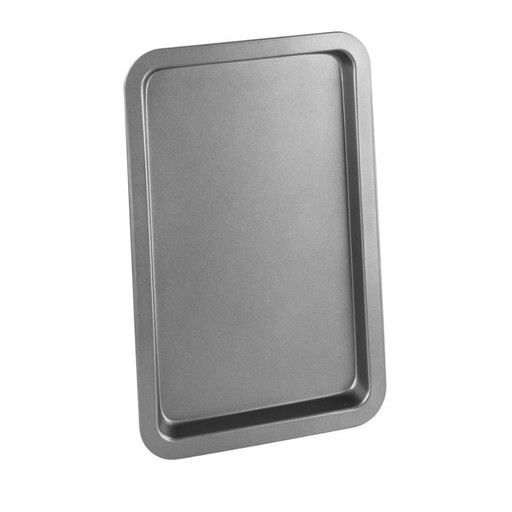
Why This Fits Their Persona: This is a practical, no-fuss choice for daily meals. Its 30cm x 18cm size is perfect for cooking for one or two, roasting vegetables or heating up oven chips without taking up the entire oven. It's a reliable workhorse for busy households.
It directly counters the "fragile coating" trap by featuring a durable non-stick surface that is also dishwasher safe for easy cleanup. The carbon steel construction offers better warp resistance than flimsy alternatives.
Its freezer-to-oven capability is a huge plus for meal prepping. The coating is also specified as being free from PFAS, PTFE and BPA, a key consideration for health-conscious cooks.
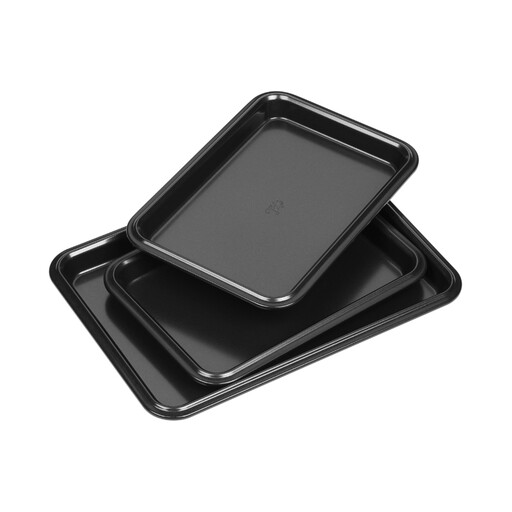
Why This Fits Their Persona: For those who take their cooking and baking seriously and want equipment that performs consistently. This set offers professional-grade features and a 10-year guarantee, making it a true long-term investment for an enthusiast's kitchen.
This set is the antidote to the "warping wonder." It's made from robust 1.0mm commercial-weight carbon steel, providing exceptional stability and preventing buckling even at high oven temperatures.
The superior Whitford Eclipse double-layer non-stick coating is durable enough to be metal-utensil safe. The set includes three versatile sizes that stack for easy storage, addressing the "size mismatch" trap.
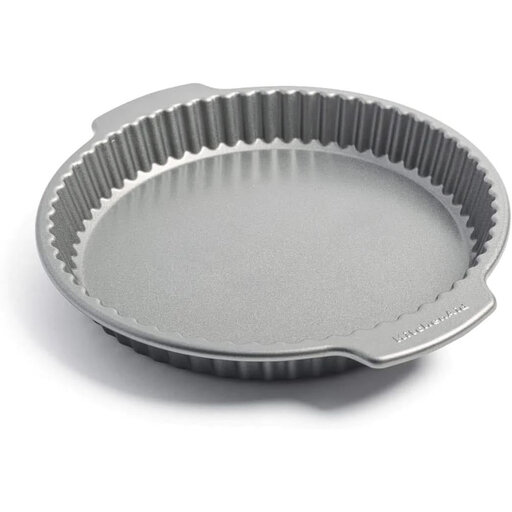
Why This Fits Their Persona: Perfect for the home cook who loves making tarts, flans and quiches and wants a professional-looking result. This isn't a general-purpose tray; it's a specific tool designed to excel at one job: creating perfect pastry cases.
It avoids the "size mismatch" by being purpose-built. The 0.8mm thick aluminised steel provides excellent structural integrity to prevent warping, while the sculptured edge helps create a neat, attractive finish without extra effort.
The combination of even heat distribution from the aluminised steel and a reliable non-stick coating ensures the delicate shortcrust pastry cooks through evenly and releases cleanly. It is also dishwasher-safe for convenience.
We have compiled a complete, real-time list of products that fully satisfy these strict selection criteria and UK safety regulations.
To prolong the life of your non-stick coating, it's good practice to wash it by hand with a soft sponge and soapy water, even if it's labelled as dishwasher safe. Avoid using metal scouring pads. When storing, place a paper towel or soft cloth between stacked pans to prevent the surface from getting scratched.
If you notice deep scratches or the non-stick coating has started to flake or peel, it is generally recommended to replace the item. A compromised surface will not perform as intended, and food will begin to stick, defeating the purpose of the pan.
The terms are often used interchangeably, but there is a subtle difference. A baking sheet is typically a flat, rimless pan, ideal for biscuits or as a base for a free-form pizza. A baking tray has raised edges or a rim, which makes it more versatile for containing liquids from a roast or preventing smaller items like oven chips from sliding off.