
24/7 Customer Support

Free returns

Same-day & Next-day Delivery

Quality Guaranteed

Unlock Your Welcome Offers: FREE Delivery | Up to 80% OFF | Free 30-day JoyPlus trial
Download the APP
Buying non-stick baking tins can make home baking easier, but a low-quality tin may still lead to sticking, uneven browning or difficult cleaning. Product listings often focus on coating claims while giving less attention to dimensions, care instructions and compatibility with your oven.
Before choosing a tin, check three practical details: how the coating should be maintained, whether the structure suits your recipe and whether the stated dimensions fit your usual batch sizes. These checks can help UK home bakers avoid spending money on bakeware that is unsuitable after only a few uses.
“Non-stick” describes the surface finish, not a guarantee of indefinite performance. Abrasive cleaners, metal utensils and dishwasher cycles can damage some coatings. A tin that is hand-wash only may need more care, while a dishwasher-safe model may suit a busier household.
Look for clear maintenance instructions and use soft silicone, wood or plastic tools where appropriate. Avoid metal scouring pads and abrasive powders unless the manufacturer specifically allows them.
A springform cake tin has removable sides, which is useful for cheesecakes, mousse desserts and delicate layered cakes. However, the join between the base and side can allow batter or water-bath liquid to escape if the design does not close securely.
A product described as a leakproof cheesecake tin should still be checked carefully. Read the construction details, inspect the clip mechanism and consider lining the base or wrapping the outside in foil when a recipe requires a water bath. “Leakproof” should be treated as a design feature rather than a reason to ignore preparation guidance.
A listed diameter does not tell you the full capacity. Check the height as well as the width, particularly for deep cheesecakes, sponge layers and quiches. Also compare the external dimensions with your oven shelf, storage cupboard and any air-fryer basket if you intend to use one there.
Carbon steel and aluminised steel are common choices for oven-safe bakeware. They are lighter than cast iron and can distribute heat across the base and sides when properly constructed.
Thickness is another useful indicator. For example, a 0.8mm metal body offers more structural support than a very thin sheet, helping a tin resist bending during ordinary handling. It does not remove the need to avoid sudden temperature changes or rough storage, but it can contribute to a more stable shape.
A non-stick interior can assist with releasing cakes and pastry cases, reducing the need for heavy greasing. It does not mean every recipe will release perfectly: high-sugar mixtures, sticky fillings and underbaked pastry may still cling to the surface.
Check whether the tin is:
For carbon steel springform tins, hand washing and thorough drying can help protect the coating. The PURECOOK three-piece set, for example, specifies hand washing and advises against abrasive cleaning tools.
A 24cm springform cake tin is a practical size for larger family cakes, cheesecakes and celebration desserts. Smaller tins may suit compact bakes or households that prefer modest portions.
A 3-piece springform cake tin set can provide more flexibility, with the PURECOOK set including 18cm, 20cm and 24cm tins. By contrast, a 28cm quiche tin is suited to larger shallow pastries, savoury quiches and tart-style desserts.
Always compare recipe instructions with the tin’s stated dimensions. Changing the diameter alters the depth of the mixture and may affect baking time.
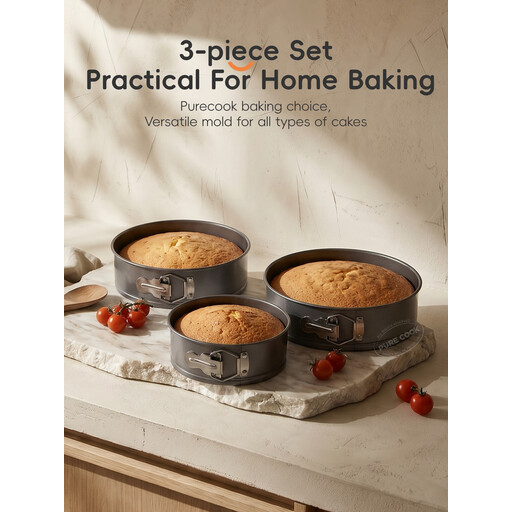
Why This Fits Their Persona: Three diameters provide a flexible starting point for households building a baking collection without buying each size separately.
The sizes are stated clearly as 18cm, 20cm and 24cm, while the care instructions make clear that the tins are not dishwasher-safe.
Carbon steel construction, quick-release clips and three round springform tins in one set.
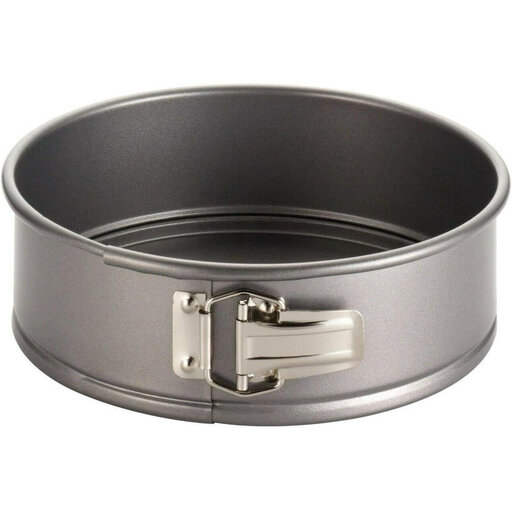
Why This Fits Their Persona: A single larger-format tin suits bakers who regularly prepare family-sized cheesecakes, celebration cakes and layered desserts.
The 24cm diameter, 7cm height and 230°C oven rating are specified, making it easier to assess recipe and oven compatibility before purchase.
0.8mm metal construction, non-stick interior, removable sides and oven suitability up to 230°C.
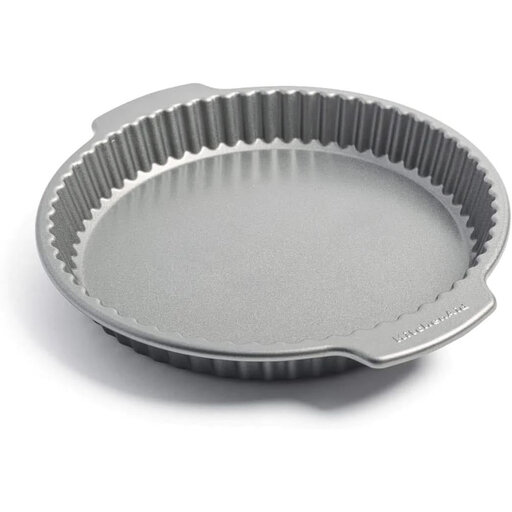
Why This Fits Their Persona: Designed for frequent tart and quiche baking, this 28cm format gives a broad, shallow base for family portions and pastry-led recipes.
The 0.8mm aluminised steel body and stated 230°C oven limit provide useful information beyond a general non-stick label.
Sculptured edge, non-stick surface and dishwasher-safe care specification for simpler cleaning.
To protect non-stick baking tins and maintain easy release:
They can be useful for cakes, tarts and quiches because the coating may assist with release and cleaning. Their value depends on suitable care, correct recipe use and a construction that matches your baking frequency. A non-stick finish alone should not be the only purchase criterion.
Yes, springform designs are commonly selected for cheesecakes because the removable side can be released without turning the dessert upside down. For a water-bath recipe, reduce leakage risk by checking the closure, lining the base where appropriate and following the recipe’s wrapping instructions.
Lifespan varies according to coating quality, frequency of use, storage and cleaning. Avoiding metal tools, abrasive products and unnecessary high heat can help preserve the surface. Inspect the tin regularly rather than relying on a fixed replacement timetable.