
24/7 Customer Support

Free returns

Same-day & Next-day Delivery

Quality Guaranteed

Unlock Your Welcome Offers: FREE Delivery | Up to 80% OFF | Free 30-day JoyPlus trial
Download the APP
A versatile, large sauté pan with a lid is a cornerstone of the modern British kitchen. It’s the workhorse for everything from a full English breakfast to a weeknight stir-fry or a slow-simmered casserole. Yet, finding the right one can feel like navigating a minefield of marketing claims. Many of us have been disappointed by a pan that warps, loses its non-stick properties after a few months or simply doesn't work well on our hob.
As a Joybuy Product Recommendation Officer, my role is to help you sidestep these common issues. Before you invest in a new pan, let’s look at the three most common pitfalls that lead to buyer's remorse.
To ensure your new pan is a lasting and valuable addition to your kitchen, focus on these three non-negotiable parameters.
The body of the pan and its coating are the two most critical factors for performance and longevity.
Your pan is only as good as its connection to your heat source. This is especially true for induction hobs.
For a deep skillet for induction to work efficiently, it must have a ferromagnetic base. This means the bottom layer of the pan must contain iron to react with the induction hob's magnetic field. Look for pans with a thick, flat, bonded stainless steel plate on the bottom. This not only guarantees compatibility but also ensures maximum energy transfer for rapid heating and helps prevent the pan from warping over time.
A truly versatile pan can move from the stovetop to the oven, allowing you to sear a steak and then finish it in the oven or braise a stew for hours.
Based on these practical criteria, we've matched a few standout products to different cooking styles and household needs.
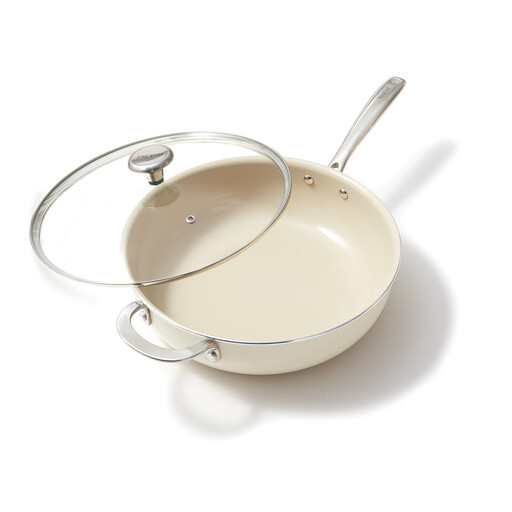
Why This Fits Their Persona: This large, deep pan is ideal for batch cooking, one-pot family meals or braising. Its robust construction and high oven-safe temperature make it a true kitchen workhorse for those who cook frequently and need maximum versatility.
It directly addresses the "toxin-free" confusion with a ceramic coating explicitly stated to be free from Teflon, PFAS, PTFE, PFOA, lead and cadmium. The heavy-duty cast aluminium body and induction base combat warping and poor heat distribution.
Extremely high oven-safe temperature (up to 450°C) and a large 5-quart capacity. The riveted stainless steel handles provide a secure, durable grip.
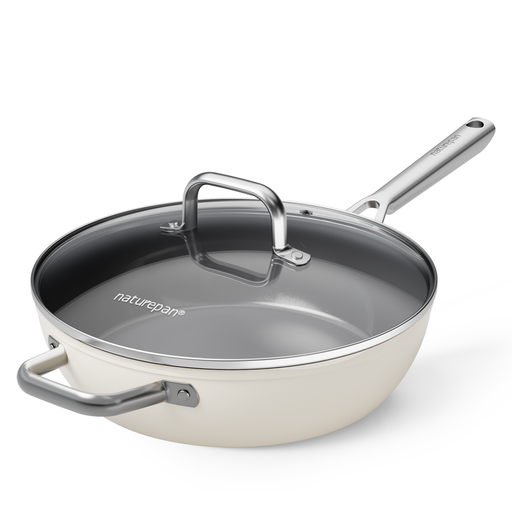
Why This Fits Their Persona: For the home cook who appreciates performance and aesthetics. This pan combines a durable, reinforced coating with a stylish, coordinated finish, making it suitable for both cooking and serving. It balances high-end features with practical, everyday usability.
It tackles the "miracle coating" trap by using a ceramic surface reinforced with diamond and titanium particles for enhanced durability. The optimised base is designed specifically for fast, even heating on all hobs, including induction.
Oven-safe to 260°C and fully dishwasher-safe for effortless cleanup. The stain-resistant ceramic coating on the exterior keeps the pan looking new.
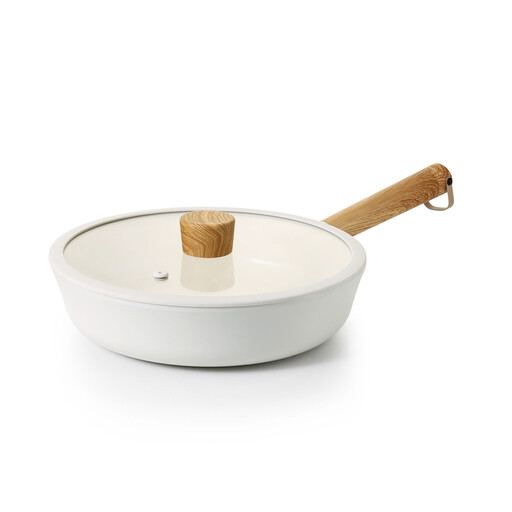
Why This Fits Their Persona: This pan delivers the most important features—a reliable non-toxic ceramic coating and all-hob compatibility—at an accessible price point. It's a great all-rounder for those setting up a new kitchen or needing a dependable daily pan without the premium cost.
It provides a clear, non-toxic ceramic coating (PTFE/PFAS/PFOA-free) and a magnetic base for solid induction performance, avoiding the two biggest pitfalls for buyers. The trade-off is a lack of oven safety, which is a fair compromise for the price.
Excellent value for a 28cm deep frying pan with a lid. It is compatible with all stovetops and features a high-quality, safe ceramic non-stick surface.
We have compiled a complete, real-time list of products that fully satisfy these strict selection criteria and UK safety regulations.
With proper care, a quality ceramic non-stick pan should provide excellent performance for 2 to 3 years of regular home use. To maximise its lifespan, avoid using metal utensils, do not preheat the pan while empty and allow it to cool down before washing. Hand-washing is always preferable to using a dishwasher.
It is strongly advised not to use metal utensils on any non-stick surface, including ceramic. While some premium coatings are marketed as "metal-utensil safe," using wood, silicone or nylon tools will always be the safest way to prevent scratches and preserve the integrity of the non-stick layer.
A light buzzing or humming sound is normal on some induction hobs, especially at higher power settings. It's caused by the vibration of the magnetic field interacting with the cookware. However, a loud or rattling noise can indicate that the pan's base is not perfectly flat or that the pan is too lightweight. A pan with a heavy, thick, bonded base, like a cast aluminium model, will typically be quieter.