
24/7 Customer Support

Free returns

Same-day & Next-day Delivery

Quality Guaranteed

Unlock Your Welcome Offers: FREE Delivery | Up to 80% OFF | Free 30-day JoyPlus trial
Download the APP
A reliable non-stick frying pan is the workhorse of the British kitchen, essential for everything from a full English breakfast to a quick weeknight stir-fry. Yet, finding one that lasts can feel like a lottery. Many of us have faced the disappointment of a pan that warps, scratches or loses its non-stick properties within months, despite promises of lifetime performance.
As a Joybuy Product Recommendation Officer, my role is to help you navigate the crowded market and avoid common purchasing mistakes. Before you invest in new cookware, be aware of these frequent pitfalls.
To choose wisely, focus on three key technical aspects. These details determine a pan's performance, safety and longevity far more than flashy marketing.
The coating is the most critical feature. The two main types available today each have distinct characteristics:
A pan is only as good as its ability to heat evenly. The base construction is vital, especially for modern kitchens.
A truly versatile pan can move from the hob to the oven, expanding your cooking options.
Based on these practical criteria, here are several frying pans suited to different types of home cooks in the UK.
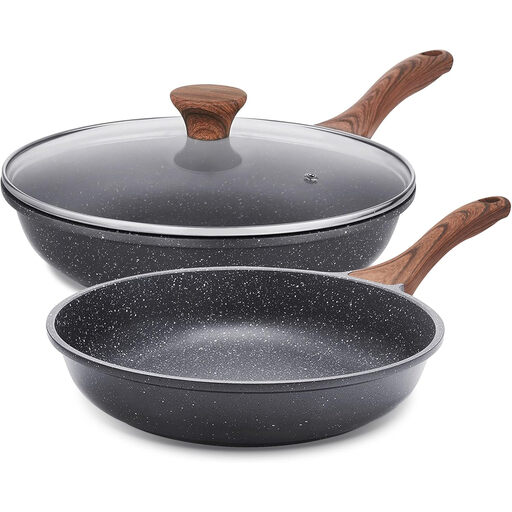
Why This Fits Their Persona: This set offers excellent value for daily cooking. The 8-inch pan is ideal as an omelette pan, while the 11-inch skillet handles larger meals. It's a practical, no-fuss solution for those needing reliable cookware for everyday tasks without a large upfront investment.
It avoids the induction gamble with a high-magnetic conductive stainless steel base for reliable performance. The Swiss granite coating is durable for daily use and is made without intentionally added PFOA.
Versatile two-pan set for multiple cooking needs. Stay-cool bakelite handles enhance safety during stovetop use.
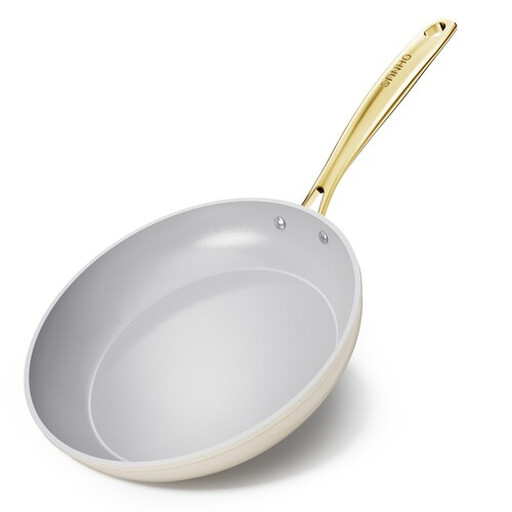
Why This Fits Their Persona: This pan is for the cook who prioritises material safety above all. Its main feature is a coating that is completely free of PFAS, PFOA and PTFE, offering peace of mind for family cooking. The durable build is designed for frequent, daily use.
It directly counters vague "healthy" claims with a clear, verifiable specification: its ceramic coating is 100% free of PFAS, PFOA and PTFE. The diamond-titanium reinforcement also addresses the durability concerns of standard ceramic pans.
High oven-safe temperature (260°C) for great versatility. Patented diamond-titanium coating offers enhanced scratch resistance compared to conventional ceramic.
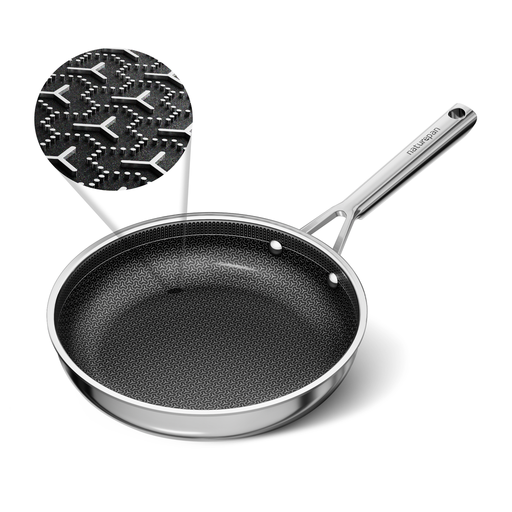
Why This Fits Their Persona: This pan is for the ambitious cook who wants the best of both worlds: the searing capability of a stainless steel frying pan and the easy release of non-stick. The hybrid design and high oven temperature make it a durable, multi-purpose tool for advanced cooking techniques.
It sidesteps the non-stick durability problem with a unique design. The laser-etched stainless steel hexagon pattern protects the non-stick coating in the valleys from utensil damage, directly addressing a primary cause of failure.
Hybrid surface allows for excellent searing while maintaining non-stick release. Extremely high oven-safe temperature (260°C) and a stay-cool steel handle offer professional-level versatility.
We have compiled a complete, real-time list of products that fully satisfy these strict selection criteria and UK safety regulations.
With proper care, a good quality non-stick pan should last between two and five years. To maximise its lifespan, avoid using metal utensils, do not overheat the pan when empty and allow it to cool completely before washing. Hand-washing is always preferable to using a dishwasher.
This is a common issue caused by a lack of a ferromagnetic base. For a pan to work on an induction hob, its base must be magnetic. If you are unsure, a simple test is to see if a refrigerator magnet will stick firmly to the bottom of the pan. If it does, it should be compatible with your induction hob.
Both are considered safe for cooking. "Granite" pans typically have a reinforced PTFE coating, which is very durable and made without PFOA. A true ceramic frying pan has a coating derived from sand and is generally free of all PFAS chemicals. Both are excellent options for a healthy frying pan and the choice often comes down to a preference for durability (reinforced PTFE) versus a completely PFAS-free surface (ceramic).