
24/7 Customer Support

Free returns

Same-day & Next-day Delivery

Quality Guaranteed

Unlock Your Welcome Offers: FREE Delivery | Up to 80% OFF | Free 30-day JoyPlus trial
Download the APP
As a Joybuy Product Recommendation Officer, my role is to help you navigate the crowded cookware market. When it comes to choosing a new non-stick induction wok, it’s easy to be swayed by clever marketing, only to end up with a pan that disappoints. Many UK households with modern kitchens find their new wok heats unevenly, scratches within weeks or isn't as "healthy" as advertised.
Before you make a purchase, let's look at the common pitfalls to avoid and the key features that truly matter for performance and longevity on an induction hob.
The "Induction-Compatible" Label Without a Proper Base: Many woks are labelled "induction-compatible," but this means little if the base is thin or only slightly magnetic. A poor connection with your hob results in slow, patchy heating, hot spots that burn food and wasted energy. A proper flat bottom wok designed for induction needs a thick, fully magnetic base to ensure stable, efficient heat transfer.
Fragile Non-Stick Coatings: A common complaint is a non-stick surface that peels or scratches after just a few stir-fries, even with careful use. While many are advertised as a PFOA free wok, this doesn't guarantee durability. Low-quality coatings can degrade quickly, diminishing the pan's usability and forcing a premature replacement.
Warping from High Heat: The high, rapid heat of stir-frying is a wok's primary function. However, woks made from thin, flimsy materials can warp when exposed to the thermal shock of high-heat cooking, especially on a powerful induction hob. A warped base will wobble, losing contact with the hob surface and making cooking impossible.
To ensure you get a reliable stir fry pan that meets your needs, focus on these three non-negotiable parameters.
The material of your wok dictates its heating properties, weight and maintenance requirements.
For any wok for electric hob or induction cooktop, the base is critical. Look for a wok with a thick, heavy and completely flat magnetic base. This ensures maximum contact with the hob's surface for stable, even and rapid heating. A thicker base also provides better heat retention and is far more resistant to warping over time.
The term "non-stick" covers a wide range of technologies, each with different benefits.
Here are a few recommendations from our catalogue, matched to different cooking styles and priorities.
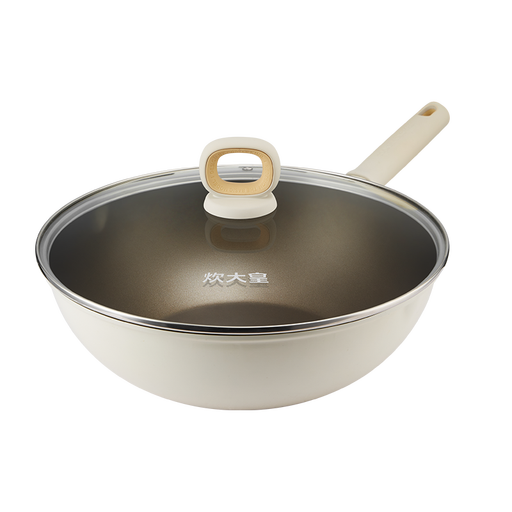
Why This Fits Their Persona: This user wants a reliable, no-fuss wok for quick and easy family meals. They value convenience, easy cleaning and a pan that works straight out of the box without complex maintenance.
Its titanium-reinforced coating is designed for greater durability than basic non-stick surfaces, addressing the "fragile coating" pitfall. The induction-ready base is built for stable performance.
A generous 32cm size is versatile for larger meals, and the included wok with lid is practical for simmering or steaming. It's a PFOA-free, low-maintenance choice.
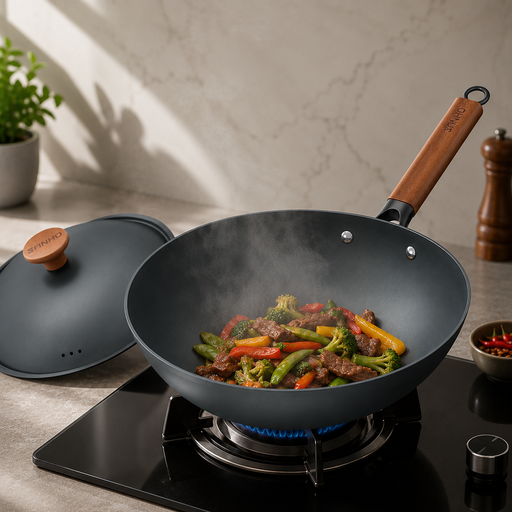
Why This Fits Their Persona: This cook prioritises safety and long-term health, actively seeking cookware free from synthetic chemical coatings. They want a durable, versatile pan for preparing a wide range of family meals.
It completely sidesteps the "fragile coating" issue by having no chemical coating at all. Its non-stick properties are derived from the steel's physical structure, and its flat bottom ensures stability on induction hobs.
It is 100% free of PFAS, PFOA and PTFE. A key benefit is its resistance to scratches from metal utensils, offering superior durability compared to many coated pans.
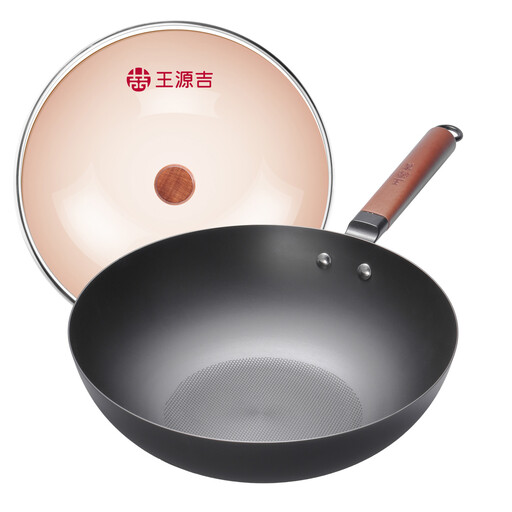
Why This Fits Their Persona: This user seeks authentic cooking performance and flavour. They appreciate the craft of cooking and are willing to season and maintain their pan to develop a perfect, natural non-stick surface over time.
As a pure carbon steel wok UK option, it is 100% coating-free, eliminating concerns about peeling or chemicals. Its flat bottom is specifically designed for stability on modern hobs, avoiding the wobble of a traditional round-bottom wok.
It is exceptionally lightweight (1.1kg), making it easy to toss and stir-fry with. Over time, it develops a superior, self-renewing non-stick patina that is both healthy and durable.
We have compiled a complete, real-time list of products that fully satisfy these strict selection criteria and UK safety regulations.
1. Will a non-stick induction wok work on my gas or electric hob too? Yes, almost all induction-compatible woks will work perfectly on gas and electric hobs. The flat, magnetic base required for induction provides excellent stability and contact on any flat-top electric or ceramic hob, and it functions just as well over a gas flame. This makes them a versatile investment for any UK kitchen.
2. What does "PFOA-free" actually mean for a healthy non-stick pan? PFOA is a specific chemical that was historically used in the manufacturing of some non-stick coatings like Teflon. A "PFOA-free" label means this particular substance was not used. However, it doesn't automatically mean the pan is free of all fluorinated chemicals, such as PTFE (the coating itself) or other compounds in the PFAS family. If your goal is a completely chemical-free surface, you should look for pans made from materials like carbon steel, cast iron or uncoated stainless steel.
3. How do I season a new carbon steel wok for an induction hob? Seasoning on induction is straightforward. First, wash the new wok with soap and water to remove the factory coating. Dry it completely. Place it on the induction hob over medium heat. Add a high-smoke-point oil (like sunflower or grapeseed oil) and swirl to coat the entire interior. Heat until the oil begins to smoke lightly, then turn off the heat and let it cool. Wipe out the excess oil with a paper towel. This initial layer begins the non-stick patina, which will improve with every use.