
24/7 Customer Support

Free returns

Same-day & Next-day Delivery

Quality Guaranteed

Unlock Your Welcome Offers: FREE Delivery | Up to 80% OFF | Free 30-day JoyPlus trial
Download the APP
A non-stick wok with lid can replace several pans for stir-frying, frying, braising, simmering and steaming. However, attractive product listings often leave out details that matter in a UK kitchen: whether the base sits properly on induction, how the surface should be maintained, and whether the stated capacity is realistic for family portions.
Before choosing a wok, look beyond phrases such as “non-stick”, “healthy cooking” or “scratch-resistant”. The construction, hob compatibility and care instructions will usually have a greater effect on everyday satisfaction.
“Non-stick” may refer to a traditional coated surface, a ceramic coating, or a coating-free carbon steel wok that develops an oil-seasoned surface over time. These options behave differently.
A carbon steel wok has no synthetic cooking coating, but it needs initial seasoning, hand washing, thorough drying and regular oiling. A ceramic non-stick wok is usually easier to use immediately, but the coating still needs sensible heat and utensil choices. A textured stainless steel wok may reduce food contact with the metal surface, but it is not necessarily equivalent to a fully coated pan.
Check the full material description rather than relying on the headline.
Traditional round-bottom cookware may require a wok ring and can be unstable on an induction, electric or ceramic hob. For most UK homes, a flat-bottom wok is a more practical choice.
Look for clear compatibility with your specific hob. Products described as suitable for induction, gas and electric hobs generally offer more flexibility, but halogen and infrared compatibility should still be checked where relevant. A magnetic flat base is particularly important for induction cooking.
A lid is useful for simmering sauces, braising meat, steaming vegetables and reducing splatter. A wok with glass lid also lets you monitor food without repeatedly releasing heat.
Check whether the lid is included, whether it has a heat-resistant handle, and whether the pan can be stored comfortably with the lid fitted. A detachable handle may help in smaller UK kitchens, but wooden or bakelite components can require hand washing and careful heat management.
A stainless steel wok offers a durable body and is generally straightforward to clean, although food may stick if the pan is not preheated and adequately oiled. A multi-layer construction, such as tri-ply stainless steel with an aluminium core, is designed to distribute heat more evenly.
Carbon steel and iron woks respond quickly to high heat and are well suited to stir-frying. Their seasoning can gradually create a physical non-stick surface, but this is a maintenance process rather than an instant coating.
If avoiding PTFE or PFAS is important to you, read the exact product specification. “PFOA-free wok” does not automatically mean coating-free, as a pan may contain another type of non-stick coating. Similarly, “Teflon-free wok” should be checked against the stated material and coating details.
A 32 cm wok is a common family size. It can provide room to toss ingredients, but the practical cooking area depends on the flat base and depth. A wide upper diameter does not always mean a wide induction contact area.
For one or two people, a 28 cm pan may be easier to handle and store. For three to five servings, a 30–32 cm wok can be more suitable, provided your hob and cupboard space can accommodate it. Overfilling any wok causes ingredients to steam rather than sear.
Coated pans generally benefit from low to medium heat, non-abrasive cleaning and wooden, silicone or nylon utensils. Even when a listing states dishwasher suitability, hand washing may help preserve the surface.
Coating-free carbon steel requires more involvement: season it before use, avoid leaving it wet, and apply a thin film of oil after cleaning. Do not place a hot stainless steel or coated pan directly into cold water, as thermal shock can distort materials or damage surfaces.
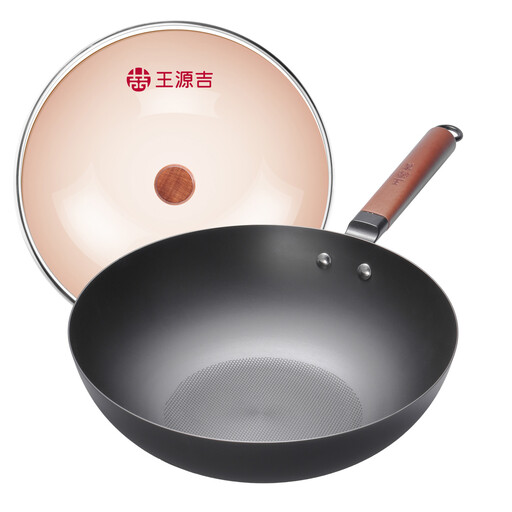
Why This Fits Their Persona: A practical option for cooks who want a lightweight, coating-free wok and are prepared to follow a seasoning routine. Its 1.1 kg body is designed for easier one-handed handling.
The listing specifies a flat base, gas, induction, electric coil and ceramic compatibility, plus a coating-free surface. Buyers can see the required daily oil maintenance before ordering.
1.1 kg lightweight construction; honeycomb-textured flat base; glass lid included; nitrogen-hardened surface treatment.
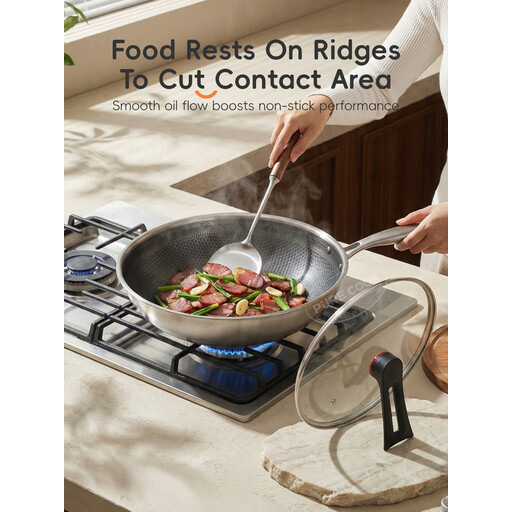
Why This Fits Their Persona: Suits households wanting a substantial 32 cm pan for everyday stir-fries, frying, braising and stewing across gas, induction and electric ceramic hobs.
The specifications identify food-contact grade 304 stainless steel, a three-layer structure and the need to hand wash without thermal shock, rather than presenting “non-stick” as maintenance-free.
304 stainless steel body; three-layer construction; honeycomb interior; tempered glass lid; suitable for low-oil cooking.
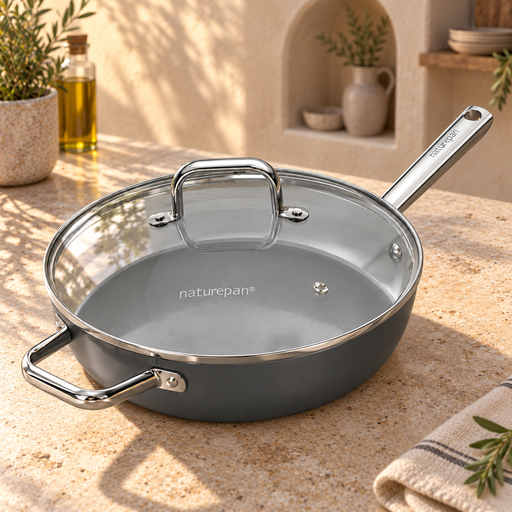
Why This Fits Their Persona: A smaller alternative for kitchens where cupboard space matters and for shoppers prioritising easy-release cooking with a matching lid.
The listing clearly states ceramic-coated aluminium rather than solid ceramic, recommends low to medium heat and identifies the 230°C oven limit with the lid removed.
28 cm size; ceramic non-stick coating; induction, gas, electric and ceramic compatibility; dishwasher-safe specification; lid included.
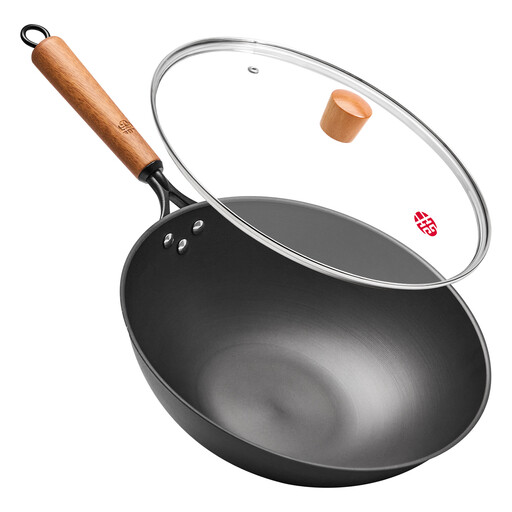
Why This Fits Their Persona: Designed for 3–5 serving meals, this flat-bottom wok is suited to family stir-fries, braising, simmering, steaming and frying on common UK hobs.
Its 12.6-inch diameter, 3.74-inch depth and 5.51-inch flat base are specified, while the product information openly requires seasoning and daily oil care.
32 cm capacity; detachable wooden handle; glass lid and iron spatula included; compatible with induction, gas, electric, ceramic and halogen hobs.
We have compiled a complete, real-time list of products that fully satisfy these strict selection criteria and UK safety regulations.
Yes, if the product has a magnetic flat base and explicitly lists induction compatibility. A round-bottom wok may not sit securely without a suitable ring. Always check the product specification rather than assuming that stainless steel or iron automatically works on induction.
A 30–32 cm wok can suit roughly three to five servings, depending on the recipe and the pan’s depth. A 28 cm option is easier to store and may be more convenient for one or two people. Avoid filling the wok to the rim, as overcrowding can reduce browning and make tossing difficult.
It can develop a smoother, more release-friendly seasoned surface through repeated heating and oiling, but it does not provide instant coated-pan performance. Seasoning can be affected by acidic foods, abrasive cleaning and prolonged soaking. Choose carbon steel if you are willing to include maintenance in your cooking routine.