
24/7 Customer Support

Free returns

Same-day & Next-day Delivery

Quality Guaranteed

Unlock Your Welcome Offers: FREE Delivery | Up to 80% OFF | Free 30-day JoyPlus trial
Download the APP
Whether you need school stationery, office stationery, a journal for journalling or a thoughtful stationery gift, choosing between notebooks can be less straightforward than it appears. Attractive covers and large page counts may catch your attention, but they do not always indicate that a notebook will suit your daily routine.
Three common buying pitfalls are worth avoiding:
A5 notebooks measure approximately 148 × 210 mm. They are convenient for handbags, backpacks, desks and meeting rooms, making them a practical choice for everyday note-taking, journalling and schoolwork.
A4 notebooks measure approximately 210 × 297 mm. The larger format is useful for project management, meeting minutes, revision notes, mind maps and work that needs to be filed with standard documents. If you plan to remove pages, check whether the sheets remain true A4 size after tearing.
For children carrying stationery to school, A5 is usually easier to manage. For office workers, students handling several modules or professionals organising project information, A4 notebooks can reduce cramped writing.
Paper weight is measured in gsm, meaning grams per square metre. Many everyday notebooks use 80 gsm paper, which is suitable for pencils, ballpoint pens and standard writing instruments. Heavier 100 gsm paper generally provides a smoother, more substantial writing surface and may help reduce ink show-through, although results vary depending on the pen.
Also check the layout:
Do not assume that “premium paper” means every pen will perform identically. Fountain pens, markers and gel pens can behave differently, so use a suitable writing tool and avoid storing the notebook near moisture.
Spiral notebooks and wiro-bound designs can open flat, which is useful when writing at a desk or sharing a page during a meeting. However, the wire can become bent if the notebook is compressed under heavy books.
Hardcover notebooks offer a firm writing surface and can protect pages in a busy bag. Look for practical additions such as an elastic band, textured lamination or a durable cover.
Softcover notebooks are usually lighter and easier to carry. Stitch binding can allow the notebook to lie flat without adding the weight of a rigid cover. This makes a softcover format suitable for carrying several books at once.
A notebook used for occasional ideas does not need the same construction as one used daily for work or study. Consider where you write, how much space you need and whether you want pages to be removable.
The following recommendations match different shopping needs using stated product specifications rather than cover appearance alone.
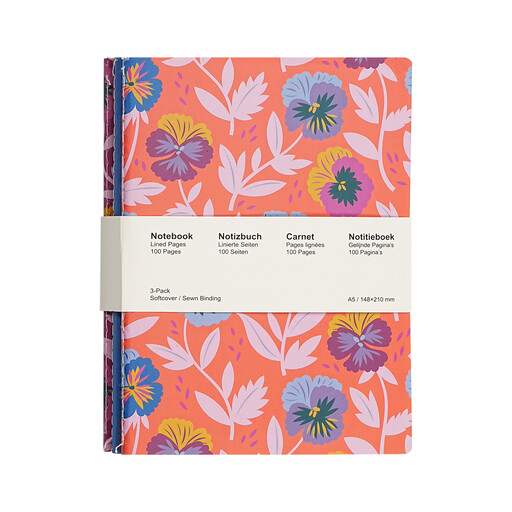
Why This Fits Their Persona: A practical option for students, new journalers or anyone who wants separate notebooks for different subjects, tasks or ideas without carrying an A4 book.
The set provides three A5 notebooks rather than one oversized volume, while stitch binding supports a lay-flat design for more comfortable writing.
Three notebooks per pack; 50 sheets of 80g cream-coloured ruled paper per notebook; lightweight softcovers.
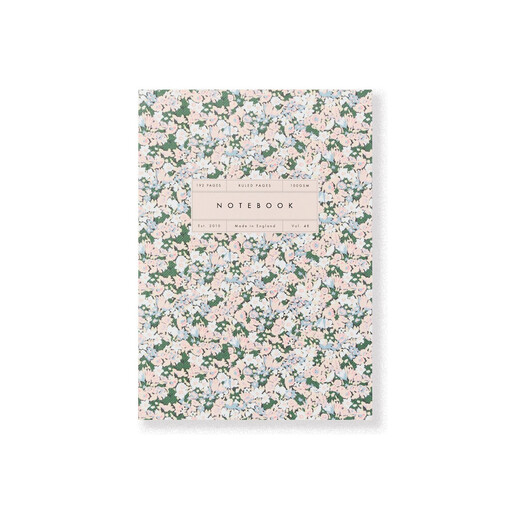
Why This Fits Their Persona: Suitable for professionals, stationery enthusiasts and journalers who want a portable notebook with a more substantial paper specification and designer styling.
The specification identifies 100gsm ruled paper and a textured cover, so shoppers can assess construction instead of relying solely on the word “designer”.
A5 format; 196 ruled pages; 100gsm inner paper; textured covers with floral styling.
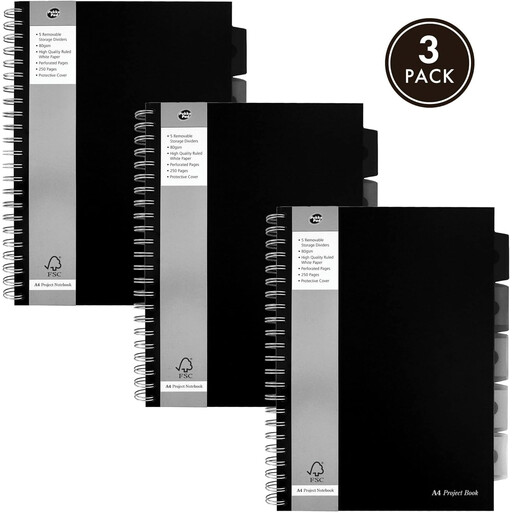
Why This Fits Their Persona: Designed for office projects, coursework, meeting notes and organised documentation where separate sections and removable pages are useful.
Its features are specific rather than vague: five repositionable dividers, storage pockets, perforated pages and a wipe-clean polypropylene cover.
Three A4 books; 250 pages per book; 80gsm FSC-certified feint-ruled paper; five storage dividers.
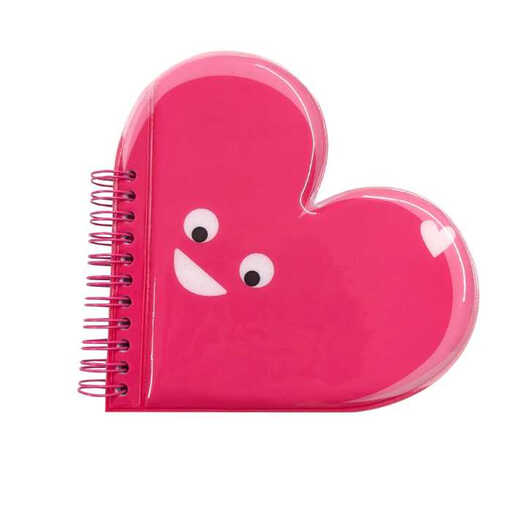
Why This Fits Their Persona: A characterful choice for children, teens and creative users who want space for doodling, stories, sketching or informal journalling.
The unlined layout is clearly specified, so it suits creative work rather than disappointing someone expecting ruled writing pages.
Padded heart-shaped cover; unlined paper; spiral binding; compact A5 format for bags and desks.
For a classic school or office setup, the Jubiluu A5 hardcover spiral lined notebook includes 96 sheets of 100g cream offset paper, an elastic closure and twin-wire binding. It is available in different cover designs and can suit writing, planning or gifting.
If you need removable A4 pages, the Pukka Pad Metallic Jotta wirebound notebook pack includes 200 pages of 80gsm paper, 8 mm ruling and a four-hole punched margin. For separate subjects or colour-coded work, the Pukka Pad Pastel Jotta notepads provide three A4 notepads in assorted pastel colours, with perforated pages and a yearly planner.
Shoppers seeking notebooks for journalling may prefer cream paper, a lay-flat binding or an unlined format. Those buying character notebooks should check age guidance where charms or other small parts are included.
We have compiled a complete, real-time list of products that fully satisfy these strict selection criteria and UK safety regulations.
Yes. A5 notebooks are convenient for meetings, to-do lists, journalling and general note-taking. Choose A4 if you need room for large tables, diagrams or documents intended for filing.
80 gsm is suitable for most pencil and ballpoint writing. 100 gsm offers a heavier writing surface and may reduce show-through, but pen type still affects performance. Check the product specification rather than relying on cover descriptions.
Keep it dry, avoid bending the cover or spiral, and do not place heavy objects on top. For notebooks with removable pages, tear along the perforation rather than pulling at the binding. A protective sleeve or dedicated compartment can also help when carrying notebooks in a school bag or work bag.