
24/7 Customer Support

Free returns

Same-day & Next-day Delivery

Quality Guaranteed

Unlock Your Welcome Offers: FREE Delivery | Up to 80% OFF | Free 30-day JoyPlus trial
Download the APP
Choosing suitable notebooks involves more than picking a cover colour. The wrong size can make a bag unnecessarily heavy, unsuitable paper can cause ink to show through, and attractive binding may become inconvenient after regular use. Whether you need school notebooks, work notebooks, a journal for personal organisation or notebooks for writing and journalling, a few practical checks can prevent wasted money.
A compact notebook may look convenient online but offer limited space for lecture notes, meeting records or project planning. Conversely, A4 notebooks can be awkward to carry every day if you mainly write short reminders.
Consider where the notebook will be used:
Check the stated dimensions rather than relying on product photographs, as proportions on a screen can be misleading.
A glued spine may look neat but usually does not offer the same flat-writing experience as spiral notebooks or wirebound notebooks. A rigid binding can also be less convenient when writing close to the inner margin.
For frequent note-taking, look for:
Binding also affects storage. If pages need to be removed and filed, a punched margin or perforation may be more useful than a permanently bound format.
“Smooth paper” does not tell you everything about how a notebook will perform with a ballpoint pen, gel pen, fountain pen or marker. Check the paper weight where available. For example, the Pukka Pad option below uses 80 GSM paper, while the Jubiluu notebooks use 100g cream offset paper.
Paper ruling matters too. Lined notebooks support tidy writing and structured notes, while unlined paper is more flexible for sketches, mind maps, lettering and free-form journalling. If you want to use both sides of every sheet, consider whether your preferred pen is likely to show through.
A5 measures approximately 148 × 210 mm, making it a practical middle ground for daily carrying. A4 is approximately 210 × 297 mm, offering a larger writing area but taking up more room.
For school or university, consider whether the notebook fits the relevant folder or laptop bag. For office use, A4 may be more suitable for meeting notes that need to be filed. For personal planning and commuting, A5 is often easier to handle.
Choose lined paper for conventional handwriting, revision notes and work records. Unlined sheets are more suitable for creative activities, sketching and flexible layouts. Paper weight is normally expressed in GSM or grams per square metre; a higher figure can indicate a more substantial sheet, although the writing instrument still affects ink show-through.
A notebook with 100g paper may feel more substantial than one using 80 GSM paper, but buyers should still check the product details and avoid assuming that paper weight guarantees suitability for every pen type.
Hardcover notebooks can resist bending in a backpack and provide a firmer writing surface. Padded notebooks offer a softer, tactile cover, although the extra texture may take up more space. An elastic band can help keep a notebook closed during transport.
If buying for a child, check the product’s stated age guidance and warnings. For all notebooks, keep paper and covers away from moisture and store them in a dry place.
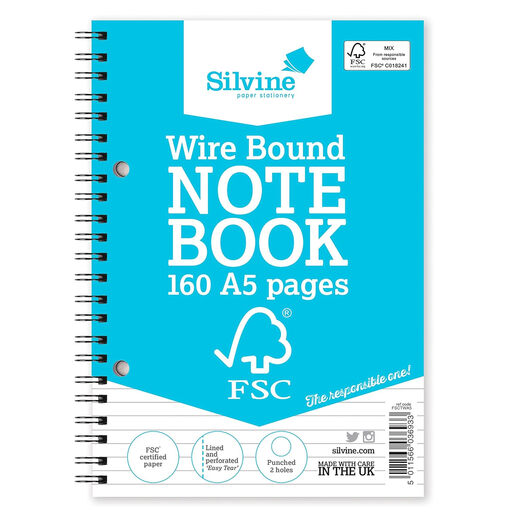
Why This Fits Their Persona: A pack of five gives students, families or home-office users several A5 notebooks for separate subjects, tasks or everyday lists.
The A5 wirebound format is clearly stated, reducing uncertainty about size and providing a practical alternative to buying several notebooks separately.
Pack of five; A5 wirebound format; FSC certified and recycled paper according to the product description.
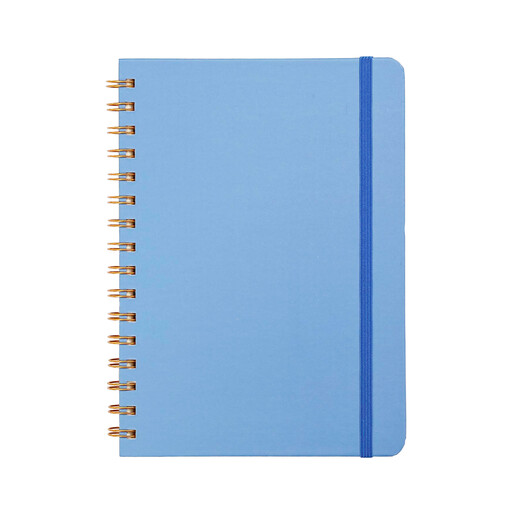
Why This Fits Their Persona: This suits professionals, university students and journal writers who want a structured A5 notebook with a more substantial cover.
The listing specifies 96 sheets, 100g cream ruled paper, a twin-wire spiral and an elastic closure, so key construction details are visible before purchase.
A5 hardcover; 100g cream ruled paper; elastic closure band; twin-wire spiral binding.
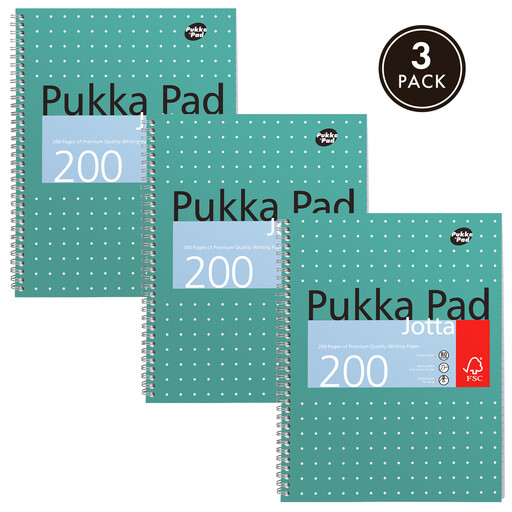
Why This Fits Their Persona: A practical match for office workers, university students and anyone handling detailed meeting, class or project notes.
The true A4 format and four-hole punched margin are specified, helping users avoid notebooks that look A4-sized but do not file neatly.
Pack of three; 200 pages per notebook; 80 GSM paper; 8mm ruling; pages designed for filing after removal.
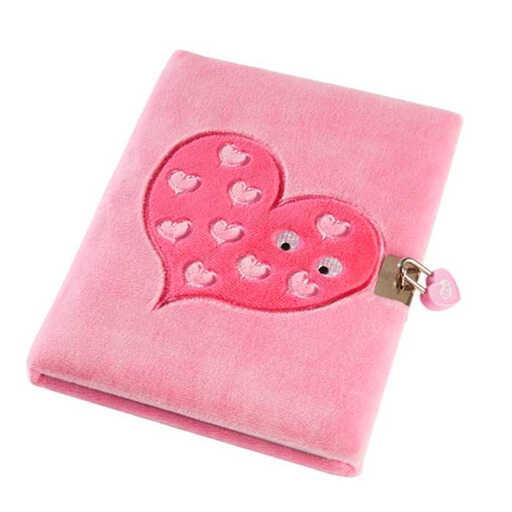
Why This Fits Their Persona: Its soft heart-shaped cover and unlined pages suit doodling, storytelling, creative play and informal journalling at home or on the go.
The unlined paper is clearly identified, avoiding the common mismatch between a creative user’s needs and a ruled school notebook.
Padded soft-touch cover; unlined paper; spiral binding; compact format for bags and everyday carrying.
We have compiled a complete, real-time list of products that fully satisfy these strict selection criteria and UK safety regulations.
Yes. A5 notebooks are useful for everyday lessons, revision, short meetings and personal planning because they are relatively easy to carry. If you regularly draw diagrams, write extended notes or need pages for filing, A4 notebooks may be more suitable.
Lifespan depends on paper quality, binding, storage and how frequently it is used. A hardcover can help protect pages in a busy bag, while spiral notebooks can be easier to open flat. Keep any notebook away from moisture and avoid overloading the binding with loose papers.
They can be. Check the specific materials rather than relying only on general sustainability language. For example, the Silvine option is described as using FSC certified and recycled paper. Also compare format, ruling, page quantity and binding so that environmental preferences do not come at the expense of practical suitability.