
24/7 Customer Support

Free returns

Same-day & Next-day Delivery

Quality Guaranteed

Unlock Your Welcome Offers: FREE Delivery | Up to 80% OFF | Free 30-day JoyPlus trial
Download the APP
Choosing between notebooks and project books can seem straightforward until the pages start bleeding, the binding becomes awkward or loose papers disappear inside an overfilled bag. Whether you need A5 notebooks for everyday notes, A4 project books for organised coursework or creative notebooks for drawing and journalling, the right choice depends on practical specifications rather than attractive packaging alone.
A padded, textured or character cover may look appealing, but it does not tell you how suitable the pages are for your pens. Check the paper weight and layout before buying. 80 gsm paper is commonly used for everyday writing, while 100 gsm paper can provide a smoother, more substantial surface and may help reduce ink show-through.
No paper is completely immune to bleed-through with heavily applied ink, markers or fountain pens, so consider the writing tools you use regularly.
A notebook with many pages may still become difficult to navigate if it lacks margins, dividers or a suitable binding. For revision, meeting notes and project work, features such as repositionable dividers, storage pockets and perforated sheets can be more useful than page count alone.
A4 offers a generous writing area and aligns with many UK documents and filing systems, but it can be cumbersome in a smaller backpack. A5 notebooks are easier to carry between lectures, offices and home, although the reduced page area may feel restrictive for diagrams or detailed project planning.
Lined notebooks support handwriting, revision and structured notes. Feint ruling, such as 8 mm spacing, can provide a useful balance between writing space and neatness. Unlined pages are more flexible for sketching, mind maps and creative work, but may be less suitable for formal notes.
For school or university use, consider whether margins are included and whether pages can be removed cleanly. Perforated pages are useful when notes need to be filed or shared.
Wiro or spiral binding can allow a notebook to open flat, which is helpful when writing at a desk or working on a diagram. A polypropylene cover is wipe-clean and can be practical in classrooms, shared offices or home-working spaces. Textured card covers offer a different balance of protection, appearance and portability.
For project organisation, internal pockets and dividers can prevent handouts, receipts and loose worksheets from becoming separated from the relevant notes. If environmental sourcing matters to you, look for clear information such as FSC certified notebooks rather than relying only on vague sustainability wording.
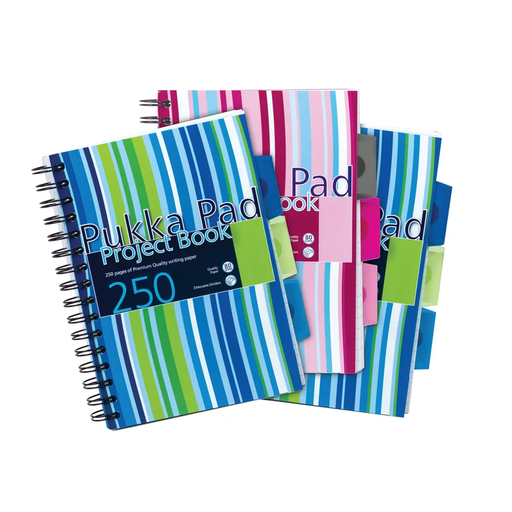
Why This Fits Their Persona: A three-pack gives students, parents and first-time stationery buyers several compact books for separate subjects, activities or personal projects.
It provides three books with 250 pages each, three repositionable dividers and storage pockets, rather than relying on page count without organisation.
A5 format, 8 mm lined 80 gsm FSC certified paper and divider pockets support portable school stationery organisation.
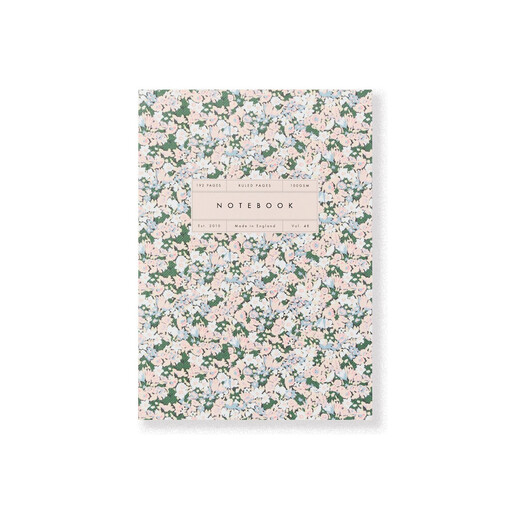
Why This Fits Their Persona: Suitable for users who value a more substantial writing surface and a distinctive cover for office desks, personal planning or thoughtful gift stationery.
The specification states 196 ruled pages and 100 gsm inner paper, making the writing format and paper weight clear before purchase.
A5 portability, 196 ruled pages and textured covers with floral prints provide a defined everyday writing format.
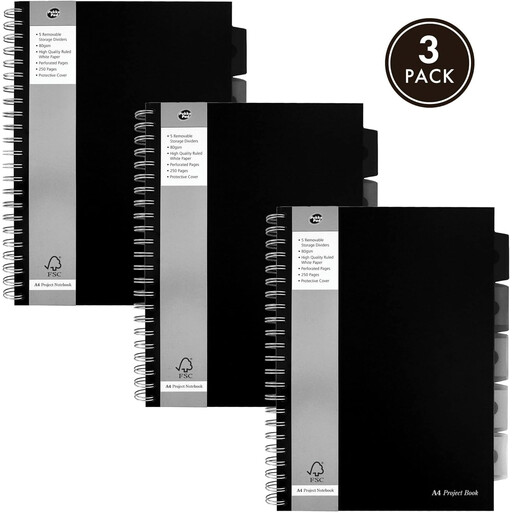
Why This Fits Their Persona: A4 pages and internal organisation suit teachers, office professionals, home workers and students managing extensive notes or multiple documents.
Five colour-coded repositionable dividers, storage pockets and clean-tear perforations provide more practical control than a plain large notebook.
Each book contains 250 pages of feint-ruled 80 gsm FSC certified paper and has a wipe-clean polypropylene cover.
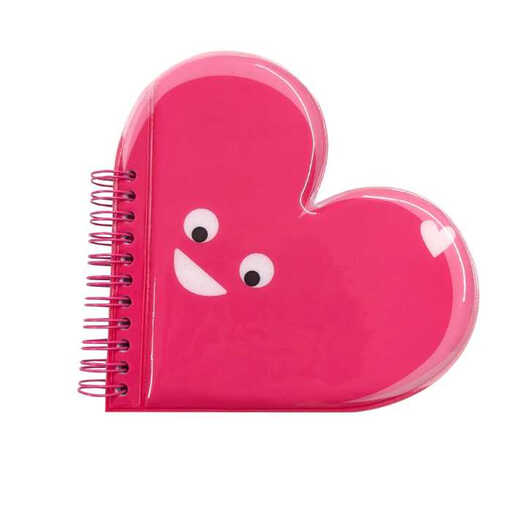
Why This Fits Their Persona: Its unlined pages are suited to sketching, doodling, stories, mind maps and informal journalling, while the playful design works as a present or personal stationery treat.
The unlined format is clearly stated, so buyers can avoid expecting a ruled school notebook when they actually need creative freedom.
Padded heart-shaped cover, spiral binding and flat-opening design support comfortable creative use.
For fans and younger users, character notebooks can make regular writing more appealing, but check small-parts warnings where charms or accessories are included. A Toy Story A5 wiro notebook has 160 pages of 80 gsm paper and six removable pop-in charms; its stated warning makes it unsuitable for children under three because of small parts.
A Squishmallows plush A5 notebook also has 160 lined pages and a soft cover, while a Lilo & Stitch novelty plush A5 notebook focuses on tactile design and informal note-taking. These options can work as gift stationery, although plush and silicone covers should be kept dry and handled according to the care guidance.
A stationery set or pack of three can reduce the need for repeat purchases, but compare the number of pages and features per book rather than judging value solely by the pack size.
We have compiled a complete, real-time list of products that fully satisfy these strict selection criteria and UK safety regulations.
Yes, A5 notebooks are portable and convenient for lectures, homework and revision summaries. However, A4 project books may be more practical for diagrams, printed worksheets and subjects requiring extensive written calculations.
Lifespan depends on page quality, binding, storage and frequency of use. Keep notebooks away from moisture, avoid bending the cover and choose suitable pens to help preserve the pages. A project book with 250 pages may last longer for frequent note-taking than a smaller notebook, but usage varies considerably.
It can be worthwhile if you use gel pens, rollerballs or write frequently. 100 gsm paper generally feels more substantial than 80 gsm paper, but the actual result depends on the ink and pressure used. For ordinary pencil or ballpoint notes, 80 gsm may be sufficient.