
24/7 Customer Support

Free returns

Same-day & Next-day Delivery

Quality Guaranteed

Unlock Your Welcome Offers: FREE Delivery | Up to 80% OFF | Free 30-day JoyPlus trial
Download the APP
Choosing notebooks and stationery can seem straightforward until a notebook falls apart in a school bag, ink shows through every page or a novelty cover proves awkward for daily writing. The right choice depends less on decorative packaging and more on paper quality, format, binding and how you plan to use it.
Whether you need A5 notebooks, A4 project books, stationery sets or note-taking supplies, these checks can help you avoid purchases that look appealing but do not suit your routine.
A stylish cover may attract attention, but it does not tell you whether the notebook has suitable paper, enough pages or a practical binding. Plush notebooks and character-themed designs can be enjoyable for journalling or gifting, yet a soft cover may be less suitable for writing on a crowded train or carrying alongside heavy textbooks.
Before buying, check the page layout, cover material and binding type, not just the design.
Page numbers can be presented without explaining paper weight or page size. A 160-page A5 notebook and a 250-page A4 project book offer very different amounts of usable writing space. Also consider whether pages are ruled, plain or divided into sections.
For coursework, meeting notes or long-term projects, dividers and storage pockets may be more useful than simply adding extra pages.
Paper products are vulnerable to moisture, bending and unsuitable pens. A notebook with a lightweight cover may become damaged in a backpack, while paper that is too thin for your chosen pen can make both sides difficult to use.
Look for practical details such as gsm paper weight, wipe-clean covers, perforated pages and whether the notebook opens flat.
A5 notebooks measure approximately 148mm × 210mm. They are portable enough for handbags, backpacks and briefcases, making them suitable for lectures, commuting, daily planning and personal notes.
A4 project books measure approximately 210mm × 297mm. They provide more room for diagrams, printed handouts, meeting minutes and structured coursework. They are more suitable for desks, folders and project-based work, although less convenient to carry.
Choose A5 for portability and A4 for workspace and document organisation.
Paper weight is measured in gsm, or grams per square metre. A notebook with 80gsm paper is generally suitable for pencils, ballpoint pens and many everyday writing tools. Heavier 100gsm paper offers a more substantial writing surface and may help reduce show-through, although results vary according to ink and pressure.
For journalling notebooks or creative writing, 100gsm paper can feel more comfortable during longer sessions. If you use markers or wet ink, check the product information carefully rather than assuming any paper will prevent bleed-through.
Also check whether covers are wipe-clean, textured, padded or made from fabric. These features affect both appearance and how well the notebook suits daily handling.
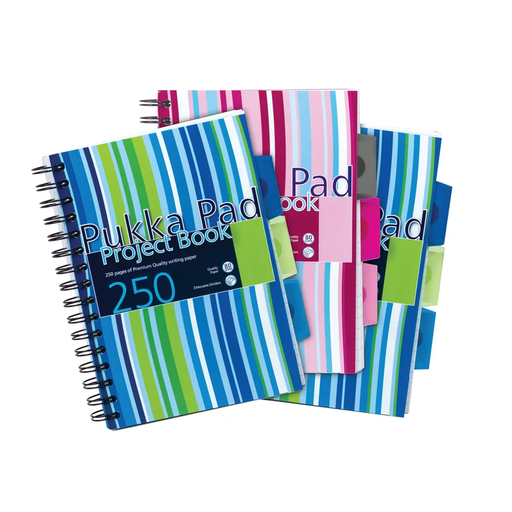
Why This Fits Their Persona: A pack of three gives students, families and home-office users separate books for different subjects or tasks, while the A5 format is easy to carry around the UK.
Its specifications clearly state 250 pages per book, 80gsm lined paper and three repositionable dividers with storage pockets, rather than relying on cover design alone.
Pack of three; A5 portability; FSC certified 80gsm paper; repositionable dividers with storage pockets.
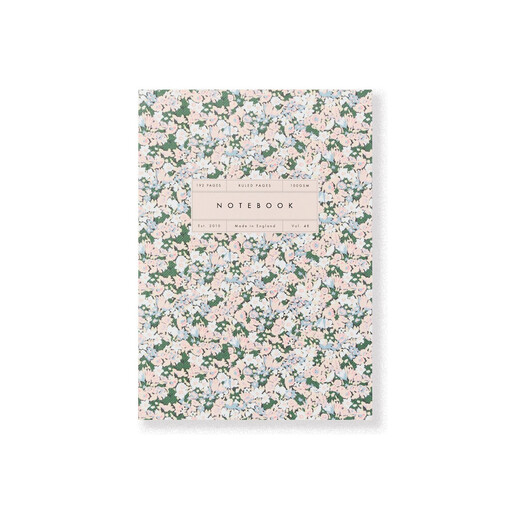
Why This Fits Their Persona: Its compact A5 shape and textured cover suit professionals, journalling enthusiasts and gift shoppers who want a more considered desk accessory.
The product details identify 196 ruled pages, 100gsm inner paper and a textured cover, giving buyers measurable information beyond its floral styling.
100gsm paper; 196 ruled pages; textured cover; margins for more structured writing.
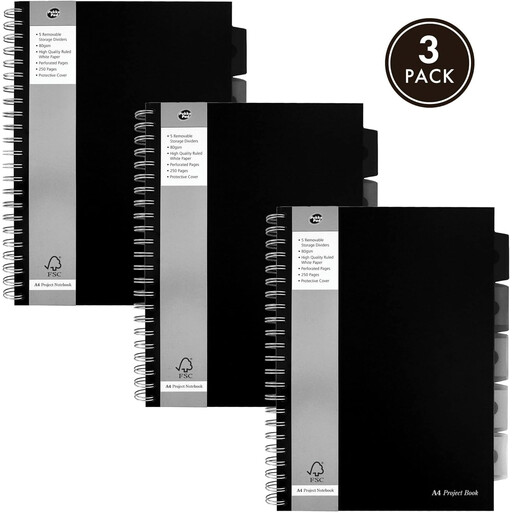
Why This Fits Their Persona: Designed for coursework, office documentation, meeting minutes and multi-stage projects where a larger writing area and clear separation are important.
It combines five repositionable colour-coded dividers, storage pockets and clean-tear perforated pages, reducing the need for separate folders for every project.
A4 format; 250 pages per book; wipe-clean polypropylene cover; five dividers; perforated sheets.
For creative users, a plain spiral-bound notebook such as the Tinc Mallo Heart Padded A5 Notebook provides unlined pages for drawing, doodling and journalling. For children, check age guidance carefully: products with charms or small parts may not be suitable for under-threes. A character notebook can make school supplies more appealing, but practical details such as page count and cover care still matter.
Yes. A5 notebooks are easy to carry and work well for quick notes, revision points, to-do lists and meetings. For diagrams, printed inserts or extensive coursework, an A4 project book may be more practical.
For pencils and standard ballpoint pens, 80gsm paper is commonly suitable. If you prefer a more substantial feel or use a wider range of pens, consider 100gsm paper. Always match the notebook to your writing tools and check for possible show-through.
Keep paper products dry, avoid placing heavy objects on top of spiral bindings and store notebooks away from direct sunlight where advised. Use pens that are appropriate for the paper, and choose wipe-clean covers if the notebook will be used in busy classrooms, shared offices or while travelling.