For recording attendance totals at a fixed study desk, start with a wired keypad that has a quiet-key claim for the exact model: Kensington describes the K79820WW’s scissor keys as quiet, and its USB-A connection avoids battery upkeep. Choose wireless if cable-free placement matters, or programmable keys if repeated commands make them useful; neither feature establishes how quiet a keypad will be, and connection and software requirements still need checking.
Who is a separate keypad for?
Quiet-study attendance recorder
If you enter totals beside other people studying, look for a quiet-key claim for the exact model rather than assuming a wireless or programmable keypad will sound quieter. Kensington describes the K79820WW’s scissor keys as quiet; HP makes a quiet-typing claim for the 430.
Fixed-desk spreadsheet user
If the keypad stays beside one computer, a wired model avoids battery changes. Kensington specifies USB-A plug-and-play operation and anti-slip feet for the K79820WW; check that the computer has a suitable port.
Attendance administrator using repeated commands
If recording totals also means repeating spreadsheet actions, programmable keys may be useful. HP’s 430 and CHERRY’s G84-4700 offer custom commands, subject to their software and operating-system requirements.
What matters when choosing?
For attendance entry in a quiet study, consider the keys and your computer’s connection first. Then decide whether moving the keypad or assigning repeated commands would change your workflow.
| Concern |
What to check |
Who this matters to |
| Quiet key action |
Look for a quiet-key claim for the exact model, then consider whether its sound will suit your study. |
If I enter totals beside people who are reading, I want the key action to cause as little disruption as practical. Around 40% of consumers put quiet operation first. |
| Simple desk setup |
Check the computer’s port, operating-system compatibility, required keys and keypad stability. |
At one desk, I need a number pad that is ready for repeated entries without managing batteries or custom settings. Around 30% of consumers prioritise that straightforward setup. |
| Cable-free placement |
Confirm whether the model uses Bluetooth or a USB receiver, and check its battery requirements. |
I may move the keypad between desks or place it on either side of my keyboard, so a cable could get in the way. For roughly 20% of consumers, flexible placement is the primary need. |
| Programmable commands |
Check how keys are configured and whether the required software works with your computer. |
When entering totals also involves the same spreadsheet commands again and again, I would use assigned keys rather than set them up for digits alone. Around 10% of consumers put that shortcut workflow first. |
Buying mistakes to avoid
-
Assuming wireless means quiet
A wireless connection changes where you can place the keypad, not how its keys sound. Kensington specifically describes the wired K79820WW’s scissor keys as quiet.
Check quiet-typing information for the exact model separately from its connection type, and consider whether you can assess the key sound before committing to it.
-
Overlooking the computer’s ports
Kensington’s K79820WW and CHERRY’s G84-4700 use USB-A, so they cannot be assumed to plug directly into a computer with only USB-C ports.
Check your available ports and, if needed, confirm that an adapter supports USB data input.
An adapter may be an additional item to carry or obtain.
-
Choosing programmable keys for digits alone
Custom keys take setup to be useful. HP’s 430 uses HP Accessory Centre for programming, while CHERRY specifies Windows for the G84-4700’s macro workflow.
Identify the repeated non-numeric commands you would assign before choosing a programmable model.
Brands to consider
Kensington
The wired K79820WW is relevant to a fixed study desk where a separate number pad and quiet-key claim matter.
- Kensington specifies quiet scissor keys, USB-A plug-and-play operation and anti-slip feet for this model.
- Check for a USB-A port; Kensington says some shortcut keys work only with Windows, despite the keypad’s stated macOS and ChromeOS compatibility.
HP
The HP 430 combines wireless number entry with programmable keys for people who also repeat spreadsheet commands.
- HP specifies Bluetooth and nine programmable keys, and describes the model’s low-profile keycaps as quiet.
- Customising the keys requires HP Accessory Centre, and the keypad uses an AA battery. Check the exact listing and key sound for your intended setup.
CHERRY
The G84-4700 is a wired option for frequent numerical entry when software macros are useful.
- CHERRY specifies user-defined software macros for the G84-4700.
- The model is specified for Windows and USB-A; confirm its key sound separately if quiet operation is the priority.
Trust
The Xalas range offers wired and wireless numeric-entry layouts for buyers who do not need macro programming.
- Trust specifies a 2.4 GHz USB receiver and included AAA batteries for Xalas Wireless, while the wired Xalas has low-profile keys and a 1.5 m USB cable.
- Choose the connection separately from key sound: a low-profile layout or wireless connection does not, by itself, establish quiet operation.
Joybuy keypad choices
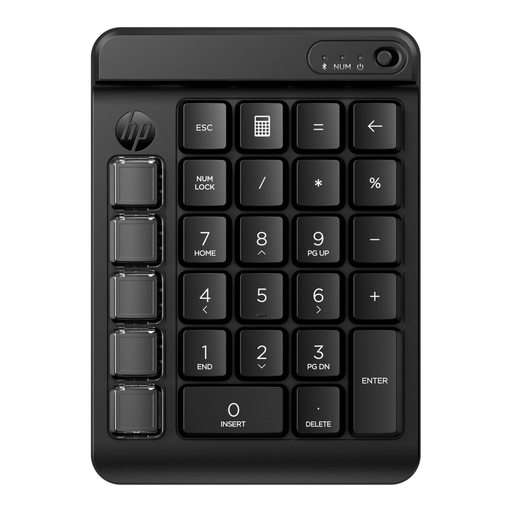
This HP 430 is a programmable wireless option for attendance work that includes repeated spreadsheet commands. If quiet key action is your deciding factor, assess its suitability for the study separately.
 No image available
HP 430 Programmable Wireless Keypad
Consider this keypad if attendance entry includes repeated commands that you would assign to custom keys, rather than digits alone.
The HP 430 has nine programmable keys and Bluetooth connectivity. Programming requires HP Accessory Centre, and the keypad uses one AA battery.
Check its key sound against the needs of your study before choosing it for quiet entry.
Joybuy
Questions about keypad use
Does a wired keypad make sense at one study desk?
A wired keypad is a practical choice if it can stay at the desk and you do not need cable-free placement. Kensington specifies USB-A plug-and-play operation for its K79820WW, so check that your computer has a suitable port or a compatible data adapter.
Will every keypad shortcut work on a Mac or Chromebook?
Not necessarily. Kensington lists the K79820WW as compatible with macOS and ChromeOS but says some of its shortcut keys are Windows-only; check the operating-system notes for the exact keys you plan to use.
What upkeep does a wireless keypad need?
A battery-powered wireless keypad will eventually need a battery change. Trust supplies AAA batteries with Xalas Wireless, while HP specifies an AA battery for the 430; also check whether the model needs a USB receiver or connects by Bluetooth.


