Shared-desk result enterers
People entering race numbers, times or placings on a desk used by several operators need a keypad that is straightforward to hand over and can be moved when the next person takes over.


For entering race results at a shared desk, choose a separate wired USB keypad when quick hand-over matters and the computer has a suitable USB-A connection. A wireless keypad gives more freedom of placement but adds compatibility, pairing and battery checks; a programmable model is worth considering when the results software uses repeatable commands. Choose a full-size keyboard with an integrated numpad if you also need to replace the main keyboard and do not need to move the number pad separately.
People entering race numbers, times or placings on a desk used by several operators need a keypad that is straightforward to hand over and can be moved when the next person takes over.
People alternating between compatible computers may value cable-free placement or device switching. Each computer still needs to meet the chosen keypad’s connection requirements.
People who repeatedly use commands in their results software may have a reason to configure extra keys rather than use a number-only layout.
At a shared race-results desk, decide whether easy hand-over, movable placement, device switching or repeated commands matter most before choosing a connection type.
Choose when: Operators need to plug in a keypad and pass it between compatible computers. Kensington specifies USB-A plug-and-play use for its wired model.
Trade-off: The desk needs a suitable USB-A connection, and the cable limits where the keypad can sit.
Choose when: Cable-free placement or switching between paired, compatible computers matters more than immediate plug-in use. Microsoft says its Number Pad can pair with up to three devices.
Trade-off: Microsoft requires Windows 10 or Windows 11 and Bluetooth 4.0 or later for that model; pairing and battery replacement also need attention.
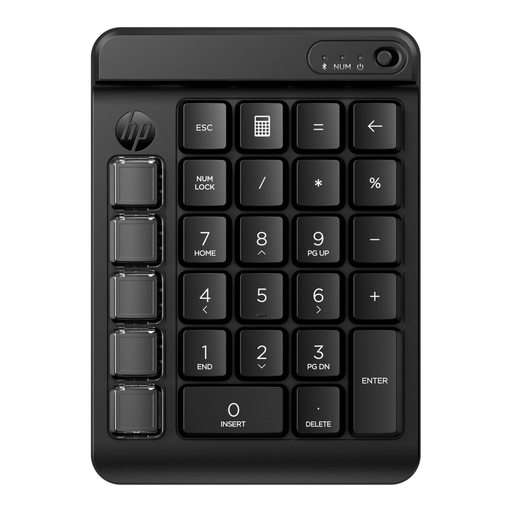
Choose when: Results work repeatedly uses commands that the software accepts as shortcuts. HP lists nine programmable keys on its 430 keypad.
Trade-off: Someone must configure the keys and make their functions clear to everyone sharing the desk.
Choose when: The main keyboard also needs replacing and a fixed number-pad position suits the workstation. Logitech lists an integrated numpad on its MX Keys for Business.
Trade-off: An integrated numpad takes desk width and cannot be moved independently of the letter keys.
| Concern | What to check | Who this matters to |
|---|---|---|
| Hand-over and compatibility | Check every computer’s operating system and available USB-A or Bluetooth connection; confirm any required shortcut keys separately. | When the next operator sits down, I need the keypad to work with that computer without sorting out a connection. Around 36% of consumers put dependable hand-over first. |
| Position and desk space | Check whether a separate keypad can sit within comfortable reach without moving the main keyboard or screen off centre. | I want to move the number pad to suit my position, then clear it away for the next user. For around 29% of consumers, flexible placement is the main concern. |
| Cable-free use | Confirm the model’s Bluetooth requirements or receiver port, paired-device options and battery type. | As I move between compatible computers, keeping the desk free of another cable matters more than plugging straight in. Cable-free use comes first for around 21% of consumers. |
| Repeated commands | List the commands used in the results software and check whether the keypad can assign and clearly label them. | If I keep entering the same commands alongside the figures, configurable keys could fit my workflow. Around 14% of consumers prioritise those shortcuts. |
Microsoft specifies Windows 10 or Windows 11 with Bluetooth 4.0 or later for its Number Pad. Other wireless keypads, such as the Trust Xalas Wireless, use a USB receiver instead.
List the computers that will use the desk and check each one against the exact model’s operating-system and connection requirements.
Kensington lists Windows, macOS and ChromeOS compatibility for its wired keypad but says some shortcut keys are Windows-only.
Check numeric entry and the particular commands needed in the race-results software as separate requirements.
A full-size keyboard keeps the numpad beside the letter keys; a separate keypad can be repositioned or cleared from the shared desk.
Choose an integrated numpad when replacing the main keyboard also makes sense. If operators need different number-pad positions, consider a separate unit.
For regular display screen equipment use, keypad position is only one part of the desk arrangement. The Health and Safety Executive advises keeping the screen and keyboard central rather than twisting to use them.
Review the screen, main keyboard, chair and keypad together, and update the workstation assessment where regular workplace use calls for one.
Its wired numeric keypad is a route for shared desks with a suitable USB-A connection.
Its Number Pad is a compact Bluetooth option for compatible Windows computers.
The HP 430 offers configurable keys for workflows that use commands as well as numbers.
The Xalas range includes a wired USB keypad and a wireless, receiver-based model.
Its full-size MX Keys models are relevant when the main keyboard, not just the number pad, needs replacing.
This programmable wireless option is relevant when race-result work involves repeated commands as well as numeric entry.
 No image available
Consider this keypad if the race-results software accepts shortcuts for commands you use repeatedly.
HP lists nine programmable keys, swappable keycaps and Bluetooth connectivity, with stated battery life of up to 24 months from one AA battery.
Configure the custom keys and check that their functions are clear to everyone using the desk.
Choose wired if quick hand-over without pairing or battery changes matters most and the desk has a suitable port. Choose wireless if cable-free placement or switching between compatible devices is more useful, after checking the model’s Bluetooth or USB receiver requirements.
No: Microsoft specifies a Windows 10 or Windows 11 PC with Bluetooth 4.0 or later. Check every intended computer against those requirements before choosing it.
Place it where the active user can reach it without twisting or stretching, while keeping the main screen and keyboard central. The Health and Safety Executive also advises positioning the keyboard just below elbow height.
The Health and Safety Executive describes the relevant display screen equipment requirement in terms of how workers use the workstation, not a particular keypad model. It says the DSE Regulations apply to workers using display screen equipment daily for continuous periods of an hour or more; assess the whole workstation for regular use rather than relying on a peripheral alone.
Check its battery type and how users will manage pairing or a USB receiver. Microsoft specifies a CR2032 coin cell for its Number Pad, Trust says Xalas Wireless uses AAA batteries, and HP states up to 24 months from one AA battery for the HP 430; do not assume one model’s battery-life claim applies to another.