For a fixed shared desk, start with a wired, plug-and-play numeric keypad if straightforward setup matters most. Consider scissor keys where nearby colleagues make key noise a concern, but check the particular model rather than assuming a measured noise level. Programmable or wireless controls make more sense when repeated commands or cable-free placement justify the extra setup and upkeep.
Who needs a separate keypad?
Shared-desk spreadsheet users
If you enter savings targets and monthly figures on a laptop or compact keyboard used by colleagues, a separate pad lets you add number keys without replacing the existing keyboard. Check that its connection works with the computers at the desk.
Noise-conscious office workers
If you enter figures near colleagues, a slim scissor-key model is worth considering. Kensington describes its scissor keys as quiet, but key type alone does not establish how loud a particular pad will sound at your desk.
Shortcut-heavy planners
If you repeatedly move through spreadsheet cells or run the same commands, check whether dedicated keys or configurable controls match those actions. Extra keys offer little value if you will use only the numbers.
What matters when choosing?
For savings-figure entry at a shared desk, establish the connection and operating-system requirements before deciding whether quieter-feeling keys, shortcuts or flexible placement warrant a different model.
| Concern |
What to check |
Who this matters to |
| Shared-desk setup |
Check the available USB port and operating-system support. For wireless models, check whether pairing is permitted. |
When colleagues take turns entering figures, I need the pad ready to use without sorting out the connection each time. Around 40% of consumers put dependable shared-desk setup first. |
| Key feel and stability |
Check the stated key type and whether the chosen model has a stable base; assess the particular pad if noise is decisive. |
Working close to colleagues, I want number entry that does not draw attention or leave the pad shifting on the desk. Quiet, stable entry comes first for around 30% of consumers. |
| Repeated commands |
Match shortcut functions to your spreadsheet tasks, then confirm operating-system behaviour and any software requirements. |
If I keep repeating the same cell-navigation or calculator actions, useful shortcuts matter more than extra controls I will never use. Around 20% of consumers prioritise those repeated actions. |
| Flexible placement |
Check the permitted connection method, battery type and arrangements for reconnecting a shared device. |
Moving between workstations, I would rather position the keypad without managing a cable, provided someone can look after pairing and power. Cable-free placement is the primary need for around 10% of consumers. |
Mistakes to avoid
-
Replacing a keyboard when you only need number keys
Logitech describes the K120 as a full-size keyboard with an integrated number pad. That replaces more of the existing setup than a separate keypad does.
Decide whether the current laptop or compact keyboard needs to stay, then check the space available for an add-on pad.
-
Assuming shortcuts work on every operating system
Kensington states that its Wired Numeric Keypad supports Windows, macOS and ChromeOS, but some shortcut keys are Windows-only.
Check the functions you intend to use against the chosen model and each shared computer's operating system.
-
Treating a keypad as a complete workstation fix
The UK Health and Safety Executive says display screen equipment requirements apply to hot-desking and advises a basic risk assessment when workers change desks regularly. Adding number keys does not settle the suitability of the whole workstation.
Place the pad within comfortable reach and follow the employer's workstation assessment process where applicable.
-
Choosing wireless without a shared upkeep plan
HP describes its 430 keypad as Bluetooth-connected and powered by one AA battery. Pairing and battery replacement need attention when several people use the device.
Choose wireless when its placement benefit is useful, and agree who will handle reconnection and battery replacement.
Relevant keypad brands
Kensington
Its Wired Numeric Keypad is an office-oriented add-on for a laptop or compact keyboard.
- Kensington specifies a USB-A plug-and-play connection, 21 scissor keys, a Num Lock indicator and anti-slip feet.
- Some shortcut keys are Windows-only, despite stated Windows, macOS and ChromeOS compatibility.
Perixx
Its separate keypads include slim scissor-key and mechanical models.
- Perixx specifies 19 scissor keys for the PERIPAD-202; the PERIPAD-303 offers Brown mechanical switches and editing shortcuts.
- Check the PERIPAD-202 connector variant and the keys you need; do not treat the mechanical model as a quieter substitute for a scissor-key pad.
CHERRY
The G84-4700 is a programmable route for frequent numeric entry and repeated commands.
- CHERRY says its keys can be user-defined through software macros.
- Check whether configuration software and personal key settings are permitted on the shared computer.
HP
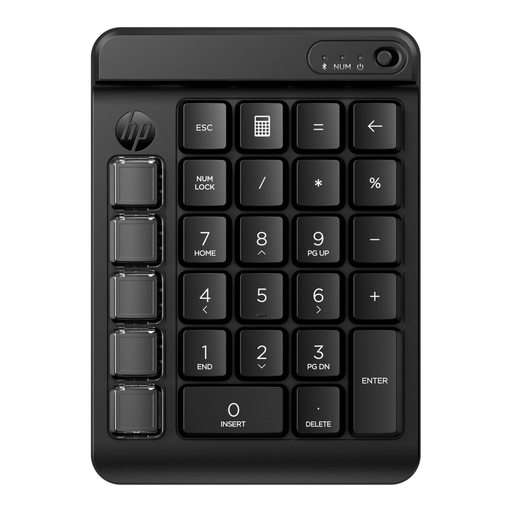
The HP 430 Programmable Wireless Keypad offers a Bluetooth route for cable-free placement.
- HP specifies an AA battery and claims battery life of up to 24 months; actual duration depends on use.
- A shared desk needs an arrangement for pairing and battery replacement.
Keychron
The K0 Max is a custom number-pad option for users who specifically need extra controls.
- Keychron describes a macro column, rotary encoder and wired, Bluetooth and 2.4 GHz connection modes.
- Confirm that those controls fit the shared workflow before taking on their configuration and connection choices.
A wireless keypad option on Joybuy
This wireless option suits savings planning where cable-free placement or programmable controls matter more than avoiding shared-desk pairing and battery upkeep.
 No image available
HP 430 Programmable Wireless Keypad
Consider this keypad if you need to position number keys away from the keyboard or want to explore custom controls for repeated planning tasks.
HP specifies Bluetooth connectivity and one AA battery, with a manufacturer-claimed battery life of up to 24 months that depends on use.
Before choosing it for a shared desk, confirm that pairing and any software needed for your intended controls are permitted, and arrange who will manage reconnection and battery replacement.
Joybuy
Common questions
Does adding a numeric keypad remove the need to assess a shared workstation?
No. The UK Health and Safety Executive says display screen equipment requirements apply to hot-desking and advises a basic risk assessment when workers change desks regularly. A keypad does not establish that the overall desk setup is suitable.
Will a wired keypad work with Windows, macOS and ChromeOS?
Check the particular model and the keys you plan to use. Kensington states that its Wired Numeric Keypad supports all three systems, but notes that some shortcuts are Windows-only.
Should a shared desk use USB-A, USB-C or Bluetooth?
Choose a connection available and permitted on the computers that share the desk. Perixx lists USB-A and USB-C variants of the PERIPAD-202, while HP specifies Bluetooth for the HP 430; Bluetooth allows cable-free placement but adds pairing and battery upkeep.
Are programmable keys useful for savings spreadsheets?
They are useful when you repeatedly perform commands that the chosen keypad can accommodate. CHERRY says the G84-4700 supports user-defined software macros; check whether the office computer permits the necessary software and whether the settings will work for everyone sharing it.


