Who needs which keypad?

Shared-desk fixture recorders

If several people enter scores, dates or reference numbers on one computer, straightforward connection, a visible Num Lock state and a keypad that stays in place are useful priorities. Kensington lists these features for its wired K79820WW.

Shortcut-driven fixture administrators

People who repeatedly use the same commands or form actions may benefit from programmable keys, provided the recording application and host setup support the intended shortcuts. CHERRY and HP offer programmable keypad options.

Flexible multi-device desk users

People who move between desk positions or compatible devices may value wireless placement more than the simplicity of a permanently connected keypad. Connection and switching requirements differ by model.

What matters when choosing?

Start with how the desk is shared, then decide whether quiet keys, repeatable shortcuts or movement between devices changes the choice.

Concern What to check Who this matters to
Ready-to-use entry Check the computer’s USB port and operating system against the keypad; look for a Num Lock indicator and a stable base. When recorders take turns at one computer, I need to enter scores without arranging a connection at each handover. Around 40% of consumers put dependable fixed-desk entry first.
Quiet shared use Look for a manufacturer’s description of key noise and check how the keypad stays in place. If others work beside me, I want key presses and desk movement to cause less disruption. Quiet use is the primary concern for around 30% of consumers.
Repeatable shortcuts Check programmable-key functions against the host system and fixture-recording application; make sure labels are clear to other users. When I repeat the same settled form actions, configurable keys may be worth setting up. Around 20% of consumers place workflow control first.
Flexible placement Check device compatibility, pairing and switching steps, and the required battery type. If I move between workstations or clear the desk after a session, I need a keypad that can move with me. For around 10% of consumers, placement and device switching come first.

Mistakes to avoid

  • Choosing Bluetooth for a permanently shared computer without a handover plan

    Pairing, device selection and battery changes can add steps for each person using the desk. Requirements vary by model: Microsoft specifies Windows 10 or 11 and Bluetooth 4.0 or later for its Number Pad.

    For one fixed computer, consider a compatible plug-and-play wired model. If the keypad needs to be wireless, agree how users will pair it, switch devices and manage its battery.

    Reconnecting a wireless keypad can also take staff or volunteer time during a handover.

  • Assuming every extra key works on every operating system

    Kensington lists Windows, macOS and ChromeOS compatibility for its K79820WW, but says some shortcut keys work only with Windows.

    Check the operating system and the particular shortcuts needed for fixture entry before relying on those keys at a mixed-OS desk.

  • Setting up macros before the recording process is settled

    Programmable keys help only when the intended actions are repeatable and their configuration works with the application. CHERRY and HP describe programmable functions, not compatibility with every fixture-recording workflow.

    Identify the recurring actions first, then check the required software and make the key labels understandable to everyone sharing the desk.

    Allow time to configure, label and retest shortcuts if the workflow changes.

  • Putting an old keypad in general rubbish

    Electrical keypads have a reuse or recycling route at end of use. Recycle Your Electricals includes items with a plug, battery or cable in its recycling guidance.

    Check local reuse and electrical-recycling arrangements, including instructions for any removable battery.

Brands to consider for these keypad routes

Kensington

The wired K79820WW represents a straightforward route for a fixed shared desk.

  • Kensington lists a USB-A plug-and-play connection, 21 keys, four shortcut keys, a Num Lock indicator and anti-slip pads; it describes the scissor keys as quiet.
  • Some shortcuts are Windows-only. Kensington labels this model as no longer available on its own page, so check the exact model’s availability and warranty terms with the seller.

CHERRY

The G84-4700 is a programmable option for a settled numeric-entry workflow.

  • CHERRY specifies 17 numeric keys, four additional keys and user-defined software macros.
  • Check that the configuration software works in the intended setup. CHERRY lists region-specific layouts, so confirm the exact variant and key legends before ordering.

HP

The HP 430 is a wireless programmable route for a desk with an agreed device handover process.

  • HP lists nine programmable keys, swappable keycaps, Bluetooth with Swift Pair support and low-profile mechanical switches. Its stated battery life is up to 24 months from one AA battery.
  • Pairing, configuration and battery management need an owner or clear instructions when several people use the keypad.

Keychron

The Q0 Max is a customisation-focused number pad for users who need more than routine fixture-number entry.

  • Keychron lists wired, 2.4 GHz wireless and Bluetooth 5.1 connections, support for three Bluetooth devices, a macro column, a rotary encoder and QMK/VIA configuration.
  • Its configuration adds work that basic numeric entry may not require. Check availability for the exact version wanted.

Joybuy product choices

This wireless programmable keypad is relevant when the fixture-entry process uses repeatable shortcuts and someone can manage setup at the shared desk.
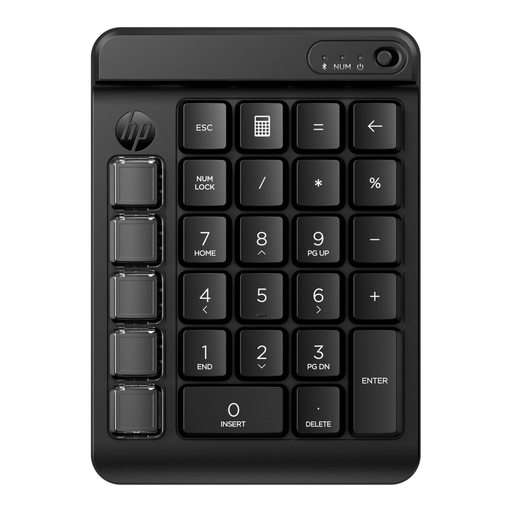
HP 430 Programmable Wireless Keypad

HP 430 Programmable Wireless Keypad

Consider this keypad when recorders need labelled, repeatable shortcuts and the desk has a clear process for Bluetooth pairing and handovers.

HP lists nine programmable keys, swappable keycaps and low-profile mechanical switches. It states battery life of up to 24 months from one AA battery.

Before relying on macros, check their compatibility with the fixture-recording application. If Num Lock visibility or grip matters at this desk, confirm those features for the exact keypad. Keep removable keycaps and batteries away from young children.

View on Joybuy

Questions about shared-desk keypads

Should a shared fixture desk use a wired or Bluetooth keypad?

A compatible wired USB keypad is usually simpler for one fixed shared computer because it needs no pairing or battery changes. Bluetooth becomes more useful when the keypad must move between positions or devices, provided users can manage pairing and batteries.

Can programmable keys help with fixture recording?

They can help when the same actions recur in a settled workflow and the keypad’s configuration method works with the host system and application. CHERRY describes software macros for the G84-4700, while HP lists nine programmable keys for the 430; check the intended commands before setting them up for shared use.

What compatibility checks matter before connecting a keypad?

Match the keypad’s connector or wireless requirements to the computer, then check support for any extra keys you intend to use. Kensington’s K79820WW uses USB-A and supports Windows, macOS and ChromeOS, although some shortcuts are Windows-only. Microsoft specifies Windows 10 or 11 with Bluetooth 4.0 or later for its Number Pad.

What should I do with a keypad at the end of its use?

Use an appropriate reuse or electrical-recycling route rather than general rubbish. Recycle Your Electricals provides guidance for items with a plug, battery or cable; check local instructions for handling any removable battery.