What matters when choosing?
Decide whether the keypad will stay beside one computer or move around the desk, then check its connection, placement and any non-numeric keys against the actual logging task.
Wired USB keypad
Choose it when: Readings are entered at one desk and avoiding pairing and batteries matters more than cable-free placement.
Allow for: The cable must reach the preferred position, and its connector must fit the computer. Kensington lists USB-A for its K79820WW; Targus lists a 5-foot USB-A/USB-C cable for its AKP13GL.
Bluetooth programmable keypad
Choose it when: The pad needs cable-free placement or recurring commands are worth assigning to dedicated keys.
Allow for: The HP 430 needs Bluetooth pairing and an AA battery; programming its keys requires HP Accessory Center.
| Concern |
What to check |
Who this matters to |
| Uninterrupted number entry |
Match a wired keypad’s connector and cable reach to the computer and desk; check whether a visible Num Lock indicator matters to your task. |
If I enter readings throughout a shift, I want number entry without stopping to pair a device or change a battery. Around 31% of consumers put uninterrupted entry first. |
| Adjustable placement |
Check where the pad can sit relative to the keyboard and mouse, including cable reach or the need for a wireless connection. |
When I change tasks at my standing desk, I want to move the pad aside without losing a comfortable working position. Placement is the primary concern for around 31% of consumers. |
| Repeatable shortcuts |
Confirm which keys can be programmed and whether the required software works on the intended computer. |
If entering a reading also means repeating the same commands, I want those actions available on dedicated keys. Around 23% of consumers prioritise workflow customisation. |
| Device fit |
Verify the operating system, available USB ports or Bluetooth support, and any model-specific limits on shortcut keys. |
When I use more than one work device or have limited desk space, I need a pad that fits the setup I actually use. Device compatibility and footprint come first for around 15% of consumers. |
Joybuy choices for programmable entry
This wireless option is relevant when meter logging involves recurring commands or a keypad that can be placed without routing a cable. For a digits-only task, weigh its setup requirements against a wired pad.
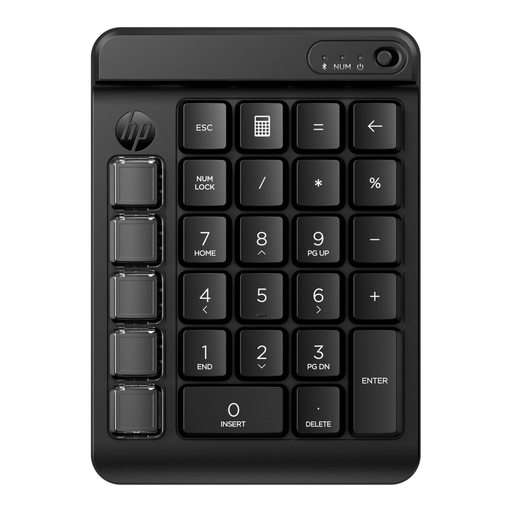 Image unavailable
HP 430 Programmable Wireless Keypad
Consider it when readings are entered alongside recurring commands or the pad needs cable-free placement at the desk.
HP lists Bluetooth and nine programmable keys for the HP 430. Programming requires HP Accessory Center; check that it works with the computer and any workplace software restrictions. Bluetooth use requires pairing and one AA battery. Before ordering, check that the numeric-key layout suits your entry process.
View on Joybuy
Common questions
Does UK display screen equipment guidance require a separate numeric keypad?
No, the Health and Safety Executive’s guidance does not prescribe a separate numeric keypad for meter entry. Where workers regularly use display screen equipment as a significant part of their normal work, the applicable workstation duties should guide equipment and layout decisions.
What should I check when using a keypad at a standing desk?
Check whether you can enter readings while maintaining a comfortable, sustainable position for the whole task. The Health and Safety Executive advises considering the workstation as a whole, so account for the keyboard, mouse and other equipment as well as the movable pad.
Should I choose USB-A, USB-C or Bluetooth?
Choose a connection your computer supports and that lets the pad sit where you need it. Kensington lists USB-A for the K79820WW, Targus lists a USB-A/USB-C cable for the AKP13GL, and HP lists Bluetooth for the HP 430; Bluetooth removes the desk cable but adds pairing and battery use.
Will a keypad’s shortcut keys work on a Mac or Chromebook?
Not necessarily: check the shortcut behaviour of the exact model, not just its general operating-system compatibility. Kensington lists Windows, macOS and ChromeOS support for the K79820WW but says some of its shortcut keys are Windows-only.


