Choose a portable wireless number pad if you need to move it around a laptop setup, a wired programmable pad for repeated codes and commands at a fixed workstation, or a customisable model if you will use its shortcuts and connection options. At a standing desk, none of these features replaces careful placement: keep the main keyboard central and just below elbow height, and position the keypad so you need not reach or twist, in line with Health and Safety Executive guidance.
Who needs a separate keypad?
High-volume questionnaire coders
If you repeatedly enter scores, response codes or numeric identifiers, a separate numeric cluster lets you keep a compact main keyboard. Programmable keys may also suit commands you use repeatedly at a fixed workstation.
Standing-desk laptop analysts
If you work from a laptop or compact keyboard, a separate pad gives you more choice about where the numbers sit as your desk height changes. Place it within comfortable reach rather than beyond the mouse.
Shortcut-heavy multi-device users
If you switch between compatible devices or use recurring analysis shortcuts, connection options and remappable keys may matter more to you than a basic numeric layout.
What matters when choosing?
Check that the keys fit your questionnaire workflow, then work out where the pad can sit at standing height. Connection method and customisation matter once those basics are settled.
| Concern | What to check | Who this matters to |
|---|
| Repeated numeric entry |
Check for the number keys, decimal separator and other keys your coding or analysis workflow requires. |
When I enter long runs of scores and response codes, I need a numeric cluster that fits the task. Around 31% of consumers put repetitive entry first. |
| Standing-desk placement |
Try the pad beside your main keyboard at your working height, without reaching across the mouse. The Health and Safety Executive advises keeping the keyboard central and just below elbow height. |
If moving between sitting and standing leaves my number pad awkwardly placed, I want room to reposition it without twisting. Roughly 31% of consumers prioritise placement. |
| Connection flexibility |
Check the exact wireless or wired mode, receiver and port requirements, and compatibility with your work device. |
When I move the pad or change devices, I need a connection that works with my setup. About 23% of consumers make connection flexibility their primary concern. |
| Custom shortcuts |
Identify commands you would assign to programmable keys and check that the configuration method suits your device. |
For repeated analysis commands, I would rather trigger a known shortcut than enter it each time. Around 15% of consumers put custom controls first. |
Mistakes to avoid
-
Assuming every wireless pad uses Bluetooth
Wireless keypads can use different connection methods. Lenovo UK specifies a 2.4 GHz receiver for the Lenovo Go Wireless Numeric Keypad, while Keychron UK lists Bluetooth, 2.4 GHz and wired modes for the K0 Max.
Check the exact model’s connection mode, available ports and any restrictions on your work device before choosing.
-
Putting the pad wherever it fits
A separate pad offers placement choice, but reaching past the mouse or twisting to use it can make the arrangement uncomfortable.
Set your desk height, then position the main keyboard and pad within easy reach. The Health and Safety Executive advises keeping the keyboard just below elbow height and avoiding a twisted posture.
-
Choosing macros without a repeatable task
Programmable keys add setup work if you only need ordinary number entry.
List the codes, commands or shortcuts you regularly use before deciding whether CHERRY’s software macros or Keychron’s remapping controls would serve a purpose.
-
Overlooking the wider workstation
For employees who use display screen equipment daily for continuous periods of an hour or more, the Health and Safety Executive says employers must assess the workstation. A changed keypad arrangement is worth considering as part of that setup.
If this describes your work, raise the revised keyboard and keypad placement through your employer’s workstation-assessment process.
Brands to consider for different keypad needs
Lenovo
The Lenovo Go Wireless Numeric Keypad illustrates a portable, conventional-layout option for a laptop or shared desk.
- Lenovo UK lists 21 keys, a 13 mm profile, a 109 g weight and a 2.4 GHz wireless connection for this model.
- Its receiver-based connection makes the available USB-A port worth checking; do not assume it supports Bluetooth.
CHERRY
The G84-4700 is a wired programmable option for a fixed station with frequent numeric entry or repeated commands.
- CHERRY specifies a USB-A connection, 17 + 4 keys and software-definable macros for this model.
- A cable affects where you can place it on a height-adjustable desk; check the exact regional variant and key legends.
Keychron
The K0 Max is aimed at workflows that can use remapping and several connection modes.
- Keychron UK lists 2.4 GHz, Bluetooth 5.3 and wired connections, QMK remapping, a macro column and a rotary encoder for the K0 Max.
- Those controls take time to configure and may add little to straightforward number entry.
Joybuy product choices
This wireless HP keypad is worth considering if repeated shortcuts are part of your questionnaire workflow. Confirm that its numeric keys match the values you need to enter.
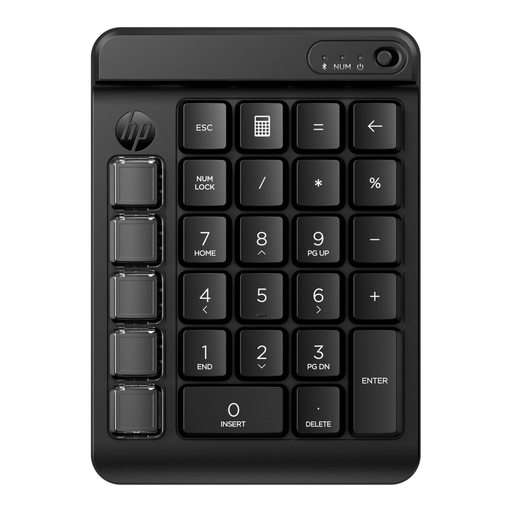 Image unavailable
HP 430 Programmable Wireless Keypad
Consider this wireless model if you have recurring commands to assign while analysing questionnaire results.
Nine programmable keys and low-profile mechanical switches are listed for the HP 430. Before buying, check that its numeric layout includes every key your data-entry workflow requires.
View on Joybuy
Common questions
Does a separate numeric keypad make a standing desk comfortable on its own?
No. It gives you more placement choice, but the whole arrangement matters. The Health and Safety Executive advises keeping the keyboard central and just below elbow height, without twisting your back; put the keypad where you can use it without reaching across the mouse.
Does adding a keypad affect a workplace screen-equipment assessment?
It can be relevant to the workstation arrangement. The Health and Safety Executive says employers must assess workstations for employees who use display screen equipment daily as part of normal work for continuous periods of an hour or more. If you change where your keyboard and keypad sit, raise the new arrangement through your employer’s assessment process.
Should I choose a receiver, Bluetooth or a wired keypad?
Choose by the ports, devices and placement your work requires. Lenovo UK specifies a 2.4 GHz receiver for the Go Wireless Numeric Keypad; Keychron UK lists receiver, Bluetooth and wired modes for the K0 Max. A wired pad avoids wireless connection management but needs a cable route that works as the desk moves.
When are programmable keys useful for questionnaire analysis?
They are useful when you can identify commands or shortcuts you repeat often enough to assign them. CHERRY specifies software macros for the G84-4700, while Keychron lists QMK remapping for the K0 Max; if you mainly enter numbers, check the basic key layout before adding configuration to your workflow.


