Small-desk spreadsheet analyst
If you enter results frequently but also need room for a mouse and paperwork, a separate keypad lets you keep numeric entry without committing desk space to a larger main keyboard.


If mouse and paperwork space is tight while you enter race results, start by considering a separate keypad: you can move it or put it away without replacing your main keyboard. A wired model avoids receiver and battery management but needs a suitable port and room for its cable; wireless placement is more flexible, while programmable keys are worth considering only if you have repeated commands to assign to them.
If you enter results frequently but also need room for a mouse and paperwork, a separate keypad lets you keep numeric entry without committing desk space to a larger main keyboard.
If you share a workspace or pack away your equipment after each session, consider how easily you can reposition the pad. The connection method, receiver, batteries and stated operating-system support all affect that choice.
If checking results involves the same spreadsheet or application commands repeatedly, programmable keys may be useful alongside digit entry—provided you can configure the commands you need.
For race-result work at a small desk, decide whether clear desk space, movable placement or repeated commands will drive your choice. A compact keyboard with an integrated number pad is a separate option if you intend to replace the main keyboard as well.
Consider it when: You mostly enter numbers at one desk and want to avoid batteries and a wireless receiver.
Trade-off: Its cable needs routing and occupies a suitable port.
Consider it when: You regularly shift the pad to another position or clear it away after a results session.
Trade-off: A receiver-based model requires you to keep track of the receiver and manage its batteries.
Consider it when: You can name spreadsheet or application commands you would assign to keys and use repeatedly.
Trade-off: Custom commands require setup and suitable configuration software.
Consider it when: You are replacing your main keyboard and want number entry in the same device.
Trade-off: The number pad stays fixed to the keyboard rather than moving independently.
| Concern | What to check | Who this matters to |
|---|---|---|
| Usable desk space | Measure the free area beside your keyboard; compare it with the full keypad dimensions and where its cable exits. | If my mouse and results sheets already take up most of the desk, I need number entry that I can move out of the way. Around 42% of consumers would put preserving that space first. |
| Movable placement | Check the required port or wireless connection and the chosen model's stated operating-system compatibility. | When I move between laptop setups, I want to place the pad where it suits the session and pack it away afterwards. For roughly 33% of consumers, that flexibility would be the primary concern. |
| Repeated commands | Identify commands you would assign, then check the programmable keys and the software needed to configure them. | If checking results means repeating the same application actions, I want those commands within reach as well as the digits. About 25% of consumers would prioritise shortcut customisation. |
An integrated number pad stays attached to the keyboard. Even if the complete keyboard fits, it cannot be moved aside independently when mouse or paperwork space becomes tight.
Measure the space beside your current keyboard before choosing. If you need to move just the number pad between sessions, look at a standalone design.
Targus states Windows, macOS and Chrome OS compatibility for its AKP13GL, while Trust describes its wired Xalas for Windows laptops. A USB connection alone does not establish support for your setup.
Check the exact model's published operating-system support and connector against the ports on the computer you will use.
If the connector does not match an available port, you may also need a suitable adapter or hub.
Trust's Xalas Wireless uses a 2.4 GHz USB micro receiver and AAA batteries. Cable-free placement still leaves you with a receiver to keep track of and batteries to maintain.
Choose this arrangement if repositioning matters to you, and decide where you will store the receiver between sessions.
Custom keys add a configuration step but offer little practical value if your work consists mainly of occasional digit entry. HP uses HP Accessory Center to set commands on its 430 keypad.
Write down the actions you repeat during result checking, then confirm that you can configure them before choosing a programmable model.
These product lines show the difference between a basic separate pad, wireless placement, programmable commands and an integrated number pad. Check the exact model rather than assuming a feature applies across a brand.
A wired standalone option for a fixed small-desk setup.
Separate Xalas keypads with wired and 2.4 GHz wireless connections.
A programmable Bluetooth route for repeated result-checking commands.
An integrated-number-pad option for someone replacing the main keyboard.
This programmable keypad is relevant if checking race results involves repeated commands as well as numeric entry. Check that its key layout suits the numbers you enter before choosing it for that task.
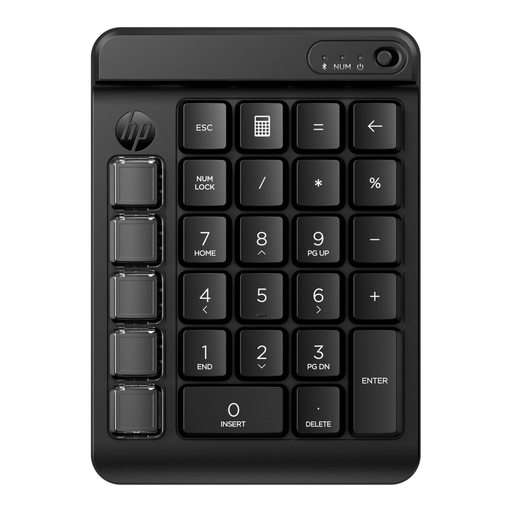 Image unavailable
Consider it if you regularly use the same commands while reviewing race results. HP lists nine programmable keys and Bluetooth connectivity for the 430; configuring custom commands uses HP Accessory Center. Before relying on it for digit entry, check that its key layout matches your workflow.
Choose a separate keypad if you need to move or put away the numeric keys without changing your main keyboard. An integrated option makes more sense if you are replacing that keyboard too; compare its complete dimensions with the space available, not just the size of its number pad.
Compatibility depends on the model. Targus states Windows, macOS and Chrome OS support for the AKP13GL, whereas Trust describes its wired Xalas for Windows laptops. Check both the stated operating systems and the connection your computer can accept.
Choose wireless if you need to shift the pad around the desk or remove it after a session. Trust's Xalas Wireless uses a 2.4 GHz USB micro receiver and AAA batteries, so that freedom of placement comes with receiver and battery management.
They can be useful if you repeatedly run commands that you can assign to keys. HP lists nine programmable keys on the 430 and uses HP Accessory Center for configuration; check the commands and software support you need before choosing it for this reason.
Check your local small-electricals collection service or an available take-back route. UK government guidance on waste electrical and electronic equipment describes recovery, reuse and recycling as aims of the framework; local collection arrangements should be checked where you live.