For straightforward entry of vote counts and decision numbers at a fixed shared desk, start with a wired USB number pad. A programmable keypad is worth considering when the recording software accepts repeatable keyboard shortcuts; Bluetooth also allows cable-free positioning, but adds pairing and battery checks. Confirm the required keys and commands before buying, and consider the whole workstation rather than treating a keypad as an ergonomic fix.
Who uses a shared-desk keypad?
Shared-desk decision clerks
Clerks entering vote counts, agenda codes or decision numbers need a keypad that can be positioned for successive users. A wired connection avoids Bluetooth pairing during handover, though keypad placement still needs to work within the whole workstation.
Shortcut-driven committee administrators
Administrators using repeatable commands for decision statuses, templates or navigation may benefit from assignable keys, provided their recording software accepts those commands and the shared computer permits configuration.
Frequent numeric-entry users
People entering figures repeatedly may prefer a dedicated numeric layout to the number row of a full-size keyboard. Key position and the space available beside the main keyboard matter at a shared desk.
What matters when choosing?
At a shared committee desk, establish how the keypad will be handed over, then check the recording software and the keys needed for its forms.
| Concern |
What to check |
Who this matters to |
| Reliable handover |
Check the available USB port, cable reach and where the keypad can sit beside the main keyboard. |
When several clerks take turns, I want the keypad ready for the next person without pairing or battery checks; around 33% of consumers put reliable handover first. |
| Decision shortcuts |
Test the exact commands in the recording application and confirm that configuration software may be installed. |
If I repeatedly enter decision statuses, assignable keys matter only when the application accepts those commands. Around 25% of consumers prioritise shortcuts. |
| Cable-free placement |
Confirm Bluetooth availability and decide who will manage pairing and the battery. |
I may need to move the keypad to a different position as desk users change, making a cable inconvenient; around 17% of consumers put flexible placement first. |
| Repeated numeric entry |
Compare the key layout with the form, including any required Enter, decimal or navigation keys, and assess its position at the desk. |
Entering counts throughout a meeting makes key location and reach important to me. Around 25% of consumers prioritise the experience of frequent number entry. |
Mistakes to avoid
-
Buying programmable keys before testing the software
Assigning a command to a key does not establish that the committee-recording application will respond to it, and configuration may require permission on the shared computer.
List the actions users repeat, test their keyboard shortcuts in the application and agree which labelled commands everyone at the desk will use.
-
Assuming wireless makes handover easier
Bluetooth allows cable-free positioning, but a shared desk also needs a clear arrangement for pairing and power management.
Choose cable-free placement when it solves a desk-layout problem; otherwise, compare the simplicity of a wired USB connection.
Wireless use can also mean time spent reconnecting the keypad and responsibility for replacing its battery.
-
Treating the keypad as the whole ergonomic solution
For workers covered by its display screen equipment guidance, the UK Health and Safety Executive says assessment should consider the whole workstation, including equipment, furniture, work conditions and the job being done.
Place the keypad within comfortable reach and review it alongside the desk, chair, display and work pattern.
-
Assuming every number pad has the required keys
Connection types, operating-system requirements, layouts and programmable functions differ between the cited models. A missing key or incompatible connection can interrupt a recording form.
Compare the actual key map with the form and confirm the workstation’s port, operating system and any adapter requirements before ordering.
Relevant brands for reference
HP
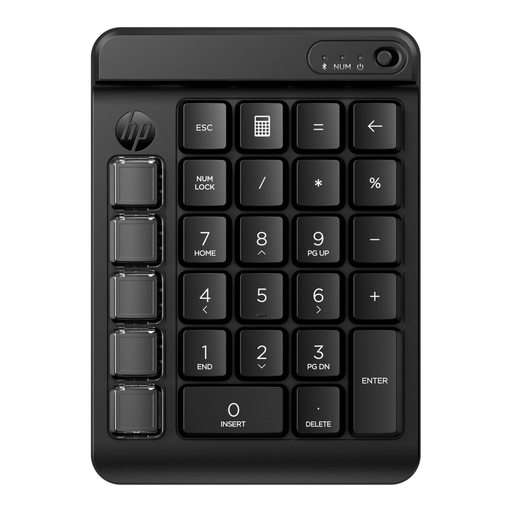
The HP 430 is a compact Bluetooth option for numeric entry and assignable shortcuts at a shared desk.
- HP lists nine programmable keys, swappable keycaps and Bluetooth with Swift Pair support for this model.
- Programming requires HP Accessory Centre, and the intended recording application must accept the assigned commands.
CHERRY
The G84-4700 is a compact wired option for frequent figure entry and programmable commands at a fixed desk.
- CHERRY specifies user-defined software macros, USB-A and a 17-plus-4-key layout for the G84-4700.
- Its listed operating system is Windows; check the shared computer and application before relying on its macros.
Targus
The AKP10EU illustrates the simpler wired number-pad approach for basic figure entry.
- RS describes the AKP10EU as an 18-key USB numeric pad with 19 mm concave keys and PC/Mac compatibility.
- RS says it will no longer stock this model; check availability elsewhere if this particular layout suits the desk.
A Joybuy option for programmable entry
This Bluetooth keypad suits a shared desk where labelled, repeatable commands and cable-free positioning are useful, provided the recording application accepts the chosen shortcuts.
 No image available
HP 430 Programmable Wireless Keypad
Consider this model when clerks can use repeatable keyboard commands in their decision-recording application and need to reposition the keypad without a cable.
HP specifies nine programmable keys, swappable keycaps and Bluetooth with Swift Pair support. HP states a battery life of up to 24 months from one AA battery; actual battery life will depend on use.
Programming requires HP Accessory Centre. Before buying, check installation permission, the application’s shortcuts and whether the keypad has every numeric, Enter or decimal key your form requires.
View on Joybuy
Common questions
Does a shared committee desk need a workstation assessment?
For workers who use display screen equipment daily for continuous periods of an hour or more, the UK Health and Safety Executive says employers must carry out a workstation assessment. That assessment considers the whole workstation and the job, not just the numeric keypad.
Can a programmable keypad record committee decisions automatically?
A programmable keypad can trigger an intended action only if the specific recording application accepts the assigned shortcut or macro. Test the required commands in that application and confirm that configuration is permitted on the shared computer.
Is wired USB or Bluetooth more practical at a shared desk?
Wired USB suits a fixed position when users want to avoid pairing and battery checks. Bluetooth suits a desk where cable-free repositioning matters, provided the computer supports it and someone is responsible for pairing and battery replacement.
How should an organisation dispose of an unwanted keypad?
Check the organisation’s approved electrical-equipment disposal process or an applicable retailer take-back option rather than assuming the keypad belongs in general waste. GOV.UK’s guidance explains that waste electrical and electronic equipment is regulated to encourage recovery, reuse and recycling.


