Cable- and port-conscious budgeters
If you update a budget on a laptop or compact desk, a Bluetooth keypad can leave computer USB ports free and avoid a permanent cable. Check Bluetooth compatibility and allow for charging or battery replacement.


A numeric keypad need not use a mains socket. Choose wired USB if your computer has a free compatible port and you want to avoid pairing and batteries; choose Bluetooth if keeping USB ports free and removing a permanent desk cable matters more. Check device compatibility and the wireless model’s battery or charging requirements before buying.
If you update a budget on a laptop or compact desk, a Bluetooth keypad can leave computer USB ports free and avoid a permanent cable. Check Bluetooth compatibility and allow for charging or battery replacement.
If you work at one regular desk and have a spare computer USB port, a wired keypad avoids Bluetooth pairing and keypad battery checks.
If your budgeting routine involves repeated spreadsheet or calculator commands, programmable keys may be useful—but only if you can configure them for the software you use.
Limited wall sockets do not, by themselves, call for a wireless keypad. Decide whether you can spare a computer USB port, then consider how much pairing, battery management or shortcut configuration you want.
| Concern | What to check | Who this matters to |
|---|---|---|
| Ports and cables | Check for a free USB-A or USB-C port, or compatible Bluetooth. A wireless keypad still needs charging or a replaceable battery. | When I update a budget on a laptop at a compact desk, I want to keep its USB ports free and avoid another permanent cable; around 42% of consumers put ports and cables first. |
| Ready-to-use entry | Check the wired connector, cable reach and operating-system support, along with the keys you use in your spreadsheet. | At my regular budget desk, I want to enter figures without pairing or checking a keypad battery; about 33% of consumers prioritise straightforward number entry. |
| Spreadsheet shortcuts | Check the programmable keys and whether their configuration software supports your operating system. | If I repeatedly use spreadsheet or calculator commands, I want shortcuts I will actually configure; roughly 25% of consumers make custom controls their primary concern. |
A wireless keypad removes the permanent data cable, not the need for power. The product information lists one AA battery for the HP 430, while Satechi specifies USB-C charging for its Slim Wireless Keypad.
Choose wired USB if avoiding keypad battery management matters most. Otherwise, decide whether periodic charging or replacing a battery suits you.
A wired keypad does not need its own mains socket, but it does occupy a compatible computer USB port.
Inspect your available ports before ordering. Targus specifies a dual USB-A/USB-C cable for its AKP13GL; check that the supplied connectors match your computer.
Key output and compatibility depend on the model. Satechi cautions that its Slim Wireless Keypad’s output can differ outside default iOS and macOS settings.
Check the exact model’s supported operating systems and any notes about the calculator, Delete, Num Lock and shortcut keys you expect to use.
Programmable keys and mechanical options add choices to configure, while basic budget entry may call only for a conventional numeric layout.
List the commands you repeat in your spreadsheet before deciding whether programmable controls are worth having.
The AKP13GL is a wired option for a fixed desk with a spare computer USB port.
The HP 430 is a Bluetooth option for keeping a computer USB port free while adding programmable controls.
The Q0 Max is a custom keypad to consider if macros and connection options are part of your regular workflow.
The Slim Wireless Keypad is a rechargeable Bluetooth option for a desk without a permanent keypad cable.
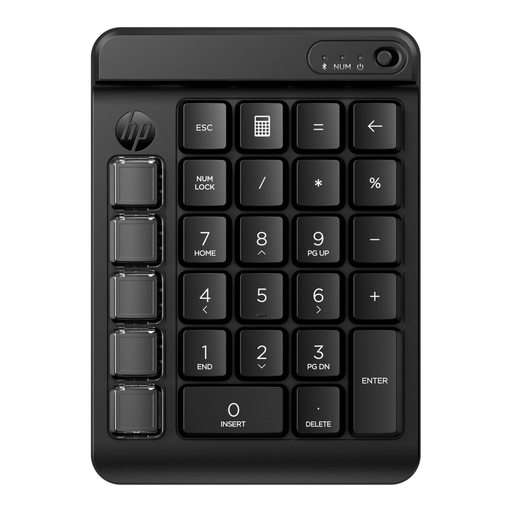
This HP 430 Bluetooth keypad is a choice for household-budget entry when you want to keep a computer USB port free and may use programmable spreadsheet shortcuts.
 No image available
For budget spreadsheets where avoiding a permanent USB cable matters. The HP 430 uses Bluetooth;the product information lists nine programmable keys and one AA battery for the model. Check compatibility and key-programming software before relying on shortcuts.
A wired USB keypad or battery-powered wireless keypad does not normally need its own mains socket. A rechargeable model still needs periodic USB charging; check how the particular keypad is powered.
Choose wired USB if you have a spare compatible computer port and want to avoid pairing and battery upkeep. Choose Bluetooth if keeping that port free and removing a permanent desk cable matters more, provided your device supports the keypad’s connection.
Do not assume its charging cable carries keypad input. Satechi says its Slim Wireless Keypad can work wirelessly while charging but cannot be used as a direct wired input device; check the manual for the model you are considering.
Check your local authority’s collection instructions for electrical items and batteries, and ask the retailer about take-back options. GOV.UK describes the UK’s waste electrical and electronic equipment rules as aiming to reduce electrical waste sent to landfill or incineration.