Parents packing dairy yoghurt for a nursery child
You need a portion the child can manage, with a label staff can identify and a way to keep it cool until lunch. Check the nursery’s food and allergy arrangements before choosing a pack.


Individually sealed yoghurt pots are straightforward to pack for nursery because they need no decanting and keep the product label with the portion. A large tub is an option if the nursery accepts food portioned at home and you can label and chill it. Check the child’s milk-allergy arrangements and the nursery’s rules first; if lunchboxes are not refrigerated, the NHS advises using an insulated box with an ice pack.
You need a portion the child can manage, with a label staff can identify and a way to keep it cool until lunch. Check the nursery’s food and allergy arrangements before choosing a pack.
You want to compare ingredients and nutrition information for the exact pots you might pack, rather than assuming every flavour or product from a brand has the same recipe.
Sealed multipack pots avoid routinely decanting a large tub. You will still need to arrange cold storage for the journey and the nursery morning.
Choose a format the nursery accepts, then check the exact pot’s label and how the lunch will be kept cool.
Consider when: You want a sealed portion without decanting; Yeo Valley describes its Little Yeos Greek Style Natural six-pack as made with organic whole milk and no added sugar.
Keep in mind: It still contains milk and needs suitable cold storage; check the exact pack and the nursery’s rules.
Consider when: Your child already eats the chosen yoghurt and you want several ready-to-pack portions.
Keep in mind: Fruit, corner and no-added-sugar varieties have different recipes; check the exact flavour rather than relying on the brand or pack size.
Consider when: The nursery accepts home-portioned food and you can send a securely closed, labelled serving with a spoon.
Keep in mind: Portioning adds preparation, and both the serving and opened tub need to be handled according to the product’s storage directions.
| Priority | What to check | Your needs |
|---|---|---|
| Cold storage | Ask whether the nursery refrigerates lunchboxes. If it does not, the NHS advises an insulated box with an ice pack; follow the yoghurt’s storage instructions too. | My child’s yoghurt needs to stay cool from leaving home until lunch. |
| Milk and allergens | Read the exact pot’s allergen declaration and check the nursery’s food policy. The Food Standards Agency identifies milk as a common ingredient in yoghurt; Department for Education allergy guidance also addresses labelling and safe storage of food brought from home for English schools and is described as useful for early-years settings. | I need staff to be able to identify what is in the lunchbox and follow the child’s allergy arrangements. |
| Ingredients and nutrition | Compare the ingredients and nutrition panel for the chosen flavour, including sugars per 100 g and per pot. Check product-specific claims such as ‘no added sugar’ rather than applying them to a whole range. | For an everyday pot, I want to know how a plain option differs from the flavoured yoghurts my child eats. |
| Portion and preparation | Count the pots and check the amount in each. For a large tub, confirm that the nursery accepts a labelled container and check its directions for storage after opening. | Several ready-to-pack portions would make mornings simpler; if I portion a tub, I can prepare and chill the serving safely. |
Plain, fruit and corner-style yoghurts can differ by flavour and variant, even when their pot sizes look alike.
Compare the current ingredients, allergen declaration and nutrition panel on the exact pack you intend to send.
A sealed pot still needs appropriate storage. The NHS advises an insulated box with an ice pack if the nursery does not refrigerate lunchboxes.
Ask where packed lunches are kept and follow the yoghurt’s storage directions.
If there is no nursery fridge, you may need an insulated lunchbox and ice pack.
Yoghurt commonly contains milk. Nursery staff also need to be able to identify food brought from home and follow arrangements for children with known allergies.
Read the nursery’s policy, check the pot’s allergen declaration and keep the original labelled pot where practical. Do not pack milk-containing yoghurt for a child with a milk allergy.
A tub requires a separate, secure serving container and must be stored as its label directs after opening. Tesco Groceries, for example, lists a three-day refrigerated use period after opening for Onken Raspberry 450 g.
Use a tub for nursery only if home-portioned food is accepted and you can label and chill the serving.
These examples show formats to compare, not a judgement that every product from a brand has the same ingredients or is suitable for a particular nursery.
Its Little Yeos range includes child-size pots, alongside other yoghurt multipacks.
UK grocery listings include fruit multipacks in several pack sizes.
Its multipack formats include Müller Corner pots in UK grocery listings.
An organic fruit-yoghurt multipack is one format to compare with plain or child-size pots.
Own-label multipacks offer another pot format to compare when shopping for nursery lunches.
Its large tubs are more relevant to sharing at home or portioning before nursery than to packing an unopened individual pot.
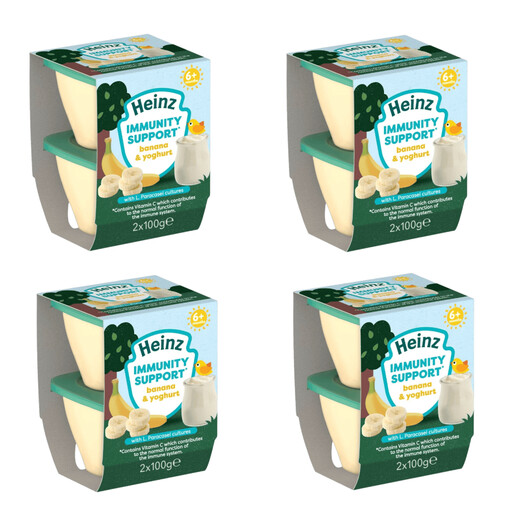
This option is a multipack of individual yoghurt-and-fruit pots. Check its age label, milk declaration and the nursery’s arrangements before choosing it for a lunchbox.
 No image available
Eight individually sealed pots, supplied as four twin-packs, provide separate portions for nursery lunches. The product is labelled for children aged 6+ months and contains milk. Check the current ingredients and nutrition panel if you are comparing it with plain or no-added-sugar yoghurt, and follow the nursery’s allergy and cold-storage arrangements.
Yes, if the nursery permits it and you can keep it cool. The NHS advises an insulated box with an ice pack when lunchboxes are not kept in a nursery fridge. Include a spoon if the child needs one.
Do not pack milk-containing yoghurt for a child with a milk allergy. The Food Standards Agency identifies milk as a common ingredient in yoghurt; check the exact label and follow the child’s individual plan and the nursery’s allergy policy when choosing food to send.
Follow the nursery’s food and allergy policy, and keep the product identifiable. Department for Education allergy guidance for specified English schools addresses clear labelling, preparation and storage of food brought from home; it is also described as useful for early-years settings.
Compare the exact flavours’ ingredients and nutrition panels, including sugars per 100 g and per pot. A no-added-sugar claim applies to the labelled product, not every flavour in its range, and does not make different yoghurts nutritionally interchangeable.
Yes, if the nursery accepts home-portioned food and you can send it in a secure, labelled container while keeping it chilled. Follow the tub’s directions after opening; a sealed individual pot avoids the extra portioning step and retains its original label.