First establish whether you need the snack itself to qualify as low fat, or whether you can account for its fat within a wider eating plan. The Tesco, KP and M&S nut bags described below do not meet the UK low-fat condition for solid foods; if nuts fit your plan, compare fat per pack as well as per 100 g, then check the serving size, ingredients and allergens.
Who needs to check the label?
People who need a low-fat food
If the snack itself must qualify as low fat, a small bag is not enough to establish that. The Tesco, KP and M&S examples below exceed the UK condition for a low-fat solid food, which legislation.gov.uk states as no more than 3 g fat per 100 g.
People planning the fat in a serving
If nuts are permitted within your eating plan, the declared fat in the portion you intend to eat matters alongside the per-100 g figure. A sealed bag gives you a stated quantity, but its full contents may be more than you intended for one snack.
People checking salt or allergens
Recipes and precautionary allergen statements vary between products. The Food Standards Agency distinguishes peanuts, which are legumes, from tree nuts; check the exact pack rather than assuming one nut or peanut snack can replace another.
What matters when choosing a bag?
Start with the type of low-fat requirement you are following, then use the pack label to work out what your intended serving contributes.
| Priority |
What to check |
Your needs |
| Low-fat status |
Check total fat per 100 g. Legislation.gov.uk gives a limit of 3 g fat per 100 g for a low-fat claim on solid food; this is a food-claim condition, not a personal daily allowance. |
Does the snack itself need to qualify as low fat? If so, a smaller portion of a higher-fat product does not change its per-100 g figure. |
| Portion size |
Read both the stated serving size and fat per pack. Tesco Groceries lists 13.6 g fat in its 25 g Mixed Nuts & Pecans bag, compared with 26.8 g in its 55 g Roasted Nut Snack Pack. |
I can account for nuts within my eating plan, but I want to know what I would consume if I finished the bag. |
| Recipe and salt |
Compare salt per pack and read the ingredients, not just the roasting or flavour description. Tesco Groceries lists less than 0.01 g salt per 25 g Mixed Nuts & Pecans bag; its KP Dry Roasted Peanuts listing gives 0.48 g per 30 g sachet. |
Salt or added ingredients matter to me as well as fat, so I want to compare the particular flavours I might buy. |
| Allergens and suitability |
Read the current ingredients, allergen and precautionary statements. Check any whole-nut warning when choosing food for a young child. |
If the snack is for someone else, I need to check their requirements against that exact product rather than relying on the category name. |
Common mistakes to avoid
-
Assuming a small bag is a low-fat food
A smaller bag changes the amount eaten, not the fat per 100 g. For example, Tesco Groceries lists 54.4 g fat per 100 g for its 25 g Mixed Nuts & Pecans bag, above the 3 g-per-100 g UK low-fat condition for solids stated by legislation.gov.uk.
Decide whether you need a qualifying low-fat food or a portion whose fat you can account for. If the food itself must qualify, check another snack category.
-
Letting protein or fibre wording answer the fat question
Protein or fibre information does not alter the declared fat content. The Tesco Groceries listings for KP peanut sachets give 14 g fat per dry-roasted 30 g pack and 15 g per salted 30 g pack.
Read total fat per 100 g and for the portion you will eat before considering other nutrition information.
-
Looking at fat but overlooking the recipe
Flavours have different ingredient and salt declarations. Tesco Groceries lists 0.48 g salt in a 30 g KP Dry Roasted Peanuts sachet, while the M&S Sweet & Salty Nut Mix described by Ocado contains sweetened ingredients as well as salt.
Compare the current packs for fat, saturates, salt, sugars and ingredients if those details affect your choice.
-
Treating peanuts and tree nuts as interchangeable
The Food Standards Agency classifies peanuts as legumes, distinct from tree nuts. Individual products may also carry additional allergen or precautionary statements.
For a person with an allergy, follow their clinical advice and check the exact current label before offering or substituting a snack.
Brand and product-line references
These labelled examples show why pack size and recipe matter; the figures apply to the named products, not to every product from each brand.
Tesco
Tesco Groceries lists a 25 g Mixed Nuts & Pecans bag and a 55 g Roasted Nut Snack Pack with different amounts of fat per pack.
- The Mixed Nuts & Pecans bag lists 13.6 g fat and less than 0.01 g salt per 25 g pack.
- The Roasted Nut Snack Pack lists 26.8 g fat per 55 g pack; neither named product meets the UK low-fat condition for solid foods.
KP
Tesco Groceries lists KP salted and dry-roasted peanut snack packs in 30 g sachets.
- A stated 30 g sachet makes the declared per-pack amounts straightforward to compare.
- The dry-roasted sachet lists 14 g fat and 0.48 g salt; the salted sachet lists 15 g fat and 0.36 g salt. Neither is a low-fat food.
M&S
Ocado lists M&S Sweet & Salty Nut Mix as a five-pack of snack bags and M&S Fruit & Nuts as a pouch described as two servings.
- The Sweet & Salty Nut Mix has a stated 25 g individual bag, which can be compared with its nutrition information per 100 g.
- Ocado lists 49.4 g fat per 100 g for the Sweet & Salty mix. Its Fruit & Nuts listing gives 29.5 g fat and 35.5 g sugars per 100 g; neither figure makes it a low-fat substitute.
Chestnut options on Joybuy
These chestnut products offer a different format from the peanut and mixed-nut bags discussed above. If you need a food that qualifies as low fat, check the fat per 100 g on the exact pack; also check how its contents are portioned before using it as a grab bag.
 No image available
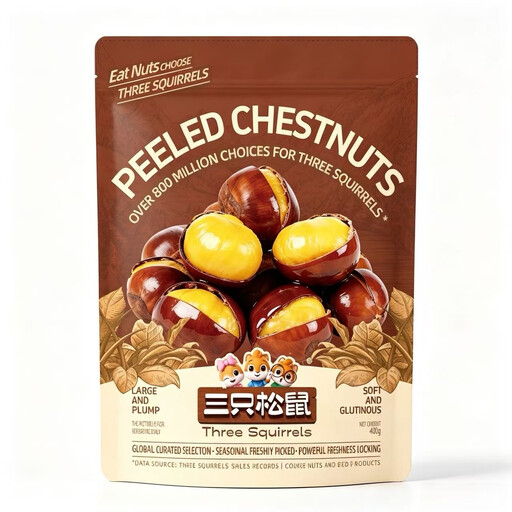
Three Squirrels Sweet Chestnut Kernels 400g
For a portioned chestnut snack, check the nutrition information for the amount you plan to eat and how the listed 400g is divided. Compare fat per 100 g with your requirement rather than assuming that a chestnut product qualifies as low fat.
View on Joybuy
 No image available
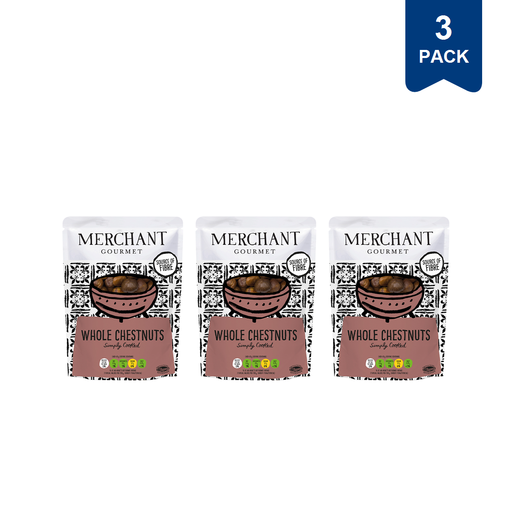
Merchant Gourmet Whole Chestnuts 180g (3 Packs)
If you want a grab-bag portion, check how the stated 180g and three packs are divided before deciding what counts as one serving. Read the current fat declaration and allergen statement for the exact pack.
View on Joybuy
Questions about nut grab bags
Does a small nut bag count as a low-fat food?
Not solely because it is small. Legislation.gov.uk states that a low-fat claim for a solid food requires no more than 3 g fat per 100 g. Tesco Groceries lists 54.4 g per 100 g for its 25 g Mixed Nuts & Pecans bag, so its small portion does not make that product low fat.
How should I compare bags if nuts fit my eating plan?
Compare the fat in the amount you intend to eat, using per-pack information where the whole bag is your serving. Tesco Groceries lists 13.6 g fat for its 25 g Mixed Nuts & Pecans bag and 26.8 g for its 55 g Roasted Nut Snack Pack; the larger bag need not be treated as one serving.
Is dry-roasted necessarily lower in salt or fat than salted?
No conclusion follows from those descriptions alone. Tesco Groceries lists 14 g fat and 0.48 g salt per 30 g KP Dry Roasted Peanuts sachet, compared with 15 g fat and 0.36 g salt per 30 g KP Salted Peanuts sachet. Compare the labels of the products you are considering.
What should I check before giving a nut snack to someone else?
Check the exact pack’s ingredients, allergen statements and any warning about whole nuts and young children. The Food Standards Agency distinguishes peanuts from tree nuts, and the name of a nut mix does not tell you every ingredient or precautionary warning it carries.


