For a school-holiday lunch, consider a whole-nut grab bag only if the child can safely eat whole nuts, has no relevant allergy and the school or holiday club allows them. The NHS says not to give whole nuts to children under five; for an older child, compare the actual pouch size, salt, sugars and allergen wording before choosing. KP’s 5 × 30g peanut multipacks provide individual pouches, while Tesco’s almond snack pack contains 60g rather than a single 30g pouch, according to their Tesco Groceries listings.
Who needs to consider what?
Parents packing holiday-club lunches
Check the named club’s lunchbox and allergy policy before packing nuts, alongside the child’s own allergy needs. The Department for Education says schools in England must publish an allergy safety policy; that does not establish a rule for every holiday club.
Families considering whole nuts for children aged five and over
Consider the child’s ability to eat the snack safely, not just the pack size. The NHS says whole nuts should not be given to children under five because of choking risk.
Shoppers seeking an individual savoury snack
Check whether the pack contains separate pouches and compare nutrition on the amount that will actually be served. Tesco Groceries lists KP peanut multipacks with 30g pouches, but its almond snack pack contains 60g.
What should you check before choosing?
Start with whether nuts are suitable for the child and setting, then compare the portion and label values on the same basis.
| Priority | What to check | Your needs |
|---|
| Allergies and setting rules |
Check the setting’s current policy, the ingredients and any precautionary allergen wording on the pack. Follow the child’s allergy-management advice when assessing cross-contact warnings. |
I need a lunchbox snack that the setting permits and that is suitable for this child’s allergies. If either condition rules out nuts, I’ll choose a non-nut snack. |
| Age and texture |
The NHS says not to give whole nuts to children under five. For younger children, choose an age-appropriate food texture instead of a whole-nut grab bag. |
For a child under five, a pouch of whole nuts is not the right format, however conveniently it is packed. |
| Pack size |
Read the net weight and count the inner pouches. Tesco Groceries lists KP peanut multipacks as 5 × 30g, while its almond snack pack contains 60g. |
One separately wrapped pouch would be convenient for this lunch; if I choose a larger pack, I’ll decide how much to serve rather than treating the whole pack as 30g. |
| Salt, sugars and flavour |
Compare values per 30g, then check the ingredient list. Tesco Groceries lists 0.36g salt and 1.5g sugars for KP original salted peanuts and 0.48g salt and 1.5g sugars for its dry-roasted listing; ASDA Groceries lists 0.23g salt and 4.2g sugars for KP honey roast. |
If the child prefers honey-roast flavour, I still want to compare its sugars as well as its salt. A flavour name alone does not tell me how these pouches differ. |
Common lunchbox mistakes
-
Assuming nuts are allowed during the holidays
A school or holiday club’s allergy arrangements can affect what may be packed, regardless of the snack’s portion size.
Check the named setting’s current lunchbox and allergy policy before buying a multipack for its lunches.
-
Giving a young child a pouch of whole nuts
The NHS says whole nuts are a choking risk for children under five.
Do not use a whole-nut grab bag for that age group; choose an age-appropriate alternative.
-
Assuming equal-sized pouches have equal label values
For 30g KP peanut pouches, Tesco Groceries lists 0.36g salt for original salted and 0.48g for dry roasted; ASDA Groceries lists 0.23g salt and 4.2g sugars for honey roast.
Compare salt and sugars per pouch before choosing a flavour, and check the pack being served.
-
Treating every snack pack as one 30g portion
Tesco Groceries lists its almond snack pack at 60g, although it also gives nutrition information per 30g.
Check the full pack weight and whether it contains inner pouches if a separate 30g portion matters.
Relevant brand and retailer ranges
KP
Tesco Groceries and ASDA Groceries list KP peanut multipacks in 30g salted, dry-roasted and honey-roast pouches.
- Separate 30g pouches make the amount in one bag clear.
- The variants differ: Tesco Groceries lists 0.36g salt for original salted and 0.48g for dry roasted per pouch; ASDA Groceries lists 4.2g sugars for honey roast per pouch. Check the variant’s own allergen label.
Tesco
Tesco Groceries lists an own-label almond snack pack containing 60g, rather than separate 30g pouches.
- Its listing names almonds as the ingredient and gives less than 0.01g salt per 30g.
- The full pack is 60g, and the listing says it may contain peanuts, other nuts, sesame seeds and soya.
M&S Food
M&S Food lists a 70g cashew-nut pack as another whole-nut format to compare with peanut multipacks.
- The listing identifies the nut type and gives nutrition values per 100g, including 0.05g salt.
- It is a 70g pack, not a separate 30g pouch. M&S Food states that it is unsuitable for people with a nut or peanut allergy.
Joybuy nut snack options
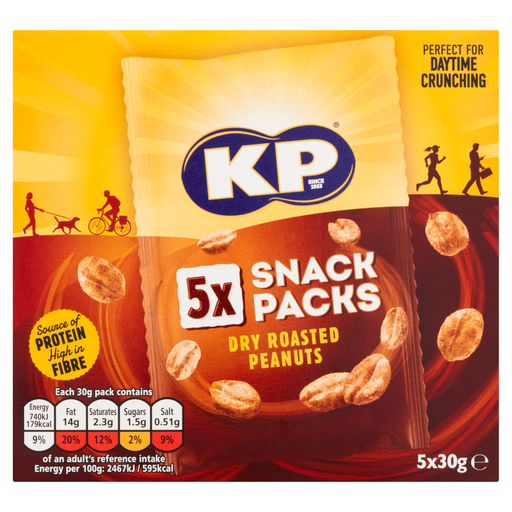
This dry-roasted peanut multipack is an option to consider when separate 30g pouches suit the lunch and whole nuts are appropriate for the child and permitted by the setting.
 No image available
KP Snacks Dry Roasted Peanuts 5 × 30g
Five individual 30g pouches provide a defined amount for a permitted whole-nut lunchbox snack. Check the physical pack’s ingredients and allergen wording before serving.
View on Joybuy
Frequently asked questions
Can I pack nuts for a holiday club or school lunch?
Check that setting’s current allergy and lunchbox policy before packing them. The Department for Education says schools in England must publish an allergy safety policy, but that does not mean nuts are permitted in every school or holiday club.
Can a child under five have a whole-nut grab bag?
No. The NHS says not to give whole nuts to children under five because of choking risk; choose an age-appropriate alternative to a bag of whole nuts.
Are peanuts and tree nuts the same allergen?
No. The Food Standards Agency identifies peanuts as legumes and distinguishes them from tree nuts such as almonds and cashews. Check the child’s allergy-management advice and the product’s actual declaration rather than assuming that tolerance of one means tolerance of the other.
Does “may contain” mean an allergen is an ingredient?
Not necessarily. The Food Standards Agency explains that precautionary allergen labelling communicates that an allergen could be unintentionally present. For a child with an allergy, assess that warning using their allergy-management advice.
Is an online listing enough to check allergens?
Read the physical pack before serving, even if you used a listing to compare options. Ingredients and allergen wording on the pack are the details to check for the product in hand.


