Regular nut-loaf bakers
If you make a nut loaf regularly, check for a stated bake or roast function, a suitable temperature range and enough usable space for your own tin. A litre-capacity figure cannot settle the fit question.


If your loaf tin fits and the shared full-size oven is reliably available, you may not need another appliance. Otherwise, consider a fan-assisted mini oven for conventional loaf-tin baking or an air-fryer oven with stated bake or roast controls. Check the usable interior, worktop space, electrical load and cleaning arrangements before choosing.
If you make a nut loaf regularly, check for a stated bake or roast function, a suitable temperature range and enough usable space for your own tin. A litre-capacity figure cannot settle the fit question.
If the appliance must be moved or stored after use, consider its external dimensions, cable reach and cleaning routine as well as its cooking controls. Electrical Safety First advises against overloading sockets and extension leads.
If someone sharing the kitchen avoids nuts, plan how tins, accessories and preparation areas will be cleaned and kept separate. Food Standards Agency guidance for food businesses stresses protecting other foods from allergen cross-contact; a separate oven alone does not establish safety.
Consider it when: Your main task is baking a loaf in a conventional tin and you want an oven with stated temperature controls.
Allow for: Worktop depth and electrical load; even a 30L model needs a separate check for tin clearance.
Consider it when: You also want its other cooking functions and the exact model states bake or roast controls suitable for your recipe.
Allow for: The arrangement of trays and racks may restrict which loaf tin you can use.
Keep using it when: It is available when you need it and already accommodates your tin.
Allow for: Shared scheduling and the same cleaning and nut-separation arrangements you would need with a new appliance.
| Concern | What to check | Who this matters to |
|---|---|---|
| Loaf baking and tin fit | Compare your tin with the usable rack, cavity and door clearance; confirm the bake or roast controls reach your recipe temperature. | I want my usual loaf tin to sit level and leave enough clearance for baking. Around 44% of consumers put loaf baking and tin fit first. |
| Shared space and power | Check external dimensions and the manual's placement requirements, then assess the appliance rating and the combined load on its socket or lead. | When worktop and sockets are shared, I need somewhere practical to use and store the oven. For around 33% of consumers, that shared-kitchen practicality is the primary concern. |
| Nut-allergen separation | Check which accessories and food-contact areas can be cleaned as instructed; agree how nut-containing equipment will be used and stored. | I share equipment with someone who avoids nuts, so residue and accessory separation affect whether the arrangement works. Nut-allergen separation comes first for around 23% of consumers. |
An 11L, 13L or 30L label does not tell you the rack width, door clearance or space above your loaf tin.
Measure the tin, including its rim, and compare it with the exact oven's documented usable interior before buying.
Electrical Safety First warns that ovens and grills used alongside other large appliances can overload an extension lead, creating a fire risk.
Use a suitable wall socket where possible. If a lead is necessary, check its marked rating against the combined load and do not connect extension leads to one another.
Nut residue can remain on accessories and surrounding preparation areas. Food Standards Agency allergen-control guidance applies to food-business settings; it does not certify a domestic oven as allergen-safe.
Agree a cleaning and storage routine with other kitchen users, using clearly identified separate accessories where needed.
Tefal and Instant make product-specific claims based on particular comparisons. Those conditions do not establish the same result for a dense loaf in your chosen tin.
Prioritise fit and cooking controls, then use a suitable recipe and check the loaf as it cooks rather than assuming a claimed time applies.
These models illustrate different oven formats; compare the exact appliance rather than treating a brand name as a guarantee of loaf-tin fit.
Its 22780 mini oven and Express 12.6L air-fryer mini oven illustrate a larger fan-assisted format and a smaller multifunction format.
The Easy Fry FW501 is an 11L air-fryer oven with stated bake and roast functions.
The Vortex Plus 13L is a multifunction air-fryer oven with stated bake and roast functions and two cooking levels.
Ninja is among the brands covered by Which? in its UK mini-oven testing programme.
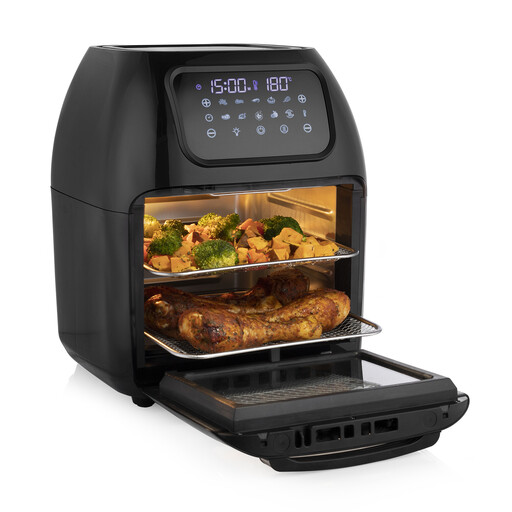
This air-fryer oven is a countertop option to investigate for a shared kitchen. Before choosing it for a nut loaf, confirm its cooking controls and the space available for your tin.
 No image available
Consider this countertop oven if you want an air-fryer format, provided its controls and usable interior suit your nut-loaf recipe and tin.
The product is listed with a 10L capacity, 1800W rating, touch screen, 10 programmes and dishwasher-safe parts. Check which parts the cleaning instructions cover; dishwasher-safe parts do not make the appliance allergen-safe.
Before use in a shared kitchen, check the combined electrical load and agree how accessories used for nuts will be cleaned and stored.
Check the usable rack width and depth, door opening and clearance above your actual tin before assuming it will fit. A stated capacity in litres cannot answer those questions on its own.
Use one only if its marked rating accommodates the combined load of everything connected to it and it can be used safely. Electrical Safety First warns that ovens and grills may overload a lead shared with other large appliances; a suitable wall socket avoids that shared-lead arrangement.
No: a separate appliance alone does not establish that accessories or preparation areas are free of nut residue. Agree a cleaning and separation routine if another kitchen user avoids nuts. For food-business operations, check the allergen-control requirements applicable to that operation; Food Standards Agency guidance addresses protecting other foods from cross-contamination.
Not on their own. Tefal and Instant make speed or energy claims for particular product comparisons, which do not establish how your nut loaf will cook. Start with tin fit, the required bake or roast controls and the practicalities of using the appliance in your shared kitchen.