Gym-goers carrying a snack
A 30g pack can go in a gym bag or desk drawer for after a session. If your training leaves you wanting a fuller meal, plan the rest of your food separately rather than treating the nuts as a complete meal.


A five-pack of 30g peanuts is a convenient choice when you want separate post-gym snacks to carry or share. Salted and dry-roasted KP packs each list 9g protein and 1.5g sugars per pack, but their salt content differs; honey-roasted packs list more sugars. Nuts need not be the whole post-training meal: the British Nutrition Foundation identifies carbohydrate as a fuel for exercise, so consider what else you will eat after your session.
Separate packs are useful when portability and a stated serving size matter more than opening one larger bag.
A 30g pack can go in a gym bag or desk drawer for after a session. If your training leaves you wanting a fuller meal, plan the rest of your food separately rather than treating the nuts as a complete meal.
Five separate 30g packs let you take one at a time or share them without repeatedly opening a larger bag. Check that the ingredients and allergen statements suit everyone who may eat one.
Salted, dry-roasted and honey-roasted KP packs have different sugars, salt and protein values per 30g. Compare the exact flavour’s label as well as its taste.
Start with the pack format, then compare nutrition per individual pack and read the allergen information for the person who will eat it.
| Priority | What to check | Your needs |
|---|---|---|
| After-training food | Check protein per pack and consider what other food you will have. The British Nutrition Foundation describes carbohydrate as a fuel for exercise; the amount and intensity of activity affect dietary needs. | I want something to carry after the gym, but may also want another food or a meal after a demanding session. |
| Portions | Read both the outer-pack count and the serving size. The KP multipacks listed by Tesco, Ocado and Asda contain five 30g packs; compare nutrition per pack, not just per 100g. | Separate packs would make it easier to set aside snacks for different days or share them with someone else. |
| Flavour and label | Compare sugars, salt and protein for the exact variant. Tesco and Ocado list 1.5g sugars and 9g protein per 30g salted pack; Ocado lists the same amounts for dry-roasted. Asda lists 4.2g sugars and 8.1g protein for honey-roasted. | I might prefer honey-roasted peanuts for their flavour, or choose between the other variants using their per-pack figures. |
| Salt | Do not judge salt content by the flavour name. Tesco lists 0.36g salt per 30g KP salted pack, while Ocado lists 0.48g for the dry-roasted pack. | If salt matters to my choice, I want the figure for the particular pack I am buying. |
| Allergens | Read the current ingredients and any may-contain statement on the physical pack. GOV.UK says regulated allergens in prepacked food must be clearly labelled in the ingredients list. | I need to check whether the snack suits each person who might eat it, including anyone for whom cross-contact warnings matter. |
A small pack is a portable snack, but it does not settle what else to eat after every kind of session. The British Nutrition Foundation identifies carbohydrate as a fuel for exercise, and activity levels affect dietary needs.
Think about the session and your next meal when deciding whether to eat the nuts on their own or alongside another food.
Asda lists 4.2g sugars and 8.1g protein per 30g KP honey-roasted pack; Tesco and Ocado list 1.5g sugars and 9g protein for the compared salted and dry-roasted packs. Ocado’s dry-roasted pack also lists more salt than Tesco’s salted pack.
Compare the serving size, sugars, salt, protein and ingredients for the exact flavour before choosing.
A peanut product may carry warnings about other allergens as well as declaring peanuts in its ingredients. A short ingredient list does not make a may-contain statement irrelevant.
Read the full allergen information on the current pack before anyone with a relevant allergy eats it.
Five 30g packs contain 150g in total, but the nutrition figures discussed here are generally stated for one 30g pack. A larger mixed-nut bag offers a different way to share and requires you to divide it yourself.
Choose separate packs if you want ready-divided snacks; consider a larger bag if you would rather portion nuts out for a group.
These references help distinguish five-pack peanut snacks from mixed-nut and sharing formats; they do not imply that every item is a multipack.
KP has salted, dry-roasted and honey-roasted peanut products listed in five-pack, 30g-per-pack formats by Tesco, Ocado and Asda.
M&S offers mixed-nut formats for shoppers interested in variety or sharing rather than a five-pack of peanuts.
Tesco lists KP 5 x 30g peanut snack packs alongside larger nut products, allowing shoppers to compare formats.
Asda lists a KP honey-roasted option in the five-pack, 30g-per-pack format.
This dry-roasted peanut multipack offers five 30g portions for shoppers who want separate snacks after the gym or across several days.
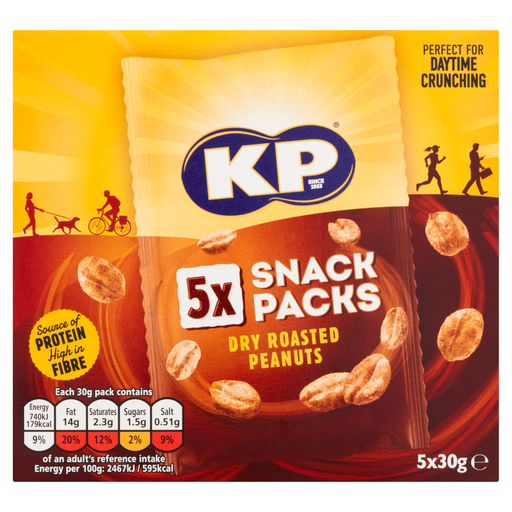 Image unavailable
Five 30g packs provide separate portions to carry or share. Ocado lists 9g protein and 1.5g sugars per 30g for this named multipack. Read the current pack’s salt, ingredients and allergen information before choosing it.
A nut pack can be a convenient snack, but it need not be your whole post-training meal. The British Nutrition Foundation identifies carbohydrate as a fuel for exercise and notes that dietary needs vary with activity, so consider the session and what else you will eat.
Tesco and Ocado list 1.5g sugars per 30g pack for the compared KP salted and dry-roasted peanuts. Asda lists 4.2g for KP honey-roasted peanuts in the same pack size. Check the current label for the variant you buy.
No. Ocado lists 0.48g salt per 30g KP dry-roasted pack, compared with 0.36g on Tesco’s KP salted pack listing. Use the nutrition table for the exact product rather than the flavour name.
Read the current pack’s ingredients and any may-contain statement. GOV.UK says regulated allergens in prepacked food must be clearly labelled in the ingredients list; a product containing peanuts may also carry warnings relevant to other allergies.
Use the listing to compare products, then read the physical pack before eating. Asda advises that food product details can change, making the current ingredients, nutrition and allergen information important.