Parents at a school that permits the product
Individual portions can be packed without measuring out nuts each morning. Check that the particular product’s peanut, tree-nut and precautionary-allergen wording meets the school’s policy.


Check the school’s current packed-lunch and allergy policy before choosing a nut multipack: if it restricts the product’s peanuts, tree nuts or relevant ‘may contain’ warnings, choose a non-nut snack for school instead. Where the product is permitted, individual packs avoid portioning each morning; a larger pack needs dividing at home. In either format, compare the full allergen declaration and salt per intended portion rather than relying on a flavour name.
Individual portions can be packed without measuring out nuts each morning. Check that the particular product’s peanut, tree-nut and precautionary-allergen wording meets the school’s policy.
Compare the salt figure for the portion going into the lunchbox, not just the words ‘salted’ or ‘dry roasted’. NHS guidance suggests swapping salted nuts for unsalted nuts when reducing salt.
Start with the school’s own rules rather than the type of pack. Department for Education guidance for England notes that schools may discourage allergens such as nuts from being brought on site.
Settle the school-policy question first. Then compare the packet’s allergen wording, portion format and nutrition information for the amount that will actually be packed.
| Priority | What to check | Your needs |
|---|---|---|
| School policy | Check the school’s current packed-lunch and allergy policy. Compare its restrictions with the specific product, including any relevant precautionary warnings. | I need a snack that the pupil can take to this school; if this nut product is restricted, I’ll choose a non-nut option. |
| Allergens | Read the ingredients and full allergen statement on the current packet. Peanuts and tree nuts are different allergen categories, but either may matter under the school’s policy. | A peanut product’s name alone does not tell me everything I need to check about allergens. |
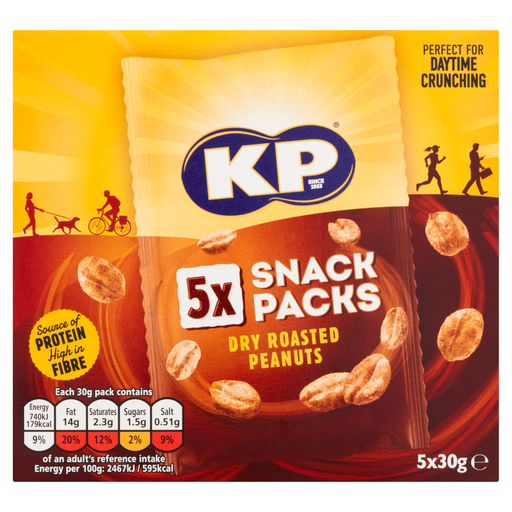
| Salt | Compare salt per individual pack or planned portion. Ocado lists 0.48g per 30g pack for KP Dry Roasted Peanuts and 0.36g per 30g pack for KP Original Salted Peanuts; those figures do not describe every product with those flavour names. | If I’m comparing salt, I want the figure for the amount going into the lunchbox. I won’t assume ‘dry roasted’ means less salt. |
| Portions | Check the number and weight of individual packs, or decide how a larger bag will be divided and carried. Use the nutrition values for the intended portion. | Sealed portions would simplify packing; with a larger bag, I can portion it at home and keep its label available for allergen checks. |
A nut product may be acceptable at home but not meet a particular school’s packed-lunch rules. Department for Education guidance for England notes that schools may discourage nuts on site.
Check the current policy before buying for school. If it restricts the product’s declared allergens, choose a non-nut snack for the lunchbox.
In Ocado’s listed KP multipacks, Dry Roasted Peanuts have 0.48g salt per 30g pack, while Original Salted Peanuts have 0.36g per 30g pack. The preparation name is not a substitute for the nutrition panel.
Compare salt for the portion you plan to pack. If reducing salt is the aim, NHS guidance suggests unsalted nuts in place of salted nuts, where nuts are permitted.
A peanut pack can carry precautionary warnings about other allergens. Tesco’s listing for KP Salted Peanuts Snack Packs, for example, says they may also contain other nuts, milk, soya and gluten.
Read the ingredients and complete allergen statement on the packet, then check both against the school’s requirements.
These examples illustrate pack formats and label checks; a brand’s appearance here does not mean that every product in its range meets a school’s policy.
Tesco Groceries and Ocado list KP Original Salted peanut snack packs in a 5 × 30g format; Ocado also lists a KP Dry Roasted 5 × 30g multipack.
Tesco Groceries lists larger own-brand nut packs, including an unsalted mixed-nut product, alongside the KP salted peanut snack packs.
The M&S Nut Collection is a mixed-nut product containing almonds, Brazil nuts, cashews and hazelnuts.
These options cover two different packed-lunch formats: four individually wrapped peanut snack bars and a peanut multipack labelled as five 30g portions. Check the school policy and each product’s current packet before packing either for school.
 No image available
Four individually portioned bars avoid repacking, but this is a snack-bar format rather than a pack of loose nuts. Check the current ingredients and allergen statement against the school’s policy.
 No image available
The named multipack provides separate peanut portions for packing on permitted school days. Check the current packet for its pack format, salt per portion and complete allergen statement; do not infer salt content from ‘dry roasted’.
Check the individual school’s current packed-lunch and allergy policy before packing them. Department for Education guidance for England notes that schools may discourage allergens such as nuts from being brought on site; do not assume that a particular nut product is permitted.
No. The Food Standards Agency identifies peanuts as legumes and distinguishes them from tree nuts such as almonds and cashews. For a school lunch, check the policy and the packet’s full allergen statement rather than assuming that this classification makes peanuts acceptable.
No: compare the salt figure on the specific packet. Ocado lists 0.48g salt per 30g pack for KP Dry Roasted Peanuts and 0.36g per 30g pack for KP Original Salted Peanuts. NHS guidance suggests swapping salted nuts for unsalted nuts when reducing salt.
An individual pack removes the need to divide a larger bag each morning: Tesco Groceries lists KP Salted Peanuts Snack Packs as five 30g packs. A larger pack needs portioning at home; use the nutrition information for the amount you intend to put in the lunchbox.
Yes. Read the ingredients, allergen statement and portion information on the packet you are packing for school, and compare its allergen wording with the school’s current policy.