What should you check?
Start with the per-100g figures to compare packs on the same basis, then use your intended portion to interpret the snack you will eat.
| Priority |
What to check |
Your needs |
| Carbohydrate |
Compare carbohydrate per 100g, then work out the value for the amount you intend to eat. Check the ingredients and label again if the nuts have sweet additions. |
“I want to account for this snack’s carbohydrate in my usual planning, rather than rely on a diabetes-related claim.” |
| Total and saturated fat |
Read total fat and saturates as separate per-100g figures. Tesco Groceries lists 51g fat and 8.1g saturates for KP Unsalted Peanuts, against 55g fat and 6.5g saturates for Tesco Unsalted Mixed Nuts. |
“If I’m choosing nuts with less fat, I need to know whether I mean total fat or saturated fat; these examples point to different choices.” |
| Portion size |
Check whether the pack gives per-serving values and how large that serving is. Compare it with the amount you will actually eat. |
“A handful from the bag may not match the labelled serving.” Diabetes UK advises paying attention to snack portions because larger amounts increase energy intake. |
| Salt and flavouring |
Compare salt per 100g and read the ingredients, particularly when switching between plain, seasoned and sweetened products. |
“I’d prefer less salt, but an unsalted label must not stand in for checking carbohydrate or fat.” |
| Product claims |
For a reduced-fat claim, identify the comparison product and check both products’ fat figures on the same basis. Use the nutrition panel rather than treating “unsalted” as a fat claim. |
“I want to know what has been reduced before choosing a pack for that reason.” |
Brand and retailer examples
These named products illustrate why carbohydrate, fat and salt need separate checks; a brand name alone does not settle the choice.
KP
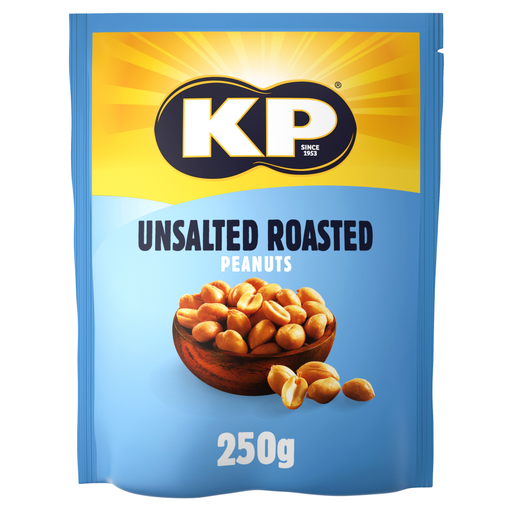
KP Unsalted Peanuts offer a single-nut alternative to a mixed pack.
- Tesco Groceries lists 5.7g carbohydrate and 0.03g salt per 100g for its 250g pack.
- The same listing gives 51g total fat and 8.1g saturates per 100g: unsalted does not mean reduced fat.
Tesco
Tesco Unsalted Mixed Nuts are an example to compare with single-nut packs.
- Tesco Groceries lists 8.7g carbohydrate, 6.5g saturates and 0.02g salt per 100g.
- The product lists 55g total fat per 100g. Check its ingredients and allergens if the mix matters to your choice.
Asda
ASDA Mixed Nut Selection provides another mixed-pack nutrition panel for comparison.
- ASDA Groceries lists 6.3g saturates and 0.03g salt per 100g.
- It also lists 53g total fat and 12g carbohydrate per 100g; one lower figure does not decide every priority.
M&S
The M&S Nut Collection is a further example of how values vary between mixes.
- Marks & Spencer lists 4.6g carbohydrate and 0.02g salt per 100g.
- Its panel also lists 59.4g total fat and 8.3g saturates per 100g.
Planters
Planters describes an unsalted dry-roasted peanut product on its US brand site.
- The brand describes “unsalted” as containing no added salt.
- For a UK purchase, compare the nutrition, ingredients and allergens on the exact pack rather than applying figures from a different market.
Nut options on Joybuy
These options cover unsalted roasted peanuts and a chopped nut mix. Compare each pack’s label for the nutrition values and portion that matter to your choice; neither product title makes a reduced-fat claim.
 No image available
KP Snacks Unsalted Roasted Peanuts 250g
For a single-nut, unsalted option, compare this pack’s carbohydrate and fat values with mixed nuts. Tesco Groceries lists 5.7g carbohydrate, 51g total fat, 8.1g saturates and 0.03g salt per 100g for KP Unsalted Peanuts; check the current pack and your intended portion.
View on Joybuy
 No image available
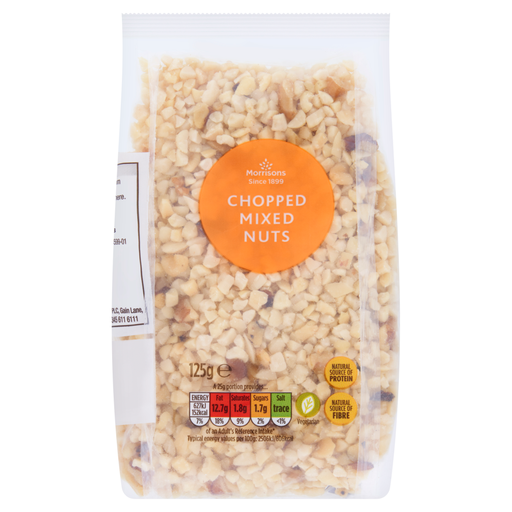
Morrisons Chopped Mixed Nuts 125g
This chopped mix is an alternative if you prefer mixed nuts to peanuts alone. Check its carbohydrate, total fat, saturates and salt per 100g, along with the ingredients and allergens, before comparing it with another pack.
View on Joybuy
Questions about choosing nuts
Are reduced-fat nuts automatically a better choice when managing diabetes?
No. A reduced-fat claim does not tell you the carbohydrate value or the amount you will eat. Diabetes UK notes that carbohydrate type and amount can matter when managing diabetes, so compare the nutrition panel and your intended portion rather than relying on that claim alone.
Does unsalted or dry roasted mean low fat?
No. Those descriptions do not give a total-fat value. For example, Tesco Groceries lists 51g fat per 100g for KP Unsalted Peanuts and 55g per 100g for Tesco Unsalted Mixed Nuts; read the fat figure on the exact pack.
Is a “diabetic” label enough to choose a nut snack?
No. The label does not replace a check of carbohydrate, fat, salt, ingredients and portion size. Compare those details with the choices you normally make for your meals and snacks.
How do I compare packs with different serving sizes?
Compare their per-100g nutrition figures first. The NHS explains that nutrition information is given per 100g and sometimes per portion; after the like-for-like comparison, check what each pack’s serving means for the amount you intend to eat.
What should I check on a mixed-nut pack?
Read the ingredients and allergen declaration for the exact pack, as well as its nutrition panel. A mix can contain several kinds of nut, so do not assume it has the same ingredients or warnings as a single-nut product.


