Calorie-conscious gym-goers
If you want a predictable snack amount, compare calories for the portion you will put in your bag rather than relying on the word “nuts”.


Nuts are not automatically a low-calorie gym-bag snack: choose the amount you intend to eat, then compare the declared calories at that weight. Tesco lists 145 kcal for 25g of its salted pistachio kernels, while M&S lists 153 kcal for a 25g Sweet & Salty Nut Mix bag; check salt, ingredients and allergens as well as calories.
If you want a predictable snack amount, compare calories for the portion you will put in your bag rather than relying on the word “nuts”.
If protein or fibre matters to your choice, read those figures alongside calories per portion and the salt declaration on roasted or salted products.
Check the exact pack’s ingredients and precautionary statements before taking it to a shared space. The Food Standards Agency distinguishes peanuts, which are legumes, from tree nuts.
Start with the amount you will eat, then use the nutrition and ingredients labels to decide which product fits your priorities.
| Priority | What to check | Your needs |
|---|---|---|
| Portion calories | Compare kcal at the same gram weight. Check whether the declared serving matches the amount you will eat. | I want to know the calories in the portion I actually pack, whether I measure it at home or take an individual bag. |
| Pack size | Check the weight of an individual bag or bar. If carrying a larger pack, decide how you will portion it. | A ready-portioned pack is convenient; with a larger bag, I would rather measure a snack before leaving home. |
| Salt and ingredients | Read salt per serving and the ingredients list. Tesco’s salted pistachios list 0.25g salt per 25g; the M&S Sweet & Salty Nut Mix lists sugar, honey and glucose syrup. | If seasoning or added sweetening matters to me, the flavour on the front of the pack is not enough to make the choice. |
| Allergens | Read the current ingredient declaration and any “may contain” statement for the exact product. Do not treat peanuts and tree nuts as interchangeable. | I need to know whether this particular snack is suitable for the people who may eat it or come into contact with it. |
Serving weight changes the comparison: Tesco lists 145 kcal for 25g of its salted pistachio kernels and 209 kcal for 30g of its pine nuts. Those figures are not for equal portions.
Decide how many grams you intend to eat, then compare products at that weight.
A nut mix can contain ingredients beyond nuts: the M&S Sweet & Salty Nut Mix lists sugar, honey and glucose syrup.
Compare its ingredients, calories and salt with a plain or unsalted option if those differences matter to you.
The Food Standards Agency distinguishes peanuts from tree nuts, and individual products can carry further precautionary-allergen statements.
Check the current label of the exact pack before putting it in your bag, particularly when sharing a space with someone who has an allergy.
The amount eaten can be harder to keep track of when you carry the whole bag. KP lists Original Salted Peanuts in several pack sizes, including a 5 x 30g multipack.
Measure a portion into a container or choose an individual pack if that makes your intended amount easier to follow.
These examples illustrate product-level label checks, not a comparison of everything each brand or retailer sells.
Tesco’s product listings give serving-level nutrition for several nut products.
KP lists Original Salted Peanuts in several sizes, including a 5 x 30g multipack.
M&S lists both natural nuts and a portioned Sweet & Salty Nut Mix.
Asda lists a Planters Chilli and Lime Peanuts product.
Asda’s KP Original Salted Peanuts listing provides nutrition, ingredients and allergy information for that specific product.
These Joybuy options include chestnut packs, peanuts, pistachios and a peanut-and-fruit bar. Compare each pack’s labelled portion and ingredients rather than treating them as equivalent nut snacks.
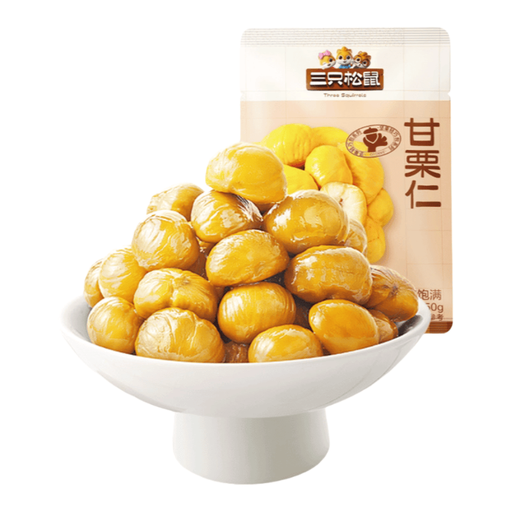 No image available
The 50 g pack gives you a defined amount to carry. Check its declared calories for the amount you intend to eat.
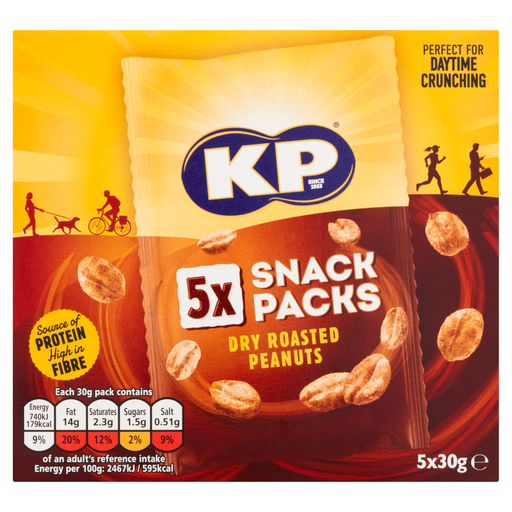 No image available
Five 30g packs provide individually sized portions for a gym bag. Check calories, salt and allergens on this Dry Roasted variant rather than using figures for KP Original Salted Peanuts.
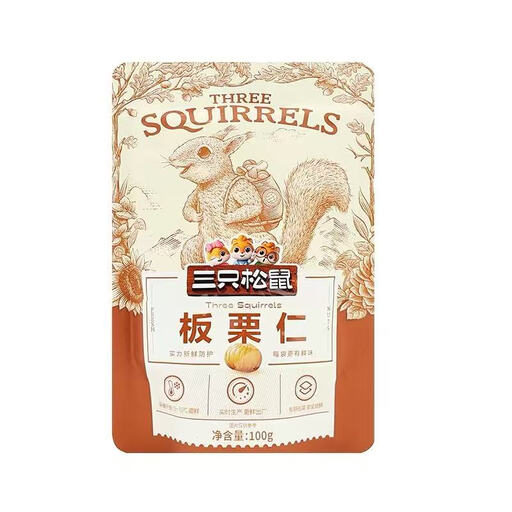 No image available
For a measured gym-bag snack, decide how much to take from this 100g pack and use that amount when checking the calorie declaration.
 No image available
This peanut bar offers a different format from loose nuts, with four 35g bars. Compare the calories and ingredients for one bar with the portion of nuts you would otherwise pack.
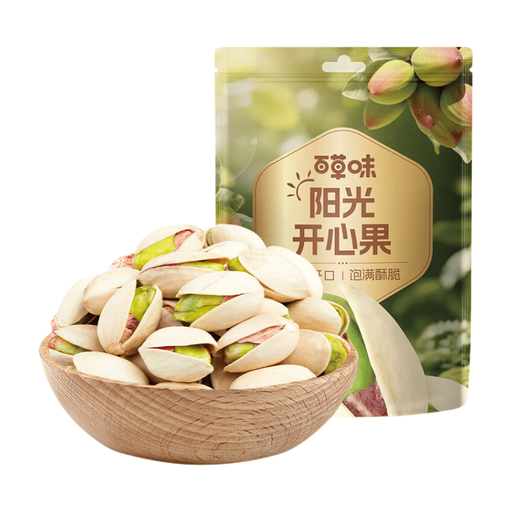 No image available
If you want pistachios, measure the amount you will take from this 100g pack. Check its own calorie and salt declarations rather than applying Tesco’s figures to a different product.
Do not assume so from the category name. Tesco lists 145 kcal per 25g of its salted pistachio kernels and 209 kcal per 30g of its pine nuts; because those serving weights differ, decide your portion before comparing calories.
Compare the declared calories for the same gram weight, then check how much you are likely to eat. For example, Tesco lists 145 kcal per 25g of salted pistachio kernels and 165 kcal per 25g of Whitworths Mixed Nuts, making those two stated servings directly comparable by weight.
If salt is a deciding factor, compare the salt declaration for the portion you intend to eat; unsalted wording does not tell you its calorie amount. Tesco’s salted pistachio kernels list 0.25g salt per 25g, while M&S Natural Almonds list 0.03g salt per 100g, so account for the different stated weights.
No. The Food Standards Agency distinguishes peanuts from tree nuts, and the exact product may have further precautionary-allergen wording. Check its current ingredients and “may contain” statement, and follow the advice given to the person with the allergy.