Space-first, small-batch bakers
If you bake oat biscuits occasionally and have little spare worktop space, measure the oven and allow for the clearance required by its manual. Cavity capacity alone will not tell you whether it fits.


Choose a compact conventional mini oven if you mainly bake small batches and want straightforward baking controls; consider a larger Bake-capable countertop oven if you need more tray space or other cooking functions. Before deciding, check the oven’s external dimensions and required ventilation space, then confirm that its tray and temperature controls suit your biscuit recipe.
If you bake oat biscuits occasionally and have little spare worktop space, measure the oven and allow for the clearance required by its manual. Cavity capacity alone will not tell you whether it fits.
If you want to bake more than one small batch at a time, prioritise usable tray space, a baking function and an adjustable thermostat. Check the tray dimensions rather than relying on the capacity in litres.
If the oven will also handle toast, grilling, air frying or other cooking, weigh those functions against the space the appliance and its accessories will occupy. Keep biscuit-baking controls on your checklist.
Check whether the oven can be placed safely before choosing a capacity; then compare usable baking space and controls for the batches you plan to make.
| Concern | What to check | Who this matters to |
|---|---|---|
| Worktop fit and ventilation | Measure the installed width, depth and overhead space, including the exact model’s required clearance and room to open its door. | With cupboards close to my worktop, I need an oven I can place and ventilate safely; around 42% of consumers put fit and clearance first. |
| Usable baking space | Check the internal tray dimensions and whether a suitable baking tray is included; litres alone do not establish batch size. | If repeated small batches would interrupt my baking, I need room for more biscuits on each tray; around 33% of consumers prioritise batch capacity. |
| Baking controls and upkeep | Confirm a baking function, a temperature range covering your recipe and how the removable parts are cleaned. | When I also use the oven for other meals, I want controllable biscuit baking without taking on awkward cleaning; around 25% of consumers put controls and upkeep first. |
Cavity volume does not show whether your biscuit tray fits or whether the oven, with ventilation space, fits your worktop.
Ask for external dimensions, the model’s clearance instructions and usable tray dimensions before buying.
Russell Hobbs bases the 26680’s preheating and cooking comparisons on specified tests, including frozen French fries, not oat biscuits.
Choose baking controls and tray space for your recipe rather than treating those claims as a prediction of your results.
Oven surfaces can become hot. The Russell Hobbs 22780 manual requires at least 50 mm of free space around that model; Breville instructs VDF127 owners to allow air circulation above and on all sides.
Follow the exact model’s placement instructions, use a stable heat-resistant surface and keep combustible items away during operation.
Electrical Safety First warns that ovens and grills may overload an extension lead, particularly when it is shared with other large appliances.
Check the oven’s power requirements and your socket arrangement. Seek qualified advice if you are unsure whether the arrangement is suitable.
The EO12012 is a conventional 12L countertop oven for shoppers considering straightforward, small-batch baking.
Its 26680 and 22780 illustrate different multifunction choices: a 20L air-fryer mini oven and a 30L mini kitchen with hotplates.
The Halo Rotisserie Air Fryer Oven VDF127 combines baking with air frying, rotisserie cooking and dehydrating.
This 10L air-fryer oven is a countertop option to consider for small batches of oat biscuits. Check its baking settings, usable tray area and installed space against your recipe and kitchen before choosing it.
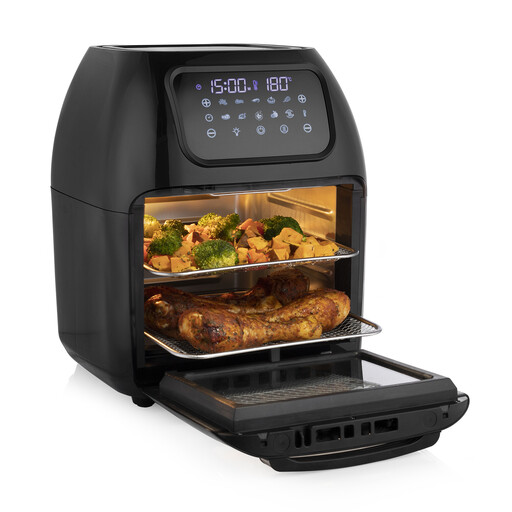 Image unavailable
For small-batch biscuit baking, confirm that its settings and a suitable tray accommodate your recipe. The product name specifies 10L capacity, 1800W power, touchscreen controls and dishwasher-safe parts. Check its external dimensions and required ventilation clearance against your worktop.
Measure the available worktop width and depth, overhead space and room for the open door, then allow for the exact model’s required ventilation clearance. For instance, the Russell Hobbs 22780 manual requires at least 50 mm around that appliance; the figure does not apply to every oven.
Not automatically: choose one if its baking controls and tray suit your biscuits and you also value its other functions. Confirm the temperature range and usable tray size rather than assuming air-frying speed claims apply to biscuit baking.
Check the exact oven’s power requirements and the electrical arrangement before using one. Electrical Safety First warns that ovens and grills may overload an extension lead, especially when shared with other large appliances; seek qualified advice if you are unsure.
Let the appliance cool fully, then remove crumbs and clean its removable trays or drip tray as the model’s manual permits. Check the plug and socket for signs of damage, and do not use an appliance that is damaged or malfunctioning.