Parents starting weaning before 12 months
Age comes before pack size. NHS guidance says oat drinks should be avoided before a baby is 12 months old, even when they are unsweetened and calcium-fortified.


Do not buy oat drink as a weaning drink for a baby under 12 months: NHS guidance says plant-based drinks, including oat drinks, should be avoided before that age. For a child aged 12 months or over, check the exact product’s age statement, fortification and protein before choosing a large pack; NHS North West Knowledge Now describes fortified oat alternatives as lower-protein second choices for children aged 1 or over with cow’s milk protein allergy.
Age comes before pack size. NHS guidance says oat drinks should be avoided before a baby is 12 months old, even when they are unsweetened and calcium-fortified.
If a child needs a plant-based alternative, check the exact drink’s age statement and nutrient label. For children aged 1 or over with cow’s milk protein allergy, NHS North West Knowledge Now describes fortified oat drinks as lower-protein second choices.
Check the pack count and total volume as well as suitability for the child. Tesco Groceries lists oat drinks in 1L cartons and an Oatly 1.5L x3 multipack; a multipack is not the same thing as a single six-pint bottle.
Start with the child’s age and the drink’s intended use. Nutrients, allergens and pack size matter only after that initial check.
| Priority | What to check | Your needs |
|---|---|---|
| Age and use | Check the child’s age and the pack’s age statement. NHS guidance says oat drinks should be avoided before 12 months; do not treat a toddler or adult drink as an infant milk substitute. | My baby is starting weaning, so I need to decide whether an oat drink belongs in the feeding plan before looking at larger packs. |
| Fortification | For a child aged 12 months or over, check the exact label for calcium, iodine, vitamin D and vitamin B12. These are the nutrients identified in NHS North West Knowledge Now guidance on plant-based alternatives for children aged 1 or over with cow’s milk protein allergy. | I’m comparing drinks for an older child and want to know what each formulation actually contains, rather than relying on the word ‘oat’. |
| Protein and sugars | Compare protein and sugars per 100ml and check whether the drink is labelled unsweetened. NHS North West Knowledge Now describes oat alternatives as lower-protein second choices for children aged 1 or over with cow’s milk protein allergy. | If oat drink is being considered as a regular drink after 12 months, I need to compare its nutrition panel with other suitable options. |
| Allergens | Read the current ingredients and allergen statements for the exact pack. The Food Standards Agency says oats must still be emphasised as an allergen when a food is labelled gluten-free or very low gluten. | Our household needs to check oats and any relevant milk, soya or gluten-related information on the product we would actually serve. |
| Pack format | Confirm the number of containers and total volume; distinguish a single bottle from a multipack. Check storage instructions before choosing a larger quantity. | I’m buying for family use, but the pack needs to suit both the child’s age and how much we can use after opening. |
NHS guidance says oat drinks should be avoided before 12 months, including unsweetened, calcium-fortified versions.
Check the child’s age before comparing pack sizes. For a baby under 12 months, continue with breast milk or the infant formula appropriate for that child rather than an oat drink.
For children aged 1 or over with cow’s milk protein allergy, NHS North West Knowledge Now describes fortified oat alternatives as lower-protein second choices to suitable soya or pea alternatives.
Compare the exact nutrition panels. If the child has cow’s milk protein allergy, growth concerns or a prescribed formula, seek individual clinical or dietetic advice.
A coffee-focused oat drink and a fortified drink can have different formulations. Marks & Spencer, for example, lists a three-ingredient oat drink separately from one described as enriched with calcium, iodine and vitamins D and B12.
For a child aged 12 months or over, check age suitability and the current nutrient label rather than using the product name as a nutrition guide.
The Food Standards Agency says oats remain an allergen even when a food carries a gluten-free or very-low-gluten claim. Other ingredient and manufacturing statements can differ between products.
Read the exact pack’s allergen information whenever the product or formulation changes.
These examples show why the formulation and age statement matter more than the brand name alone.
Oatly describes its original 1L oat drink as a general-use drink for cooking and baking as well as drinking.
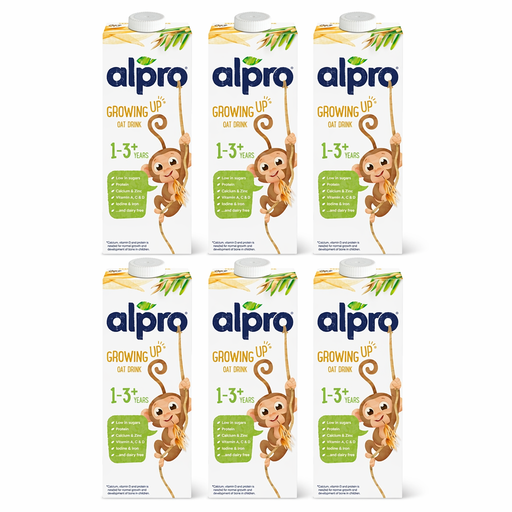
Alpro’s Oat Growing Up drink is distinct from its general oat drinks; its product page names a 3+ version.
Minor Figures Barista Oat is a coffee-focused drink offered as a 6 x 1L case.
Tesco Groceries lists own-label and branded oat drinks in several pack formats.
Sainsbury’s lists an own-label fortified Oat Drink 1L.
Marks & Spencer lists both a three-ingredient oat drink and a separate barista oat drink.
This Growing Up oat drink is an option to assess for an older child, not a weaning drink for a baby under 12 months. Check its stated age range and pack details before choosing it.
 No image available
For a child aged 12 months or over, check that this Growing Up drink’s on-pack age range matches the child before considering it. Compare its fortification, protein per 100ml and unsweetened status on the exact pack, and confirm the pack count and total volume if buying for family use.
No, not as a weaning drink before 12 months. NHS guidance says plant-based drinks, including oat drinks, should be avoided before then; continue with breast milk or the infant formula appropriate for your baby.
Check the exact drink’s age statement, whether it is unsweetened, and its calcium, iodine, vitamin D, vitamin B12 and protein information. NHS North West Knowledge Now advises these fortification checks and describes fortified oat alternatives as lower-protein second choices for children aged 1 or over with cow’s milk protein allergy.
No. Read the exact pack’s ingredients and allergen statements, including any milk or soya information relevant to the child. The Food Standards Agency says oats must still be emphasised as an allergen even when a food is labelled gluten-free or very low gluten.